News Daily

The Times

Australia

  • Written by The Conversation
Cars have taken over our neighbourhoods. Kid-friendly superblocks are a way for residents to reclaim their streets

You might remember your time as a child playing outdoors with friends and walking to school. These activities had tremendous benefits for our health and development.

Today, parents report barriers to letting their kids play, walk and ride in their neighbourhood. The safety of local streets is a major concern.

Read more: Japan's Old Enough and Australia's Bluey remind us our kids are no longer ‘free range’ – but we can remake our neighbourhoods

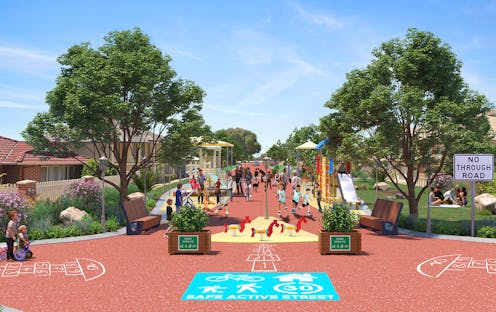
One way to boost communities is to create “superblocks for kids”. Pioneered in cities like Barcelona, a superblock covers several neighbourhood blocks reserved for shared use by cyclists, walkers and residents who simply want to use the street space. Superblocks allow low-speed access for residents’ cars, but exclude through-traffic.

Superblocks have evolved from concepts dating back to the 1970s. Retrofitted and planned examples of more liveable and safer streets can be found from Melbourne to Perth, where there are interesting alternative designs in Willetton and Crestwood.

Transforming neighbourhoods in this way enables us to once again enjoy the public space right on our doorsteps – the street.
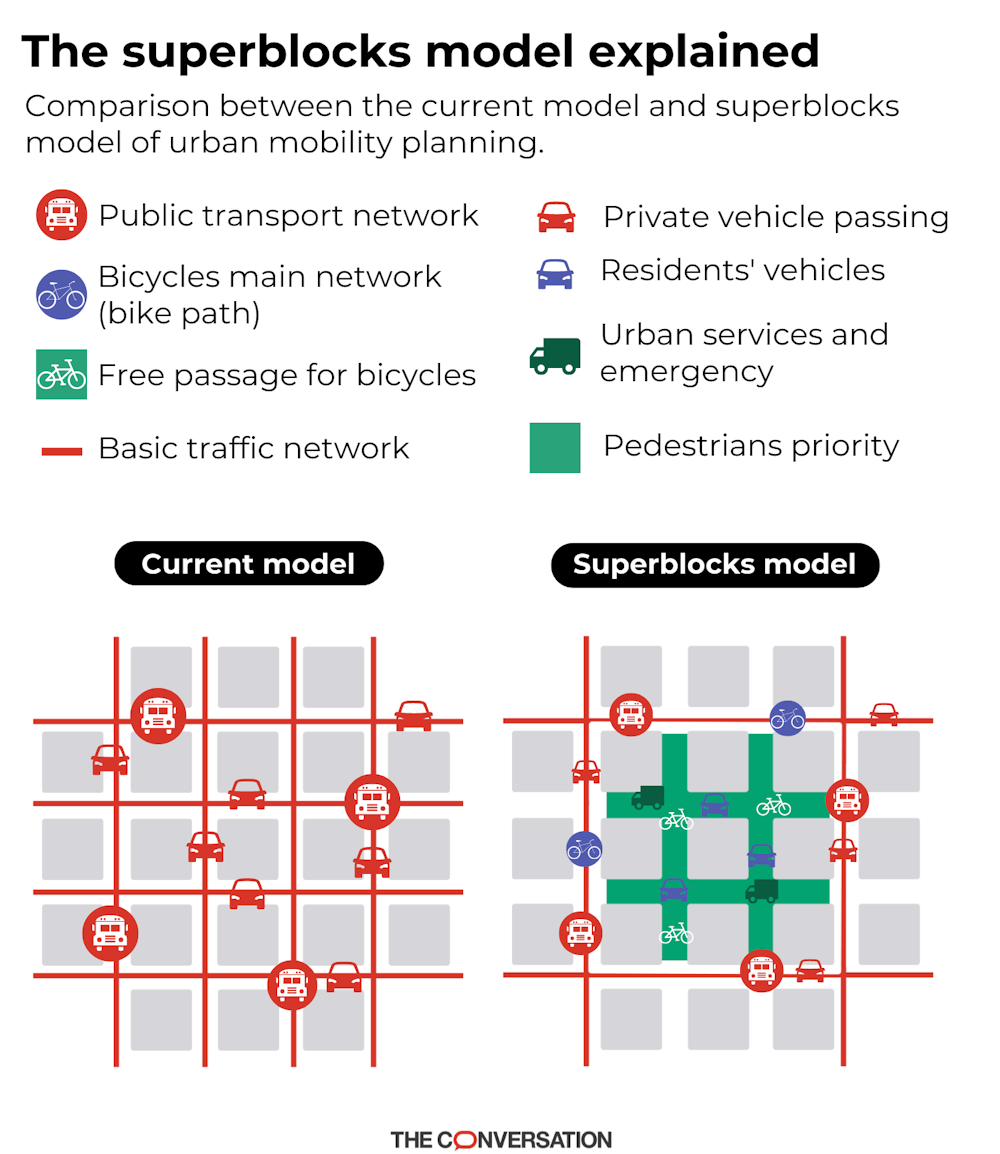
Author provided Read more: Superblocks are transforming Barcelona. They might work in Australian cities too Superblocks for kids are a low-cost fix Superblocks are a low-cost solution to the problem of the residential “stroad” – a street-road hybrid that drivers use to avoid congested main roads, many at unsafe speeds. These stroads are a troubled mix of two different functions: roads are through routes, and streets connect neighbourhoods socially and physically. Streets connect houses to local parks, shops and through routes, but are also public places themselves. The dual role of stroads comes at the expense of residents and their children. Superblocks for kids can be retrofitted to existing suburbs to create safer, quieter and more play-friendly streets. They are typically about a square kilometre in area, bounded by main roads and features such as rivers. Ideally, superblocks are clustered together to provide safe access to local amenities and public transport hubs. Everyone can still drive to their home in a superblock, but they might have to take a slightly longer, more circular route. This can reduce traffic by nudging residents to walk and cycle short journeys within their superblock. Various low-cost “filters” exclude through traffic. These filters include: The resulting superblocks are places where kids play on the streets, which are quiet and easy to cross. There’s shade and shelter, places to stop and rest, things to see and do, and the air is clean. People feel safe and relaxed. Neighbourhoods like this promote public health and community camaraderie. Four examples of streets that could be transformed in this way are shown below: Lyall Street, Redcliffe, Perth A pocket park breaks up a rat run to the airport. The Avenue, Mount St Thomas, Wollongong Plantings and bollards eliminate a known rat run. Lithgow Street, Abbotsford, Melbourne Wider kerbs make school drop-offs and pick-ups safer. Meymot Street, Banyo, Brisbane A pocket park and residents-only car access create a safer and quieter street. Rat-running is a big problem Almost twice as many cars are on Australian roads today as 20 years ago. Coupled with the rise of satellite navigation technology, this has led to more drivers using residential streets as rat runs to avoid congested main roads. Decades of prioritising cars in Australian communities have created a serious safety issue. Overall, serious road injuries are on the rise. Despite small declines in road deaths, deaths on local streets haven’t fallen. People feel less safe on their local streets, but we know what we can do to improve safety. Preventing rat-running leads to cleaner air, less noise, safer streets and more walking, riding, wheelchairs and mobility scooters. These results all promote stronger communities. Read more: Despite lockdowns, 1,142 Australians, including 66 kids, died on our roads in the past year. Here's what we need to do Everyone benefits from kid-friendly neighbourhoods A remarkable feature of building neighbourhoods for kids is how quickly residents reoccupy their streets. People emerge from their houses to talk, their voices no longer drowned by vehicle noise. Thoroughfares become communities. Children come out to play. As physical activity researchers, we know that getting children to move more is an urgent issue. Australian kids score a D- for overall physical activity levels on international ratings. Australian adults also have low levels of physical activity. Neighbourhoods for kids help everyone enjoy the benefits of becoming more active. For kids, the street can connect them to nature and help them develop movement and independent travel skills for life. Read more: Children need to play outdoors, but we're not letting them Increasing neighbourhood liveability also boosts house prices and reduces noise pollution. Leaving the car at home for short local trips Superblocks make it easier for families to choose the “right tool for the job” for small local trips — a bicycle over a car. This saves money and improves health. All these small trips add up. For example, two-thirds (2.8 million) of daily car trips in Perth are under 5km — a 20-minute bike ride or less. In Melbourne, 41% of trips are under 3km, but 58% of these are by car. That’s 3.6 million car trips a day. Where should Australia start? Our research highlights the need to listen to communities, and kids in particular, when designing neighbourhoods. In the vast majority of cases, any initial opposition to creating kid-friendly neighbourhoods soon dissipates. Residents see the benefits of safer and more pleasant streets for themselves and their families. Two-thirds of Australians support improving their neighbourhood to help them be more active. We should start by creating neighbourhoods for the communities that need it most — those with the poorest access to green space and public transport, most through traffic and crashes, and highest levels of childhood obesity. Get your community talking again! You can start by hosting a temporary play street! Demonstrating its success will help when asking your council for permanent changes. The authors encourage the reuse of the re-imagined streets. They are freely available to download in multiple open-access formats.

Read more https://theconversation.com/cars-have-taken-over-our-neighbourhoods-kid-friendly-superblocks-are-a-way-for-residents-to-reclaim-their-streets-187276

Split Corrugated Conduit for Flexible Cable Protection

For wiring assemblies in vehicles, machinery and equipment, choosing suitable cable protection helps keep cables organised and reduces direct contact with surrounding parts. Mojak Plastics supplies plastic tubing and conduit options for different installation needs, and split corrugated conduit can... Read more

Trailers Melbourne Buyers Can Compare: When Box Trailers Make Sense

For many homeowners, businesses and tradespeople, trailers Melbourne customers use every week need to be versatile enough for changing loads. A box trailer can be particularly useful because its enclosed sides help contain cargo while providing a straightforward loading area... Read more

Bottle Label Printing That Balances Design and Readability

Product labels need to attract attention while making information easy to find and understand. On a bottle, the available space may be limited by the container’s shape, so every design decision matters. Bottle label printing should account for visual hierarchy... Read more

Office Cleaning Melbourne: Planning a Consistent Workplace Routine

Businesses looking for office cleaning Melbourne need a plan that reflects the way their workplace operates. A clean office supports day-to-day organisation, helps shared spaces remain presentable and gives employees and visitors a more orderly environment. Eco Green Cleaning Management... Read more

Pinboard Solutions for Offices, Schools and Shared Information Spaces

Why a Pinboard Remains Useful A pinboard provides a simple way to display information that needs to remain visible without being rewritten. Lawdex supplies fabric and cork options for offices, schools, staff areas and other environments. A pinboard can be used... Read more

Retractable Hose Reel: A Practical Guide To Choosing The Right Hose Storage

A retractable hose reel can make hose storage more organised, accessible and practical in workshops, commercial facilities, service areas and other working environments. Instead of leaving a hose coiled across the floor or requiring staff to manually wind it after... Read more