

The queen's death certificate says she died of 'old age'. But what does that really mean?
- Written by The Conversation
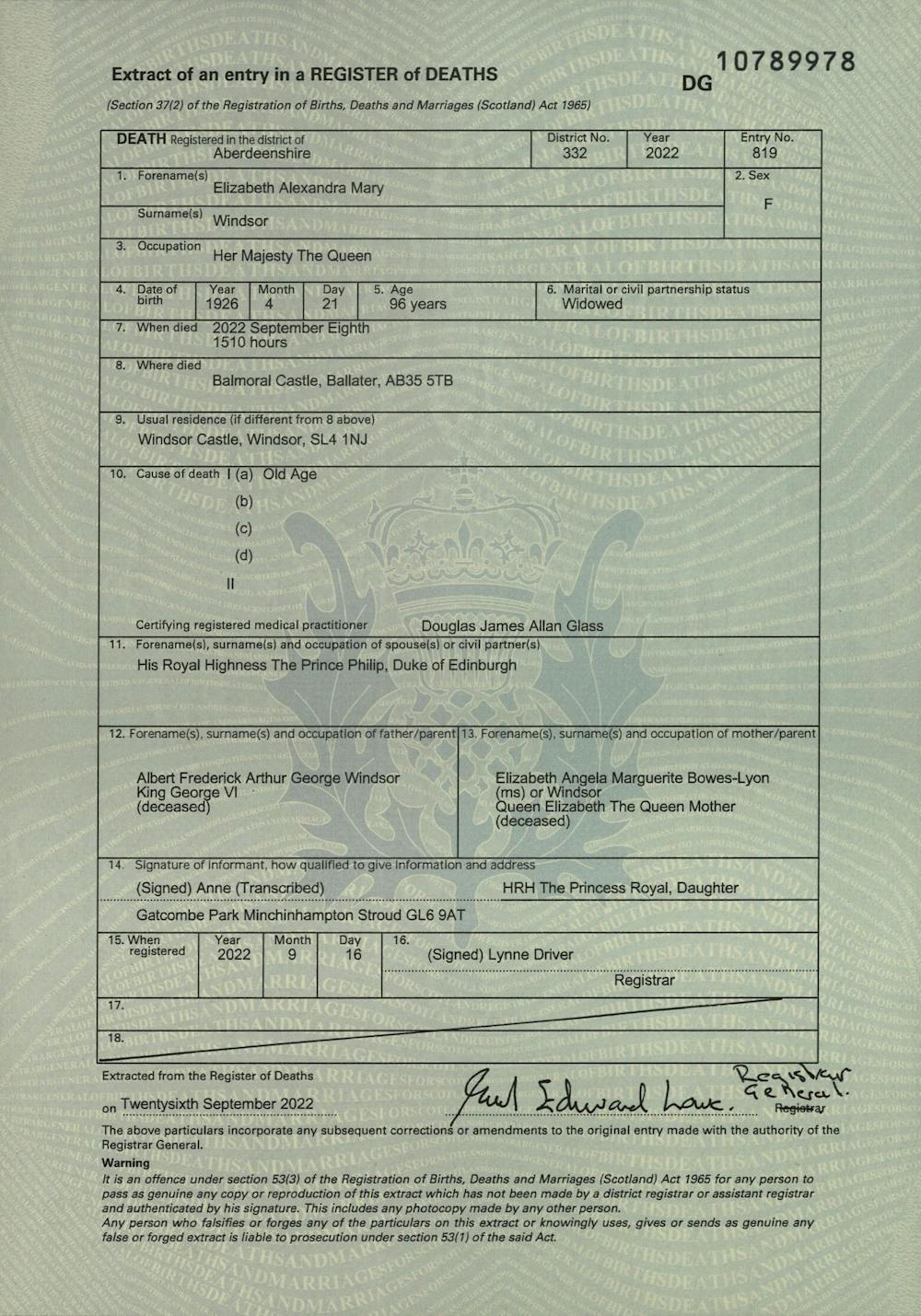
Queen Elizabeth’s newly released death certificate contains just two curious words under her cause of death – old age.
We might talk about people dying of old age in everyday speech. But who actually dies of old age, medically speaking, in the 21st century?
Such a vague cause of death not only raises questions about how someone died, it can also be hard on family and loved ones left behind.
Read more: Why do we mourn people we don't know?
The many ways people die
The leading causes of death in England and Wales are dementia and Alzheimer’s disease; heart disease; cerebrovascular diseases (such as stroke); cancer; and COVID. Other notable causes include chronic lower respiratory diseases (such as asthma); influenza; and pneumonia.
In fact, “old age” as a cause of death – alongside the vague description of “frailty” – is often categorised under “symptoms, signs, and ill-defined conditions”.
This latter category is in the top ten causes of death. But this currently trails well below COVID, and on average over a five year period, below influenza and pneumonia.
Read more: How Australians Die: cause #3 – dementia (Alzheimer's)
An interesting history
Old age, as a category for causing death, has a long history. It was a leading cause of death in the 19th century, alongside the vague description of “found dead”.
In the mid-19th century, registering someone’s death moved from clerical to secular, with the Births and Deaths Registration Act 1836 (UK).
There was then the landmark publication, the Bertillon Classification of Causes of Death, written by French statistician and demographer Jacques Bertillon.
Canadian philosopher Ian Hacking wrote that dying of anything other than what was on the official list was “illegal, for example, to die of old age”.
We may say this is a bit hyperbolic. Surely, by the end of the 19th century, it was not illegal to die of old age?
What this suggests is that providing a precise cause of death is important because it’s a valuable tool for tracking mortality trends at different levels of the population.
Eventually, “old age” became a last resort phrase to describe an unknown cause of death. Or it became useful where a person may have died from a number of complications, but where it was not practical or ethical to order an autopsy to find the precise underlying cause of death.
Read more: 'Died from' or 'died with' COVID-19? We need a transparent approach to counting coronavirus deaths
There’s no closure
The other reason why “old age” has been seldom used as the cause of death in the 20th and 21st centuries was that it doesn’t provide any closure to families of the deceased.
Research shows families want information about how their loved one died, not only because it can be useful for managing their own health concerns, but also because it provides a resolution to their loved one’s death.
An unknown cause of death can exacerbate grief and trauma, particularly if the death was sudden or unexpected. Researchers have long argued families form continuing relationships with their loved one after they die. Ascertaining how they died is one part of how the family members left behind manage their grief and memorialise the deceased.
A good death
We may decide that asking for more information about how the queen died at the age of 96 is just macabre titillation. We may decide the royal family deserves privacy surrounding intimate details of the queen’s death.
However, a specific cause of death of someone who lived a privileged life and who died at an old age, for instance, can tell us much about how to lead a healthy life and plan for a good death.
Read more: Friday essay: on reckoning with the fact of one's death


