News Daily

The Times

Australia

  • Written by The Conversation
My Year of Rest and Relaxation: 'sad-girl' fetishism or 'cuttingly funny' feminist satire?

In a new series, we look at books that have become cultural touchstones.

I took a shower once a week at most. I stopped tweezing, stopped waxing, stopped brushing my hair. No moisturising or exfoliating. No shaving. I left the apartment infrequently. I had all my bills on automatic payment plans. I’d already paid a year of property taxes on my apartment and on my dead parents’ old house upstate.

woman in pale blue suit slumped over a chair as if drugged
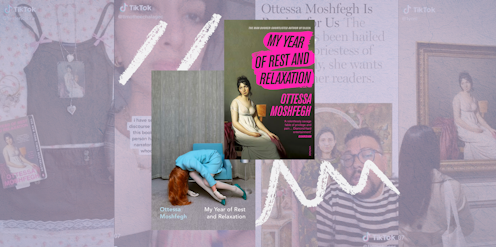
Zoned out on Xanax, Ottessa Moshfegh’s unnamed anti-hero is living the “goblin-mode” dream. It’s a dream that might have been considered out-of-touch if My Year of Rest and Relaxation were published when it’s set – at the optimistic pre-September 11 dawn of the New York new millennium. But it’s a dream that’s all too relatable in these post-pandemic times, where lockdowns, a waning will to work, and gnawing existential angst have become familiar parts of the collective consciousness. My Year of Rest and Relaxation centres on a 27-year-old female protagonist – white, thin and cashed up – who embarks on a mission to sleep away her ennui for an entire year. Aided by a complex cocktail of every relaxant known to psychiatry (and even a fictional one, “Infermiterol”, that isn’t), the narrator sees her hibernation as a chance for rebirth. It’s a way to break free from the pain of an unloved childhood and a superficial present punctuated by avant-garde art snobs and an inattentive on-off boyfriend. A critical and fan hit Four years after its release, Moshfegh’s second novel has become a publishing and cultural phenomenon, complete with TikTok trends and Margot Robbie-acquired film rights. Resonating across generations, it’s been as much a hit with literary luminaries as with a multitude of millennial and Gen Z fans, who have analysed its themes and fetishised its supposed “sad-girl” aesthetic on social media. With a job-ending public defecation, a bleak parking-lot blow job, and a subversive scene celebrating the primal pleasure of two female friends watching porn following a funeral, our protagonist’s pastimes sound sordid but have been lauded as refreshingly transgressive and relatable. Depressing, sure – but in the same way that a blues tune can soothe a sore soul, Moshfegh’s edgy eloquence and turn-of-the-millennium nostalgia (remember AOL chat, the dying days of VCR, the Yellow Pages and vogueing?) have struck a chord with readers. The protagonist may be “unlikeable” to some, but she and Moshfegh are also cuttingly funny. Take for example, lines like: “If it weren’t for the specter of death hanging over everything, I would have felt like I was in a John Hughes movie.” Or, from the narrator’s psychiatrist Dr Tuttle: “Education is directly proportional to anxiety, as you’ve probably learned, having gone to Columbia.” Read more: What is BookTok, and how is it influencing what Australian teenagers read? Smug and problematic? My Year of Rest and Relaxation is not for everyone. And its popularity in the sad-girl sphere does raise some questions. Does the narrative glamourise addiction and mental ill-health, presenting a solution dependent on endless cash, cultural capital and the smug satisfaction of being young and hot? Is it really a valuable contribution to the canon at a time when so many are struggling to access mental health services and affordable, safe housing? It’s certainly true that media depictions and social media trends featuring or glorifying destructive behaviours can be problematic and have real-life consequences. While TikTok has been praised for normalising fourth-wave feminist issues and female agency, studies have also indicated that media and popular culture portrayals of crime and suicide can (and do) inspire copycat behaviour. However, critics would do well to remember that depicting destructive behaviours and toxic cultures does not necessarily condone them, particularly in the realm of fiction. Novelists have long fought against the idea that that their characters and plotlines need be literal in pointing the way to solutions to society’s ills. “I don’t like literature that moralises anything,” Moshfegh said in a recent interview. “I mean, I think it’s the most boring way to direct a reader’s experience.” Read more: Ghoulishness, depravity and stupidity: welcome to the world of Ottessa Moshfegh's Lapvona Moral rights of artists While most would agree that insisting authors only write about well-adjusted people in a perfect world is not the way forward, what of the moral right of artists whose work may have been taken in unwanted directions on social media? The music of Fiona Apple, another (reportedly reluctant) heroine of the “sad girl” movement, is a case in point. Most of her catalogue was recently – apparently temporarily – removed from TikTok. And while Apple and her label Sony have been tight-lipped around the reasons, some have applauded it as a sign of Apple’s integrity and unwillingness to be misappropriated. Such a stance might make sense for musicians who established audiences pre-social media, but it’s hard to imagine an author eschewing the world’s fastest-growing platform – even if they didn’t like what fans were saying (and it were possible from a copyright perspective). With 71.8 billion views and counting, the hashtag #BookTok has been credited with making reading cool with young people again, and extending the shelf-life of older books by opening them to new audiences. But back to Moshfegh and My Year of Rest and Relaxation. Is the book a satire, or isn’t it? Is it feminist, post-feminist or does it put the sisterhood back 20 years? While fans and critics can continue to debate such questions, Moshfegh must be laughing all the way up the bestseller lists.

Read more https://theconversation.com/my-year-of-rest-and-relaxation-sad-girl-fetishism-or-cuttingly-funny-feminist-satire-188471

Split Corrugated Conduit for Flexible Cable Protection

For wiring assemblies in vehicles, machinery and equipment, choosing suitable cable protection helps keep cables organised and reduces direct contact with surrounding parts. Mojak Plastics supplies plastic tubing and conduit options for different installation needs, and split corrugated conduit can... Read more

Trailers Melbourne Buyers Can Compare: When Box Trailers Make Sense

For many homeowners, businesses and tradespeople, trailers Melbourne customers use every week need to be versatile enough for changing loads. A box trailer can be particularly useful because its enclosed sides help contain cargo while providing a straightforward loading area... Read more

Bottle Label Printing That Balances Design and Readability

Product labels need to attract attention while making information easy to find and understand. On a bottle, the available space may be limited by the container’s shape, so every design decision matters. Bottle label printing should account for visual hierarchy... Read more

Office Cleaning Melbourne: Planning a Consistent Workplace Routine

Businesses looking for office cleaning Melbourne need a plan that reflects the way their workplace operates. A clean office supports day-to-day organisation, helps shared spaces remain presentable and gives employees and visitors a more orderly environment. Eco Green Cleaning Management... Read more

Pinboard Solutions for Offices, Schools and Shared Information Spaces

Why a Pinboard Remains Useful A pinboard provides a simple way to display information that needs to remain visible without being rewritten. Lawdex supplies fabric and cork options for offices, schools, staff areas and other environments. A pinboard can be used... Read more

Retractable Hose Reel: A Practical Guide To Choosing The Right Hose Storage

A retractable hose reel can make hose storage more organised, accessible and practical in workshops, commercial facilities, service areas and other working environments. Instead of leaving a hose coiled across the floor or requiring staff to manually wind it after... Read more