News Daily


Men's Weekly

Australia

  • Written by The Conversation
Australia is dragging its feet on healthy eating. In 5 years we've made woeful progress

Australia is falling behind other countries in addressing the unhealthy state of our diets.

Several other countries, including the United Kingdom, Canada and Mexico, have recently taken major steps to help improve population nutrition and prevent obesity.

But our latest assessment, released as part of the International Congress on Obesity, has found major holes in Australian government policy relative to international best practice, with limited policy progress in the past five years.

What we assessed?

Our assessment of the federal government included a scorecard of how Australia is going in 50 policy areas for addressing unhealthy diets. These policy areas include key influences on what we buy and what we eat, including policies that affect the price and affordability of different foods, the types of food available, how food is labelled, and the way food is promoted.

We worked closely with government officials to document current action in each policy area. We then assessed how existing policies compared to international benchmarks.

Finally, we made recommendations to address the gaps, prioritising them based on their relative importance and feasibility. Eighty-four experts from 37 organisations participated in the assessment and prioritisation process.

Read more: No, it’s not just a lack of control that makes Australians overweight. Here’s what’s driving our unhealthy food habits

How does Australia compare to other countries?

We found implementation of globally recommended policies for improving population diets and addressing obesity in Australia falls far short of international best practice.

There has been only limited policy progress in Australia in the past five years.
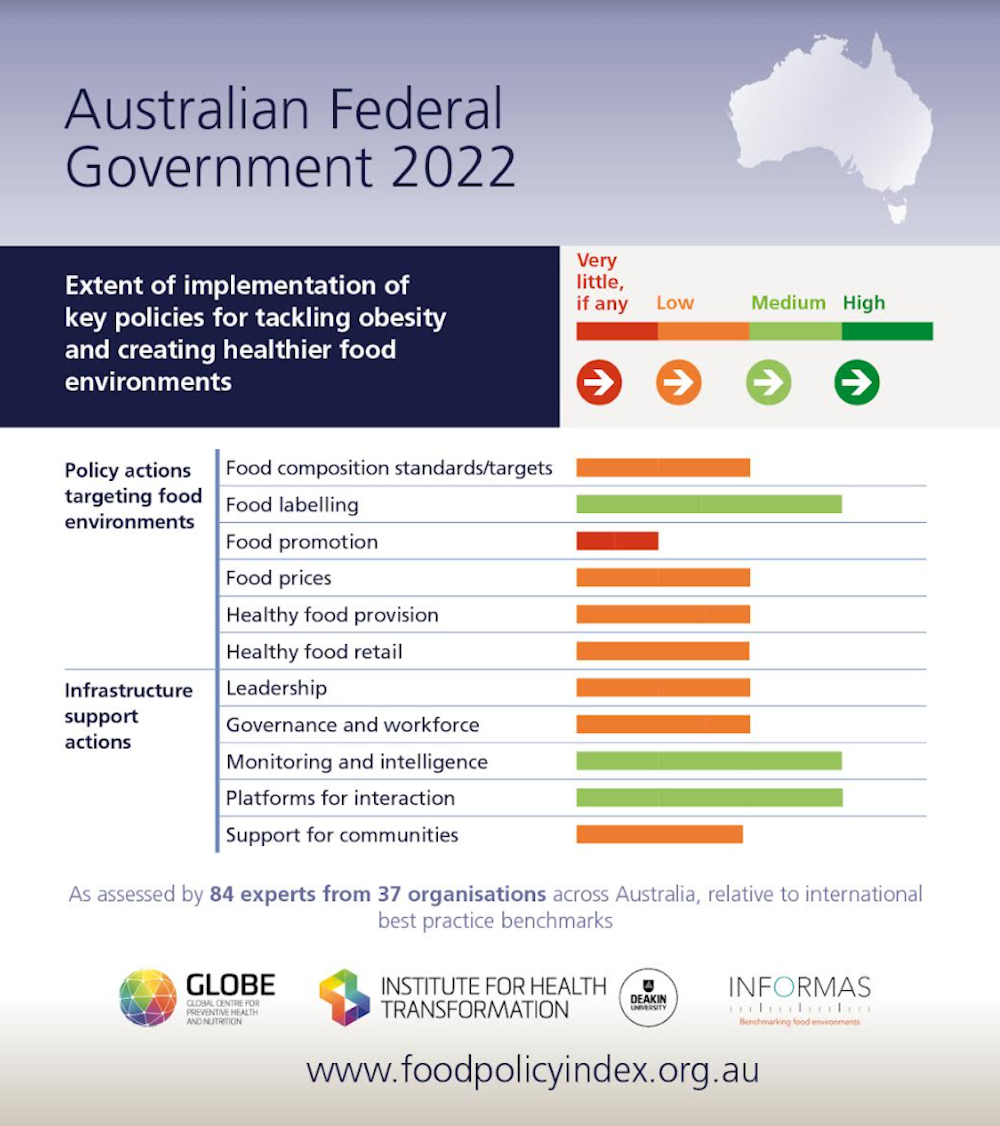
Areas where Australia is doing well One of the only areas where Australia fared well was in the area of food labelling, where some of the regulations regarding ingredient lists, nutrition information panels and health claims was rated among the best in the world. The other area that scored Australia top marks is that the GST does not apply to fresh fruit and vegetables, which helps lower their prices relative to other less healthy products. What are other countries doing better? Several other countries have implemented policies to limit the marketing of unhealthy foods and make it easier for people to choose healthier options. Countries in Latin America are leading the way globally. Chile has put in place comprehensive restrictions on TV advertising for unhealthy food, conspicuous warning labels on the packaging of unhealthy products, as well as taxes on sugary drinks. Mexico has similar policies. Food warning label for Oreos The warning labels on this product sold in Chile indicate it is high in energy (calories), sugar, saturated fats and sodium (salt). Shutterstock Elsewhere in the world, more than 50 countries now have taxes on sugary drinks. There is clear evidence these taxes have decreased consumption of the taxed products, while also incentivising soft drink manufacturers to reduce the sugar content of their drinks. Several other governments are taking strong action to protect children from exposure to marketing of unhealthy food. As an example, the United Kingdom is set to ban ads for unhealthy food online, and on TV before 9pm from 2024. Canada has similar laws before their parliament. The UK also just introduced major changes to how supermarkets operate. Laws that came into effect this month mean unhealthy products can no longer be displayed in prominent in-store locations, such as shop entrances and checkout areas. In addition, the UK has proposed a ban on price discounts on unhealthy food, although implementation remains uncertain with the recent change in government leadership. Several other innovative policies are in place internationally. For example, in some parts of Mexico, retailers cannot sell unhealthy food to children. And in Argentina, there are laws dictating maximum sodium (salt) content in a range of products. Read more: Sugary drinks tax is working – now it's time to target cakes, biscuits and snacks How bad are Australian diets? Unhealthy diets and obesity are the leading contributors to poor health in Australia. Less than 7% of people in Australia consume a healthy diet consistent with the Australian Dietary Guidelines. Nearly 65% of Australian adults, and 25% of Australian children are overweight or obese. While there isn’t good data on how these statistics have changed in the past few years, things have likely got worse since the start of the COVID pandemic. Unless we see comprehensive government action to improve population diets, there will be enormous health and financial costs to individuals, communities and the economy overall. Read more: BMI is underestimating obesity in Australia, waist circumference needs to be measured too What actions should Australia take? Federal government policy action is needed to improve population diets and address obesity. This includes: protecting children from exposure to the marketing of unhealthy food and beverages through comprehensive and consistent national legislation implementing a health levy on sugar-sweetened beverages (a sugar tax) and other unhealthy food, while addressing the affordability of healthy food improving food labelling by mandating the Health Star Rating scheme and requiring warning labels on products high in added sugar, sodium (salt) and/or saturated fat. What’s holding us back? In the past 12 months, the former federal government released key strategies in this area, including the National Preventive Health Strategy (2021-2030) and the National Obesity Strategy (2022-2032). But this has yet to result in any changes on the ground. Critically, there is strong support from the Australian community for governments to impose higher standards on marketing to support children’s health and wellbeing. More than 75% of Australians also back warning labels on unhealthy foods. It is promising to see momentum building around a legislative ban on the marketing of unhealthy food and beverages to children. But it’s now time for the federal government to catch up to the rest of the world and implement meaningful policy change to help Australians improve their diets.

Read more https://theconversation.com/australia-is-dragging-its-feet-on-healthy-eating-in-5-years-weve-made-woeful-progress-192393

When to Escalate a Debt Recovery Matter to Legal Action

Knowing when to transition from informal debt collection efforts to formal legal proceedings is a decision that many creditors find difficult to navigate. Acting too early can damage commercial relationships, while waiting too long can reduce the likelihood of recovery... Read more

Why Slurry Hose Systems Are Essential for Handling Abrasive Industrial Materials

Transporting abrasive mixtures is a common challenge in industries such as mining, dredging, and construction. These mixtures, known as slurry, consist of solid particles suspended in water or other liquids. Moving slurry through pipelines requires specialised equipment that can withstand... Read more

Why Choosing the Right Dental Clinic Matters for Long Term Oral Health

Maintaining good oral health requires regular checkups, preventive care, and professional treatment when needed. Visiting a trusted Dental Clinic plays a vital role in keeping teeth and gums healthy while preventing more serious dental problems in the future. Many people only... Read more

Is Deep Plane Facelift Safe in Thailand?

When you ask whether a deep plane facelift is safe in Thailand, you’re really asking: “Can I get high-quality surgical care with strong safety standards and reliable follow-up while I’m traveling?” That’s a smart question. But the country name alone... Read more

Why Cloud Services Are Now Essential for Business Growth and Security

In today’s fast-moving digital environment, understanding how cloud services support long-term stability has become a priority for businesses across Australia. As expectations shift and workplaces adopt more flexible models, organisations are turning to cloud services to keep systems running smoothly... Read more

Steel Cutting Services: Precision That Shapes Modern Construction

In today’s construction, manufacturing, and fabrication environments, steel cutting services play a vital role in turning raw steel into practical, usable components. From large-scale infrastructure projects to bespoke architectural features, the accuracy and quality of steel cutting directly influence the... Read more