

Xi cements his power at Chinese Communist Party congress – but he is still exposed on the economy
- Written by The Conversation
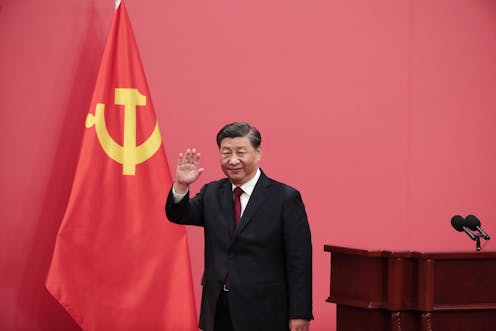
Xi Jinping’s clean sweep in elevating trusted allies to the commanding heights of the Chinese Communist Party is a political outcome that has implications beyond China’s borders.
Xi sits virtually unchallenged, for the time being, at the apex of a political organisation that oversees a country with the world’s second largest economy, a rapidly modernising military and, perhaps most importantly, global ambitions to match its growing economic and military strength.
In a ritual that would not have been out of place in a traditional Peking opera, the 69-year-old Xi led his new team of seven members of the ruling Standing Committee of the Politburo (SCP) onto the stage in front of the world’s media.
All of those who are to serve on China’s ruling body are Xi loyalists. All six have worked with him over many years.
Most significant is Li Qiang, the Shanghai party secretary. He will replace Premier Li Keqiang, who is being bundled into retirement.
The new SCP reflects the further ascendancy of a harder line Xi faction in the Chinese leadership and a setback for the party’s liberalising wing.
This is a seminal moment in China political history with unpredictable consequences.
Read more: Has Xi Jinping miscalculated in aligning himself with Vladimir Putin?
Xi in charge
No-one observing deliberations of the 20th National Party Congress could be left in doubt that China under Xi will continue to assert itself forcefully in what he calls “the great rejuvenation of the Chinese nation”.
At present, momentous changes of a like not seen in a century are accelerating across the world [in] a significant shift in the international power balance presenting China with strategic opportunities.
This was hardly a subtle reference to Chinese perceptions of a superpower rival beset with challenges at home and abroad against a background of a disrupted global environment. The Ukraine crisis is merely one example of a global order that is fragmenting.
In a “work report” delivered every five years at the most important political gathering on China’s calendar, it would be surprising if a Chinese leader did not avail himself of the opportunity to assert his country’s global ambitions.
However, Xi’s assertiveness – in contrast to his predecessors Jiang Zemin and Hu Jintao – is unsettling for China’s regional neighbours, including Australia, and for a US-led western alliance more generally.
The Chinese thrust into the western Pacific in a region long-regarded as free of big power tensions is one example.
China’s aggressive push into the South China Sea, sometimes referred to in propaganda as a “Chinese lake”, is another.
Still another is Beijing’s sabre-rattling towards Taiwan.
Since Xi’s tenure may last well into the 2030’s, Taiwan will remain his most pressing unresolved issue for the foreseeable future. As years pass, pressure for some sort of resolution, whether by force or otherwise, will increase.
Xi’s words will not have eased concerns about China’s intentions.
The wheels of history are rolling on towards China’s reunification […] Complete reunification of our country must be realised, and it can, without doubt, be realised.
Economic woes still loom large
In all of this, the critical question is whether Xi will become a more abrasive global figure unbound by restrictions on his tenure, and surrounded in the leadership by allies who are unlikely to challenge him?
Are there risks that his reach on issues like Taiwan will exceed his grasp?
The short answer is we don’t yet know. But Xi will likely have been further emboldened by his continued rise.
Xi is also a relentless aggregator of power. Since his elevation in 2007 to the Standing Committee of the Politburo, he has moved relentlessly.
In the decade since he was confirmed in 2012 as the general secretary of the Chinese Communist Party he has, step by step, consolidated power.
This all comes with the important caveat that behind the scenes in an opaque Chinese system, politicking can be brutal. Power struggles, sometimes violent, have scarred Chinese Communist Party history since its founding in Shanghai in 1921.
Xi would not need reminding that what the Communist Party giveth, it can also taketh away.
His own family’ experience is a case in point. Xi’s father Xi Zhongxun, a member of the first generation, with Mao Zedong, of Communist leaders, was purged in 1962. He was accused of being a member of a rightist clique.
Xi Jinping tasted the bitterness of that experience. He was shipped off to Shaanxi province, south-west of Beijing, in the early 1960s, where he spent six years in the countryside.
Xi senior was rehabilitated after the Cultural Revolution. Xi junior completed a degree in chemical engineering at Tsinghua University, one of China’s premier universities, before making his way up party ranks with various provincial assignments.
History will not be absent from Xi’s calculations, nor will he overlook the historical significance of the National Party Congress just concluded in Beijing.
In the annals of Communist Party history, the 2022 NPC will likely be regarded as a landmark event. The anointing of Xi as party leader, effectively for life, or at least until his age catches up with him, has echoes in the dominance of Mao Zedong, and to a lesser degree Deng Xiaoping.
Both were described as “paramount” leaders, even though Deng chose not to burden himself with the full panoply of titles that would have been available to him. Apart from his honorary presidency of the Chinese Bridge Association, he served in the powerful position of chairman of the Central Military Commission.
In Xi’s case, he is general secretary of the Central Committee of the Chinese Communist Party, chair of the Central Military Commission, and president. This is a “full-house” of leadership positions.
If there is an historical reference point for the 20th NPC, it is the 11th National Party Congress of 1982. This event crowned Deng protégé Hu Yaobang as general secretary of the Communist Party.
What is different this time is that whereas Hu was an economic liberaliser committed to Deng’s mantra of “reform and opening”, Xi Jinping has shown himself to be less of a reformer and more of a consolidator. He has sought to rein in entrepreneurial impulses unleashed under his predecessors in the interests of stabilising China and fighting corruption. This has been in pursuit of his “common prosperity” policy aimed at narrowing a yawning rich-poor gap.
Finally, there is one important respect in which Xi is exposed. This is in his management of the economy.
His “zero covid” policy has weighed heavily with its nationwide shutdowns. This has contributed to a stuttering economy to the point where GDP growth is faltering for the first time in decades.
The World Bank has cut its forecast for 2022 GDP growth to just 2.8%, from a previous forecast of 5.5%. GDP growth in 2021 was 8.1%.
With a collapsing real estate sector weighing on a stretched banking system, the economy is Xi’s vulnerability. Getting the numbers from his comrades to endorse himself and his underlings in leadership roles is one thing; shifting the economy back on track is quite another.


