

What makes a great footpath? The answer is key to our happiness and wellbeing as we age
- Written by The Conversation
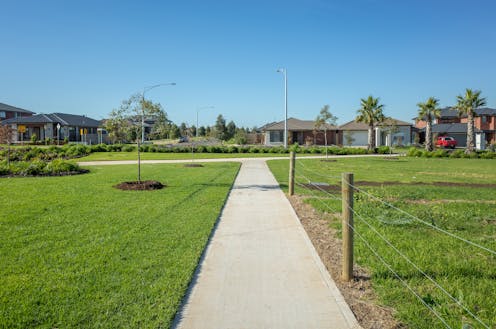
As people age, they often become less confident about walking. Fear of falling can limit the activity of older people, leading them to become isolated.
So what, exactly, makes for a great footpath to walk on?
My colleagues and I explored this question in a recent paper. We used an evidence-based tool to measure the walkability of urban roads – assessing not just the footpath itself, but the features around it.
The results can help urban designers make our cities more walkable, especially for older people.
What makes a footpath ‘walkable’?
Only about 42% of people in Sydney and Melbourne live in neighbourhoods with above-average walkability. This compares poorly with people in Lisbon (99.2%), São Paulo (97%) and Hong Kong (96%).
Generally, features that determine whether a footpath is walkable fall into one of two categories.
Neighbourhood-level features refer to a neighbourhood’s general environment, such as:
how well connected streets are to each other. Do they offer a variety of available routes for daily trips?
how densely dwellings are built and how amenities are distributed. Are there parks, train stations, cafes or shops within walking distance?
Footpath-level features refer to the safety, comfort and attractiveness of a footpath, such as:
- obstacles such as tree roots and short poles
- the width of the path
- convenience of crossing facilities
- green belts (such as grass and shrubs) and fences that separate pedestrians from traffic lanes
- areas of shade
- street furniture
- bicycles travelling along the path
- vehicles parked on the path
- noise from cars and other sources
- diversity of streetscapes such as building facades, trees and grasslands.
Previous studies on walkability have mixed these two levels of features. But our research separated them, to help urban designers identify which features are most important and which should be improved.
We focused on neighbourhood walkability for senior citizens. By 2050, one in six people in the world will be aged over age 65 – almost double the number in 2015. Australian census data paints a similar picture.
Research shows older adults who perceive their neighbourhood as walkable are happier and more satisfied with life, and less lonely.
Walkable cities help senior citizens – especially those with physical restrictions – be more physically active, and promotes stronger and more regular social connections.
So it’s particularly important to identify how to make our streets more appealing for this age group.
Read more: People love the idea of 20-minute neighbourhoods. So why isn't it top of the agenda?
What we found
Our research focused on the city of Shenzhen in China. Over the past 40 years, Shenzhen has grown into a megacity, and urban planners have historically prioritised the needs of motorised traffic over pedestrians and cyclists.
Among the methods involved in our study, we asked 256 senior citizens to rate footpath features to help us understand how much each one affects their walking.
Respondents told us bikes on footpaths and vehicles parked on footpaths were the biggest factors in reducing walkability. They reported that cars parked on footpaths made the space too crowded and increased the risk of being injured by bikes travelling on the footpath.
Convenient crossing facilities were rated as the second most important feature of footpath walkability. This includes formal crossings – such as zebra crossings and underpasses – as well as informal crossings such as quiet streets.
Read more: Aged care isn't working, but we can create neighbourhoods to support healthy ageing in place
We employed two auditors to quantify how well each feature appears in 11 sample footpaths. The results showed that the way researchers quantify the quality of a footpath can differ to the views of senior citizens.
For example, we measured the quality of a green belt based on the ratio of the length of the belt to the length of the footpath. But for the pedestrians we spoke to, no matter how wide a green belt is, it’s effective as long as it separates them from traffic lanes.
We need walkable neighbourhoods, too
Our research shows what makes a good footpath, but neighbourhood walkability is also important. If people don’t have destinations to walk to, or streets are not well connected, then they will be deterred from walking even if the footpath is good quality.
And we must remember, people experience footpaths differently. An able younger adult may consider a footpath walkable when a senior citizen or a younger child struggles to navigate it.
Every citizen has an equal right to use and enjoy public space – and footpath design should reflect this.
Read more: It's easy to get us walking more if we have somewhere to walk to near our home and work


