

Australia's borders are open, so where are all the backpackers?
- Written by The Conversation
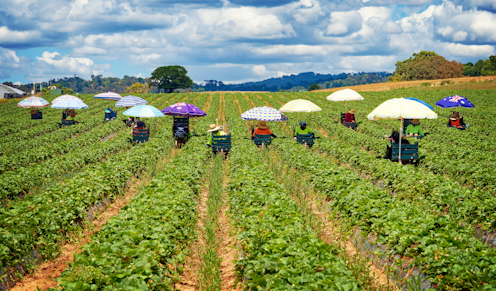
Backpackers on working holiday maker visas have been a crucial source of farm labour for decades, alongside smaller numbers of temporary migrants from the Pacific Islands, international students, and Australians.
In the 2018-19 financial year more than 200,000 people came to Australia on working holiday maker visas. On average about 35,000 a month – and more than 40,000 in December – worked on farms, picking vegetables, fruit or nuts.
Numbers declined with borders closed to visa holders from March 2020 to February 2022. But since borders reopened they have not recovered as hoped.
By the end of June almost 100,000 Working Holiday Maker visas had been granted. But by the end of August just 54,000 visa holders had arrived. With labour shortages creating more job opportunities in cities and towns, fewer are taking up farm work.
In regional communities facing extensive labour shortages there is growing uncertainty as to when – or indeed whether – enough backpackers will return to Australia to pick, pack, and process fruit and veggies.
So why aren’t backpackers coming?
In recent months I’ve interviewed 35 people – farmers, hostel operators, government representatives and community leaders – about the reasons migrant workers aren’t flocking back to Australia. This is an extension of my research into the pandemic impacts on seasonal farm workers.
Their responses suggest three main reasons for why backpackers have cooled on Australia as a top destination for a working holiday: fear of future border closures; the federal government’s poor treatment of migrants during the pandemic; and Australia’s reputation more generally for exploiting backpackers.
One hostel operator said they were fielding calls and emails mid-year from backpackers overseas hesitant to come to Australia: “They want to come and do the working holiday, but Australia’s known as the lockdown country now.”
Four other the hostel operators said they had heard similar concerns from young people in recent months, asking questions such as “What if we get stuck?” and “Who will help us book a flight back home?”.
When the federal government shut the border in 2020, its message to temporary visa holders was to “go home”.
Despite this, more than 50,000 backpackers, did stay for the first year of the pandemic, and 20,000 beyond that - providing an essential agricultural workforce. But they were excluded from most support payments and left to to fend for themselves.
Backpackers I interviewed last year said this had damaged Australia’s reputation.
On top of this are stories of exploitation, racism and mistreatment. A 2019 study by Unions NSW and the Migrant Workers Centre concluded 78% of horticulture workers were underpaid.
Increasing incentives
To entice tourists to the fields, the federal government has introduced incentives including a refund of the $495 Working Holiday Maker visa fee and relocation assistance – up to $2,000 for visa holders, and $6,000 for Australian workers – to take up seasonal work.
Piece rates, a contentious industry practice leading to many stories of wage exploitation, were finally replaced in April, when the Fair Work Commission ruled that farm workers should be guaranteed minimum hourly rate of $25.41.
Labour shortages have seen many farmers sign up to the Pacific Australia Labour Mobility scheme, a temporary migrant program open to workers from nine Pacific Island nations and Timor Leste.
Read more: New Pacific Australia Labour Mobility scheme offers more flexibility ... for employers
But these measures haven’t solved the shortfall. According to the National Farmers Federation, there are still about 172,000 vacant agricultural jobs.
What more can be done?
Backpackers bring great benefits to regional communities. Fruit and vegetable farmers need seasonal workers. Many backpackers are happy to use farm work to travel the country. According to a representative from Harvest Trail, the government farm labour information service, they are an “essential pool of workers because they’re so mobile.”
The working holiday maker visa is now available to 47 nations. India, Mongolia and Brazil were added this year.
Longer visa options would encourage more backpackers to stay. The visa, which requires a yearly renewal application, is capped at three years. Many backpackers I’ve interviewed said they “feel part of the community” and would happily remain in their farming jobs if allowed.
The Albanese government has promised to develop permanent resident pathways for some Pacific Island workers. It is worth exploring the feasibility of pathways to permanent residency for farm workers on working holiday maker visas.
Read more https://theconversation.com/australias-borders-are-open-so-where-are-all-the-backpackers-192614


