

As Victorians head to the polls, will voters punish the major parties?
- Written by The Conversation
There are now just five days until the last day of voting in the Victorian state election.
Much of the focus of the campaign so far has been on the Legislative Assembly, or lower house. To win government, a party or coalition of parties must win a majority of seats in this chamber.
At the last state election in 2018, Labor won 55 of the 88 seats, while the Liberal and National coalition won just 27 seats.
Like other jurisdictions, COVID-19 had a major impact on Victoria. In responding to the pandemic, the Andrews government introduced a range of policy measures that sought to limit the transmission of the virus in the community. These included lengthy lockdowns, curfews, and limits on how far people could travel from their homes.
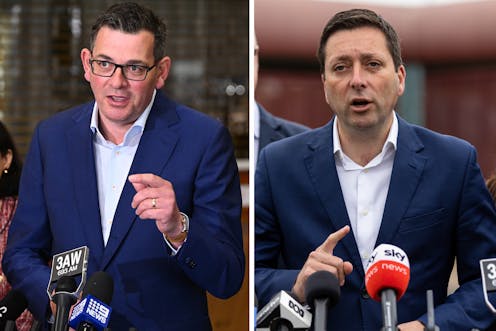
While the Victorian political debate appeared to become more polarised during this time, opinion polls have continually favoured a third consecutive win for the Dan Andrews-led Labor Party.
In contrast, the Coalition has seemingly struggled to generate support, despite being out of government for eight years. The decision to bring back Matthew Guy as Liberal Party leader last year sought to build the opposition’s momentum ahead of the election. Based on recent polls, Guy appears to have stopped voters leaving the Coalition, but the opposition still trails Labor on the all-important two-party-preferred measure.
Minor parties and new challengers
While the major parties continue to be central to the campaign coverage, minor parties are also working to increase their representation in the lower house.
The Greens currently hold three inner-metropolitan seats: Melbourne, Prahran and Brunswick. Two of these seats are on very fine margins. Melbourne is held by just 1.6%, while the Brunswick margin is 2%.
In addition to defending these seats, the Greens are hoping to win Richmond, another inner-metropolitan electorate held by Labor by 5.8%. The seat is currently held by Labor minister Richard Wynne, who will be retiring after 23 years. This opens an opportunity for the Greens to make further inroads in the Victorian parliament.
There is also a lot of interest in how the “teal” independents will perform. At the federal poll in May, teal candidates won Kooyong and Goldstein from the Liberal Party. There is an expectation they may win eastern metropolitan seats including Kew, Hawthorn and Caulfield, which had once been safe electorates for the Liberal Party.
This election will provide the teals with an opportunity to consolidate themselves in Australian politics if they are able also to win state representation.
The upper house
The state’s upper house is made up of 40 parliamentarians, with five MPs elected from each of the eight Legislative Council regions. At the last election, Labor won 18 seats, while the Coalition won 11.
The proportional voting system used to elect candidates is similar to that used in the Senate prior to 2016. To win, a candidate must win 16.7% of the vote across the region in which they are standing.
Furthermore, the controversial Group Voting Ticket (GVT) system is used to elect candidates. This means voters can simply indicate their most preferred party above the line on the ballot paper. Their preferences will then be distributed according to the preference flows designed by the party.
While this makes voting straightforward, the GVT system has been criticised for giving too much power to parties to determine where votes end up through preference deals.
Of course, voters can also choose to vote below the line by numbering at least five boxes.
Read more: How Victorian Labor's failure on upper house electoral reform undermines democracy
At the last election, the Greens won just one seat thanks to poor preference flows. In contrast, parties with beneficial preference deals were able to win representation in the state’s upper house. These included the Liberal Democrats, Derryn Hinch’s Justice Party, the Reason Party, and the Shooters, Fishers and Farmers Party.
The use of the GVT system has also come under scrutiny after so-called “preference whisperer” Glenn Druery, who has regularly designed beneficial preference deals for parties, was shown on video talking about these deals.
Irrespective of the debates about the GVT, it remains a feature of the Victorian system and could be used in future state elections unless changes are made to the electoral system following this election.
As such, the final outcome of the upper house election may replicate the existing result, which would mean neither major party controls the chamber and must work with cross-bench MPs to form a majority.
The final countdown
Opinion polls have been consistently pointing to a Labor win in Victoria. If successful, Andrews may become the longest-serving premier of the state since John Cain junior, another Labor leader, held the post from 1982 to 1990.
A third straight loss for the Liberals in Victoria will presumably lead to further introspection and analysis within the party about its policy agenda and leadership.
With many Victorians have already voted early, the future of the state’s government and party system will be revealed when counting starts on Saturday night.


