

Back from the brink: how genome research is helping the recovery of the Chatham Island black robin
- Written by The Conversation
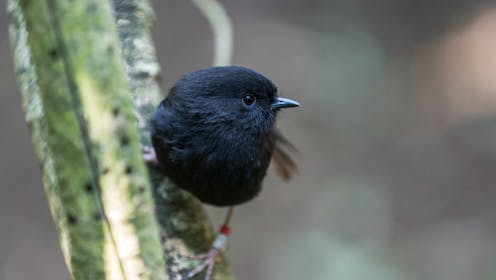
The story of Old Blue and Old Yellow, two Chatham Island black robins that went on to save their species, is one of New Zealand’s best known conservation stories.
Once abundant on Rēkohu/Chatham Islands before European arrival, the black robin population crashed when rats invaded the archipelago. In the early 1900s, 35 black robins remained on a small island (Tapuaenuku/Little Mangere), but by 1976, only seven birds had survived.
They were moved to an adjacent, predator-free island (Maung’ Rē/Mangere) and Old Blue and Old Yellow, the only remaining breeding pair, became “Adam and Eve” for the species.
Conservation biologists worried such an extreme genetic bottleneck would lessen the species’ chances of recovery by leading to an accumulation of genetic defects. But our new genome study shows that, contrary to our expectations, harmful genetic mutations have not increased since the severe decline.
Genetic threats to small populations
When we think about species extinction, human-associated threats such as habitat degradation, overhunting or introduced predators come to mind. We intuitively understand that small populations are at greater risk of extinction than large ones.
But even when major threats are removed, more subtle problems like inbreeding can push wild species to the brink of extinction. The Chatham Island black robin (karure, Petroica traversi) illustrates these issues perfectly.
At the start of the species’ recovery, the extreme level of inbreeding, with all birds descending from one pair, is not ideal. A previous study suggested inbreeding and harmful mutations, which often accumulate in extremely inbred populations, had a severe effect on individual survival and reproduction and even slowed down the recovery of the species.
Even to non-biologists, this is not surprising. Everyone familiar with the fate of European dynasties like the Habsburgs knows that relatedness between parents can cause major issues. Charles II, for example, the last Habsburg ruler of Spain and descendent of generations of closely related ancestors, died childless at the age of 39 after lifelong health struggles.
For now, black robins appear to have escaped this fate. As of 2022, there are about 290 birds, split between two different islands.
Are black robins out of the woods?
To answer this question, we compared the genomes from birds that died in the 1800s to the genomes of birds from 2014-2019. Curiously, even though inbreeding had increased severely, we did not see an increase in the number of harmful mutations over the past 200 years.
It is possible the species has been “pre-adapted” to surviving in small populations. Living on a few small islands, inbreeding might have always been a problem. There would have always been a percentage of the population with reduced health due to damaging mutations.
Natural selection might have eliminated those individuals and their harmful mutations from the gene pool without major impacts on the overall population. With few harmful mutations left in the population when the species dwindled to only two breeding birds, the negative effects of extreme inbreeding might have been reduced.
In other words, their evolution on a small archipelago may have prepared the black robins better than large mainland species for fending off the negative effects of inbreeding.
Read more: A new 3D koala genome will aid efforts to defend the threatened species
The relevance of genomics in conservation
The Chatham Island robin is not the only species to benefit from recent advances in genomics. Similar genomic studies have shown that some highly inbred species seem to have lost a large proportion of genetically harmful defects. While genetic threats remain, these species may be doing better than we once thought.
These results are also important from a management perspective as better estimates of inbreeding and harmful mutations can help identify the most genetically healthy individuals for translocations and breeding programmes (such as for kākāpō and Swedish Arctic foxes). Genomic data can also improve or verify the accuracy of pedigrees.
Read more: A huge project is underway to sequence the genome of every complex species on Earth
The main concern for conservation managers will be to determine whether and when a recovering species like black robins or kākāpō will be able to fend for themselves. How long will they require intensive management in the form of nest surveys, supplementary feeding or even artificial rearing of chicks?
At which point can we consider a species healthy enough and resilient to diseases or other external threats? And what if the recovery stops, slows down or even reverses as new harmful mutations accumulate in the population?
We do not have answers to these questions yet. Genomics can help address some of them, but it is just one tool in the conservation toolbox. Conservation successes will come from an integration of all available sources of information, including often underused sources such as traditional ecological knowledge.
If we want to know more about how black robins behaved and lived before European predators were introduced, we also need to look for – and listen to – the stories from that time. For the black robin, as well as for other highly endangered species, it is the combination of all available information that will eventually make the difference between success and failure.


