

NZ’s health system has been under pressure for decades. Reforms need to think big and long-term to be effective
- Written by The Conversation
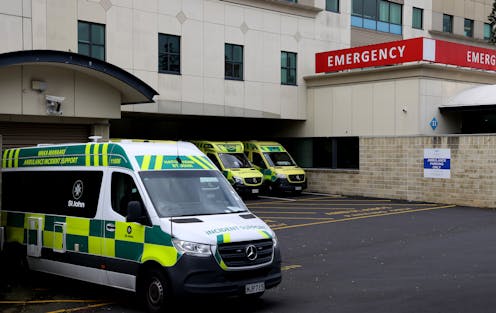
As New Zealand’s COVID cases rose in 2021, we were warned the virus would put significant pressure on our health system. But, in reality, New Zealand’s medical system has been struggling for a long time.
Over and over again, the media have put the spotlight on the struggling health-care system and the impact these issues have on individual patients and their families as well as, of course, staff.
In some situations, waiting list delays, stretched services and overworked staff have resulted in serious outcomes, including death. For New Zealanders who are missing out on treatment, or facing years-long delays, the insufficient care can cause significant stress and inhibit their ability to contribute to our economy and society.
For others, our struggling public health system can take a financial toll, by forcing people to gather all the money they can to pursue treatment in the private sector.
The long wait
Recently, the media focus has turned to New Zealand’s worsening access to non-urgent surgery.
As of last October, 30,000 people were waiting longer than four months for surgery, up from 27,500 in May when the Planned Care Taskforce was formed to cut national surgical waiting times.
At the same time, a further 38,000 New Zealanders had been waiting longer than the four-month target for being seen by a specialist for an initial assessment, up from 35,000 in May.
On the upside, there had been a reduction from 5,500 to 3,500 in those waiting over a year for surgery.
The enduring postcode lottery
The data highlighted major differences in access and care by region – the so-called “postcode lottery”.
The situation is unacceptable and was never anticipated or expected in a country with universal access as a fundamental guiding principle for health care. This principle means everyone should be treated in a timely manner without any barrier to or inequality in access.
These rising waiting lists, lengthy emergency department waiting times and uneven access can’t be blamed on COVID-19 alone. The pandemic has simply added to the pressures and revealed more starkly the multiple cracks in our health system.
A history of pressures
The issues across our health system are long-standing and attempts over the past three decades to resolve the fundamental issues have had mixed results.
In the early 1990s, the government set up the Committee on Core Health Services. The goal of the committee was to ensure patients with non-urgent needs were treated in order of priority. Assessment involved scoring patients based on need. The committee also aimed to eradicate the postcode lottery.
Read more: NZ’s medical licensing system is still a major hurdle for desperately needed foreign-trained doctors
Since then, subsequent governments have made significant changes to the health system, including introducing district health boards (DHBs) in 2001 and then the dismantling of these boards with the creation of Te Whatu Ora in 2022.
While there have been periodic improvements to the system with these changes, the basic problems recently highlighted by the media have persisted thanks to a constant and reactive game of catch-up.
Underlying problems
To be clear, the professionals providing care in New Zealand are outstanding and superbly trained. They work within a context, however, that persistently lets them down and is deeply stressful for all.
The basic issue is lack of long-range planning or solid investment in health care, affecting the entire public health-care system and all who rely on it.
Planning is usually reactive rather than establishing a solid foundation for the future.
Investments in hospitals and workforce are largely within a short-term framing, dictated by funding availability and yesterday’s needs. This means facilities are often inadequate and workforce shortages are ongoing. Hospital staff have been regularly asked to reduce expenditure to prevent budget blowouts.
It is also no secret that New Zealand is historically heavily reliant on foreign-born-and-trained health professionals.
There is no specialised long-range health planning group working in government; we badly need one, with deep expertise and connections to global networks.
System-wide solutions
There is also a historic lack of focus on system-wide solutions. We should be looking at how we use all resources in the health system – public and private – to collectively deliver on needs.
Moving to a system-wide approach would have wide-ranging implications, from how we fund health care through to health professional training.
This could mean lifting the lid on health professional regulation and allowing different professionals to take on work that is currently limited to specialists, for example.
Read more: ACC’s policy of not covering birth injuries is one more sign the system is overdue for reform
General practice also needs strengthening within the health system, along with hospitalists – specialists trained in hospital general practice.
Finally, there is a pressing need to embrace “operational excellence”, a set of practices aimed at systematically improving the quality and organisation of services. If anything, New Zealand’s health system and services currently exhibit the direct opposite of operational excellence.
The health reforms under way, led by Te Whatu Ora, offer the opportunity to address our health-care system’s key weaknesses by embracing long-range planning and operational excellence. Let’s hope we achieve this for the sake of our patients, health professionals and future generations.


