News Daily


Men's Weekly

Australia

  • Written by The Conversation
Why restoring long-distance passenger rail makes sense in New Zealand -- for people and the climate

A recent parliamentary inquiry into passenger rail drew 1700 submissions, suggesting growing support for the return of long-distance trains in Aotearoa.

The government has committed the country to decarbonisation targets that require significant cuts to transport-related emissions. But decarbonising long-distance travel is not part of the plan – the national rail operator KiwiRail remains focused on freight.

We argue the revival of long-distance passenger rail needs to be part Aotearoa’s strategy to bring emissions down.

The arguments for intercity passenger rail centre on connecting communities, equity in transport options, reduced emissions and lower energy use.

The end of the decline?

After a long decline – detailed in André Brett’s history of the New Zealand network Can’t Get There From Here – there were some gains in 2022.

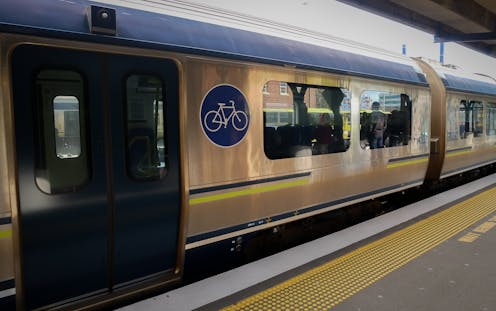
Following initial plans to turn it into a tourist train, the Northern Explorer is back running between Auckland and Wellington. Passenger numbers on Te Huia, a rail service between Auckland and Hamilton, have doubled – helped by half-price fares – since its launch in April 2021.

The commuter train Capital Connection attracts good passenger numbers on its week-day only run between Wellington and Palmerston North, despite old and unreliable rolling stock. Work is underway on improving passenger rail near Wellington.

Campaigning for rail

Several new campaigns are pushing for further improvements to passenger rail.

Save Our Trains is seeking a “comprehensive national strategy for inter-regional passenger rail services built around concerns for climate action, accessibility, affordability and economic development”.

Making Rail Work has developed a proposal to reinstate the Kaimai Express linking Auckland and Tauranga. A report for local government supported the case for more frequent services linking North Island towns.

Read more: Convenience, comfort, cost and carbon: what's the best way to travel, save money and cut emissions?

Arguing for the restoration of the Auckland–Wellington night train, public transport planner Nicolas Reid suggested such a service “would have the potential to replace up to 150,000 long-distance car trips or flights per year”.

Most controversially, the group Restore Passenger Rail staged a series of nonviolent direct actions to draw attention to the issue, closing motorways and attempting (unsuccessfully) to address the cross-party inquiry into passenger rail from the top of a motorway gantry.

Rail cuts transport emissions

Transport comprises 45% of Aotearoa’s domestic carbon dioxide emissions, but it is hard to decarbonise. It requires a combination of changes to technology, behaviour and infrastructure. But the significant emission and energy benefits of using intercity and regional rail, rather than driving or flying, are well established globally.

New Zealand’s emissions reduction plan aims for a 20% reduction (per capita) in driving by 2035, through improved urban planning and better travel options. But it does not mention intercity rail.

As half of all kilometres driven are on the state highway network, this is a major omission. Auckland Council’s transport emission reduction plan also aims to reduce domestic aviation emissions by half by 2030, before promised electric or hydrogen-powered planes can make any real impact.

A graph showing carbon dioxide emissions for different modes of transport
Our World in Data, CC BY-SA Auckland, Wellington and Christchurch are important, but they only comprise half the population. Travel within and between the smaller cities must also be decarbonised, or the whole country will fail its targets. Transport investments misplaced To reinstate fast and efficient passenger rail across Aotearoa, large capital and carbon investments are required. But that is partly because the rail network has been run down for decades, while considerable investment has gone into roads. Yet, these new roads create more traffic. Further road building, such as an expressway between Ōtaki and Levin, is being promoted, even though we know this project has an extremely poor economic return and will induce more driving. Read more: Climate explained: does building and expanding motorways really reduce congestion and emissions? When good services are on offer, people tend to use them. In Auckland, the then rundown suburban train service was used by only one million people each year in 1994. But a range of improvements saw passenger numbers top 20 million in 2017, with further growth expected once the City Rail link is completed. Demographic changes support the return of passenger rail. Aotearoa has an aging population, especially in its smaller centres. Many lack airports and driving can become problematic for older age groups. Small towns have also lost many services and visits to bigger centres for medical appointments and other services have become more important. Most towns still have railway lines connecting them to larger centres. The remaining private coach network suffers from infrequent service, poor quality and a lack of connectivity and integrated ticketing. If, in the UK, the rich take trains and the poor take buses, we suspect in Aotearoa the rich fly or drive and the poor take the bus or don’t travel at all. Not everyone drives, particularly children and old people; and of those who do drive, some would prefer not to. Internationally, we’ve seen a long-term decline in the number of young people gaining drivers’ licences. Read more: NZ’s most walkable towns and cities ranked: see how your neighbourhood stacks up For those living in larger urban centres with good public transport and biking infrastructure or in 15-minute neighbourhoods, there is far less need to own a car. To make the necessary cuts to transport emissions in our larger cities, we need to re-imagine car ownership as an option rather than a necessity. It might be a lot to lay on the humble train, but civilisation is in a tight spot. We need to collectively halve emissions by 2030, while also laying the groundwork for a truly sustainable future. This means wise use of resources – long-lasting, economical infrastructure based on proven technology, combined with renewable electricity. Trains do that.

Read more https://theconversation.com/why-restoring-long-distance-passenger-rail-makes-sense-in-new-zealand-for-people-and-the-climate-199381

Why Cloud Services Are Now Essential for Business Growth and Security

In today’s fast-moving digital environment, understanding how cloud services support long-term stability has become a priority for businesses across Australia. As expectations shift and workplaces adopt more flexible models, organisations are turning to cloud services to keep systems running smoothly... Read more

Steel Cutting Services: Precision That Shapes Modern Construction

In today’s construction, manufacturing, and fabrication environments, steel cutting services play a vital role in turning raw steel into practical, usable components. From large-scale infrastructure projects to bespoke architectural features, the accuracy and quality of steel cutting directly influence the... Read more

Lighting Stores Perth: Expert Guidance for Inspired and Functional Spaces

Choosing the right lighting can completely change how a space feels, functions, and flows. Trusted lighting stores Perth play a crucial role in helping homeowners and businesses make confident lighting decisions that go beyond appearance alone. Lighting influences mood, productivity, comfort... Read more

Why Retail Cleaning Plays a Key Role in Customer Experience

In retail environments, cleanliness directly shapes how customers perceive a brand. Retail cleaning is not just about appearance but about creating a space where shoppers feel comfortable, confident, and welcome. From small boutiques to large shopping centres, a clean retail environment... Read more

Cleaner Floors, Healthier Homes: Lefant M3L Arrives as Australians Prioritise Pet-Friendly Hygiene

As pet ownership continues to rise, Australians are placing greater emphasis on maintaining a hygienic indoor environment for both family members and their animals. Issues such as dander, loose fur, and tracked-in dirt require consistent cleaning to support better home... Read more

How Home Removalists Save Time, Money, and Energy During Your Move

Moving to a new home is an exciting chapter in life, but the process of getting there can be overwhelming. From packing and organizing to transportation and unpacking, relocation involves a long list of tasks that can consume both your... Read more