

Fear and loathing in New Zealand: an overdue examination of our ‘underworld of extremists’ is valuable but flawed
- Written by The Conversation
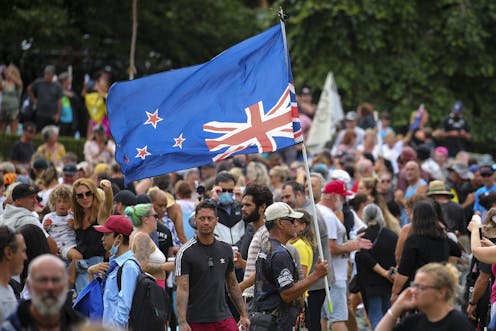
Since the horrific attacks in Christchurch in 2019 there has been substantial and growing attention paid to the extreme right in New Zealand. The pandemic – and the conspiracy theories and anti-government sentiment that developed in response – increased that scrutiny, and the sense of unease or alarm many felt about it.
Yet until now we have relied on just a handful of academic articles and media reports to gauge the extent and nature of the contemporary far right in New Zealand. Byron Clark’s new work is the first book to provide an overview of the multitude of groups and individuals loosely categorised as “alt-right”.
Fear: New Zealand’s hostile underworld of extremists – Byron C Clark (HarperCollins)
Clark is an independent researcher who has done invaluable work in exposing the ideologies, behaviour and online and offline presence of a range of fringe political groups and individuals. He has an unparalleled knowledge of this network, their YouTube and Telegram channels, and the connections between them.
The book (like Clark’s Twitter account) is a crucial starting point for anyone seeking to understand the alt-right in New Zealand. It is beautifully written and contains excellent insights that can inform the study of contemporary extremism.
As one example, he discusses how, as the traditional markers of adulthood like home ownership and a stable career became increasingly unattainable, many young men found sanctuary in gaming and other online pursuits. For some, feminism came to be seen as threatening even that refuge.
In short, this is an excellent and useful book. For those of us who research (and teach about) extremism, it will serve as an important reference point. Nor is it confined to New Zealand; it serves as a study of how quite disparate, even opposed, groups can begin to orbit one another during a time of crisis.
Defining our terms
If definitions had been provided, it might have stimulated a more nuanced consideration of the motley network of groups and movements that emerged in New Zealand during the pandemic.
Some groups covered in the book – Action Zealandia and Counterspin, for example – clearly fall within the normal definitions of these terms. But for others, their inclusion is puzzling and unconvincing. Many do not seek a society based on law and order and centralised authoritarian leadership, oppose immigration or seek to protect the “white race”.
And most have not legitimated violence. Opposing vaccinations or spreading disinformation does not qualify a group as far right – many on the left and in between also do that.
The book discusses groups as diverse as Action Zealandia and Groundswell, and individuals such as neo-Nazi Philip Arps and former knitting club member and Voices for Freedom founder Alia Bland, as if they are manifestations of the same movement. At one point, the Wellington anti-mandate protests are explained together with the Christchurch terrorist attack as being due to “people no longer knowing what to believe anymore”.
Read more: The NZ anti-vax movement’s exploitation of Holocaust imagery is part of a long and sorry history
Need for evidence
This lack of definition and conflation of different groups, ideologies and goals is connected to my second concern: a lack of evidence.
Many chapters focus on particular movements, parties or forms of “extremism” identified by the author as present or important in New Zealand. Unfortunately, the book fails either to show the movement is present in New Zealand or to provide a compelling case that it is far right, alt-right or extremist.
In part, this is because much of the discussion relies on the claims and reports of New Zealand-based commentators that are themselves not based on evidence.
Read more: Citizens' social media, like Mastodon, can provide an antidote to propaganda and disinformation
The chapter on Voices for Freedom starts by stating “no comprehensive study of New Zealand’s far right can ignore them”. But clearly that depends on how we define the far right: as far as I am aware, the group has expressed none of the views listed at the start of this review (and none are provided in the chapter).
Whatever we think of the group’s opposition to vaccination, lockdowns and other measures to control the spread of COVID-19, this does not make it far right. And as much as we might find the group’s views reprehensible and damaging, it does not seek violence.
Careful coverage needed
There is even less evidence provided in the following chapters on the anti-mandate Outdoors Party, the farmers movement Groundswell, and the apparent presence in New Zealand of a racist Rhodesian pride movement. Even the chapter on disinformation provides no data or evidence to support the claims made.
There is a tendency to focus on fragmented evidence of a New Zealand-based individual or group, and buffer a lack of activity or presence in this country with discussion of an affiliate group from the past or from overseas.
For example, Hindutva is presented as present and threatening in New Zealand, but with little to no evidence. Because of a lack of demonstrable activity or presence here, the author uses the fact that the New Zealand Hindu Council is affiliated to the India-based nationalist organisation VHP, to discuss in much greater length the VHP’s extremist activity in India, even including a discussion of the riots in Gujarat in 2002.
This history of violence and extremism in India will give many readers the impression that something similar is present in New Zealand, when no evidence has been provided for this inference.
Other important statements also required supporting evidence. The back cover states: “New Zealand has one of the highest concentrations of alt-right groups compared with other nations.” As a marketing tool this is understandable: it will shock browsers in bookstores and be repeated as fact at parties around the country. But no evidence is provided for the claim.
For all that, Byron Clark’s work provides an exceptional service to researchers and all those who want to understand the often bizarre and counterintuitive features of the far right, conspiracy theory and anti-government movements in contemporary New Zealand.
But when we write about these groups we need to take care how we describe them, and not to exaggerate their size, intentions and organisational links. Otherwise, we risk adding to their appeal among the disaffected, pushing together otherwise antithetical groups, generating misplaced fear and contributing to rising polarisation. The topic is too important not to warrant very careful coverage.


