

Australian humpback whales are singing less and fighting more. Should we be worried?
- Written by The Conversation
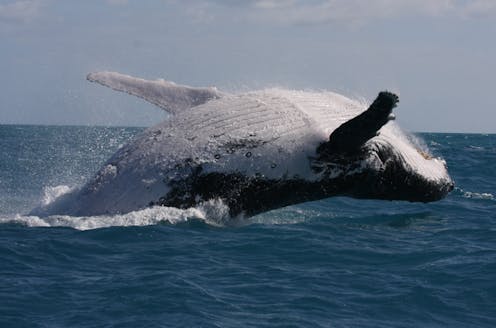
As eastern Australian humpback whale populations have recovered over the years, males have adapted their mating strategy in a highly strategic way, new research finds.
I analysed 123 days’ worth of data on Australian humpbacks (Megaptera novaeangliae), collected from 1997 to 2015, and found male humpbacks sang less and fought more as the whale population ballooned.
We think this shift in behaviour is a result of not wanting to attract other males to a potential mate, as we explain in research published today in Communications Biology.
Rapid growth, rapid adaptation
Humpbacks have recovered magnificently since 1965, when the species became globally protected.
One population off Australia’s east coast grew from less than 500 in the 1960s and is estimated to contain at least 30,000 today. This population has provided experts a rich dataset. The males in particular are great subjects thanks to their striking song broadcasts.
Carrying on work started by University of Queensland Professor Michael Noad in the ’90s, we set out to investigate exactly how the eastern humpbacks have adapted to the growth numbers.
Luckily for us these whales migrate close to the coastline, so we were able to establish a land-based observation station at Peregian Beach, a small coastal town on the Sunshine Coast.
Volunteers onshore helped us track individual whales as they moved down the coast, while an acoustic array moored offshore recorded the whales’ song and tracked singing whales. This method (which Professor Noad first established) allowed us to pinpoint the exact location of a particular whale in real time.
A trend emerged when our data were coupled with those collected by Professor Noad’s team. As the eastern humpback population grew, males weren’t singing as much as they used to. Instead they were increasingly opting to quietly find a female to mate with, or fighting off other male competition.
Specifically, the proportion of singing males decreased from two in ten in 2003–2004, to only one in ten by 2014–2015. Data from 2003–2004 also show males were less likely to sing when they had a higher proportion of males in their social circle.
And it seems the change in tactics led to a change in results. In 1997 singing males were almost twice as likely as their counterparts to be seen joining with a female and escorting her, likely to attempt to mate. But by 2014-2015, non-singing males were almost five times more likely to be seen joining a group with a female.
That said, we can’t say for sure when joining a group actually results in mating with the female and fathering a calf. That’s another piece of this puzzle: how many of the males that join groups (singing or otherwise) actually end up mating and then fathering a calf?
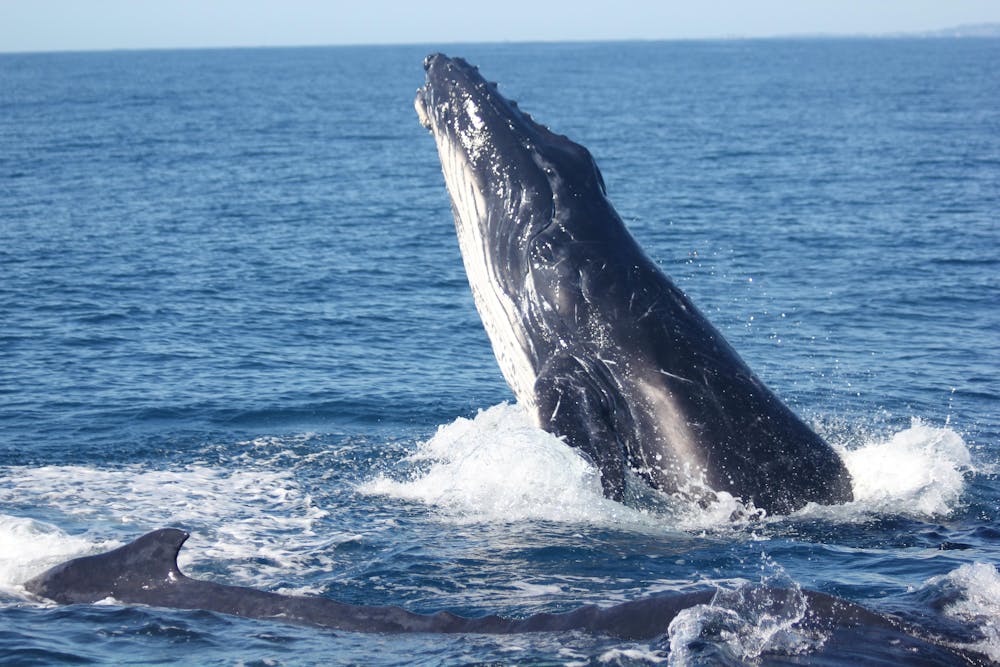
What’s driving males to fight?
A species will carry out a behaviour for as long as the benefits outweigh the costs. If something changes, and the costs start to outweigh the benefits, they will stop. It’s a basic principle, but it goes a long way towards explaining our findings.
In the early years of data collection, when there were fewer whales around, a male could sing and broadcast himself to nearby females quite comfortably – not having to worry about hordes of other males wanting his neck.
Now, with a more than burgeoning population, the same tactic attracts the risk of being interrupted by other males. As a male humpback, you’re better off spending the breeding season quietly seeking a female to mate with and not attracting the attention of other males.
Or, if you fancy yourself a big, tough guy, you might take the chance to fight other males to become the “primary escort” of a group. And this relates to one of our working theories about why singing among the eastern humpbacks has diminished through time, and fighting has increased.
Until it was banned, whaling was likely targeting larger mature adults. This could have left an immature population, full of young whales less equipped to fight. Coupled with a sudden decrease in competition overall, this may help explain why whales in the early years preferred singing as a mating tactic.
By the same token, once these same males started to mature and grow large in later years, they may have tended more towards fighting off competition.
We have observed some of these bigger and more assertive whales, the “primary escorts”, on the breeding grounds. They move from group to group, displacing other males – always maintaining their alpha status.
Are whales losing their song?
Despite what our research has observed, we don’t think whales are at risk of losing their song. The eastern humpback whales have simply changed their behaviour to improve their chances of mating. As researchers working out in the field, we still hear whales singing, so we’re not worried.
But we do have questions moving forward.
For one thing, we don’t know how the population dynamics in the eastern humpback may have changed in the past seven years. The dataset used in our study ended in 2015 (and the population has since grown). It would be interesting to know if the trend we observed from 1997 to 2015 is ongoing or has stabilised.
We also want to better understand the factors that drive a male whale’s choice to sing. Is it age, or size, a combination of both, or something else?
Until then, we can safely conclude one thing: whales are incredibly socially complex creatures – and our findings indicate they can adapt remarkably to the social pressures around them.
By the same logic, however, any species under threat that can’t adapt to changing population dynamics stands to lose out. Humpbacks have managed to bounce back, but what about the other precious animals in the world?
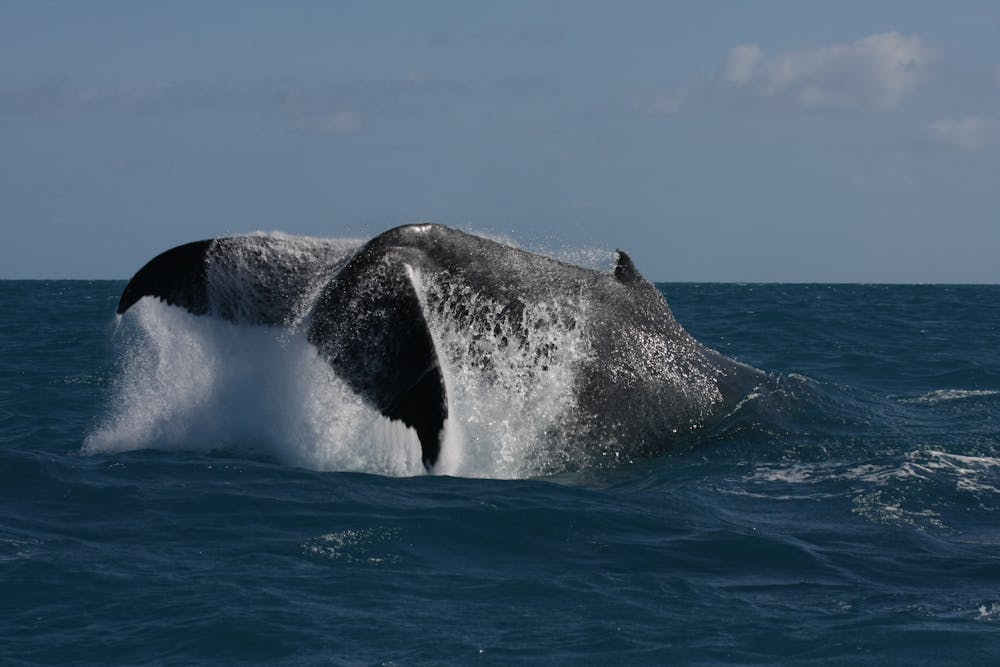 Adult humpback whales can grow up to 17 metres in length.
Cetacean Ecology Group/University of Queensland., Author provided
Adult humpback whales can grow up to 17 metres in length.
Cetacean Ecology Group/University of Queensland., Author provided
Read more: Humpback whales may have bounced back from near-extinction, but it's too soon to declare them safe


