

Solar power can cut living costs, but it's not an option for many people – they need better support
- Written by The Conversation
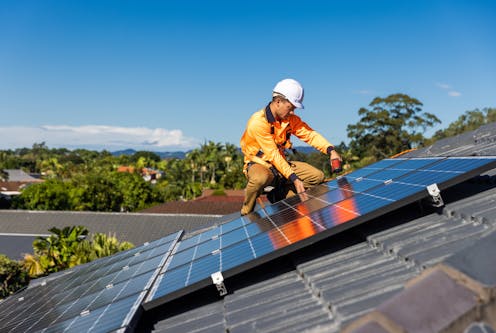
As the cost of living soars, many Australian households are turning to rooftop solar to cut their energy costs. A Pulse of the Nation survey last month showed about 29% of Australians have installed or are considering installing solar panels on their homes.
The same survey shows one in five Australians can’t afford to adequately heat or cool their homes. Many are also unable to install energy-saving options such as solar panels or insulation because of the upfront costs or because they are renters who cannot make changes to the dwelling. Among those who are financially stressed, earn less than A$50,000 or are between the ages of 18 and 34, a large majority do not intend to install energy-saving options, largely because they cannot afford them.
Renewable energy is not just critical for saving on energy bills, but also for mitigating climate change and fostering sustainable development. However, the reality is access to solar power is not equitable for all Australians. Our new research shows without better government support, many people will miss out on its benefits.
Read more: How to maximise savings from your home solar system and slash your power bills
What does equity in rooftop solar uptake look like?
Our research focuses on how to make access to rooftop solar more equitable.
It is important to distinguish between equity and equality. Equality means every household will be given the same resources or opportunities. For example, every household would receive the same subsidy to install solar panels.
Equity refers to fairness. The idea of equity recognises not all households start from the same place. Instead, adjustments to imbalances might be required.
In the context of solar adoption, equity would mean every Australian can benefit from solar power. Any subsidies or other support would be adjusted based on individual circumstances.
To better understand how it affects the adoption of solar panels, we looked at several aspects of inequity. These include financial situation, renting status, gender, education and ethnicity.
For our study, we collected 167 studies worldwide on household solar panel adoption to determine what we know about how it’s affected by these aspects of inequity.
Solar power equity has been neglected
Our findings show there is very limited in-depth data and research on this issue in Australia. Australian studies on residential solar uptake account for 20 (12%) of the 167 studies.
Research in Australia tends to focus on equity related to income. Of the 20 Australian studies, six find a positive link between income and solar panel adoption, four find a negative link, five show inconclusive results and five omit income altogether.
These mixed results can be explained, in part, by the fact that a range of factors impact whether a household can afford solar power. For example, a somewhat higher household income does not automatically mean that a household has less bill stress and enough accumulated wealth to afford the upfront cost of installing solar power.
Few studies offer a deeper analysis of variables such as education or ethnicity. For Australia, only five studies looked at education and only one at ethnicity. There is a lack of data on solar uptake among Aboriginal and Torres Strait Islander people.
This limited research does not allow for definite conclusions about how these variables impact rooftop solar uptake.
Energy-saving installations in investment properties have also received limited attention. Many Australian renters report their dwellings have extremely poor insulation. This leads to hot indoor temperatures in summer and cold conditions in winter.
Renters typically have limited ways to fix these problems. The only available options for many renters are air conditioning and portable heaters powered by traditional energy sources, which increases electricity bills.
What policies can improve solar equity?
Policies that could improve equity in rooftop solar access include:
direct financial support for low-income households that otherwise could not afford solar power
a variety of other financial incentives such as solar rebates
community solar programs that allow households to share the benefits.
Some programs are in place to help home owners on low incomes to install solar systems. For example, New South Wales has a “Solar for low-income households” program. Eligible individuals can get a free 3-kilowatt solar system in return for giving up the Low-Income Household Rebate for ten years. South Australia had a “Switch for Solar” trial, for which applications closed on August 31 2022.
However, to access these schemes Australians must first overcome one difficult hurdle: home ownership.
In addition, a focus on income alone can be problematic. Directing subsidies to low-income households alone misses households with low wealth that are above an income threshold.
The Australian government has promised new policy approaches. Its Powering Australia Plan pledged $102.2 million for community solar banks. These are community-owned projects to improve access for those currently locked out of solar power. Households can lease or buy a plot in these solar banks, instead of using their own rooftops.
The success of such projects will depend on whether they are accessible to and affordable for everyone.
More data collection is needed to identify priorities for policy action on energy equity. This can include a new Household Energy Consumption Survey (the Australian Bureau of Statistics conducted such a survey until a decade ago), broader analysis by researchers to consider equity dimensions, and collaboration between researchers and policymakers to trial new policies.


