

Tasmanian devil whiskers hold the key to protecting these super-scavengers
- Written by The Conversation
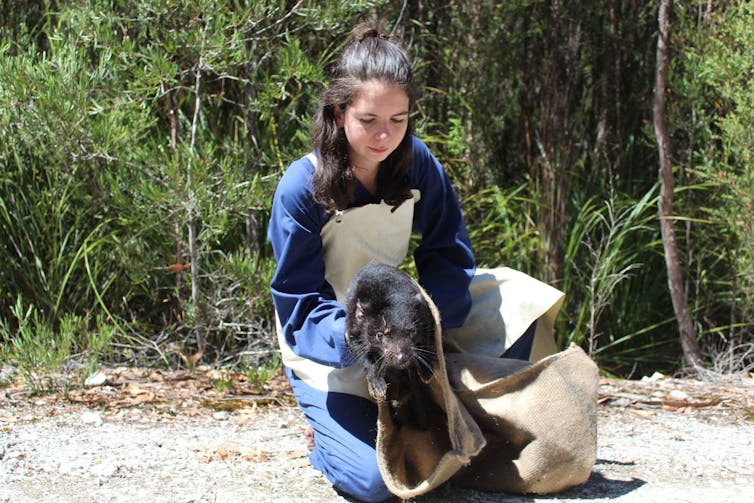
Despite the damage humans cause to the planet, in some cases wildlife can benefit from the presence of people. The Tasmanian devil, for example, frequently feeds on roadkill left by humans.
But our new research suggests this apparent benefit can come at a cost.
We compared the diets of Tasmanian devil populations living in three types of habitat, by examining their whiskers. We found in many cases, Tasmanian devils may be mostly eating foods inadvertently provided by humans. Accessing this food changed the behaviours of Tasmanian devils – and potentially put them in harm’s way.
Our findings are especially important given the risks to Tasmanian devils posed by an aggressive facial tumour disease. If we’re to protect this endangered species, we must conserve environments untouched by humans.
What are Tasmanian devils eating?
The Tasmanian devil is the biggest carnivorous marsupial in the world. It used to be found on mainland Australia but now wild populations are only found in Tasmania.
Tasmanian devils rarely hunt prey. But they’re highly effective scavengers, thanks to their sharp sense of smell, bone-crushing jaws and energy-efficient movement.
Animals that scavenge for food are “opportunistic feeders” – in other words, they eat whatever they happen to find. This usually means scavengers have a varied diet.
But our previous research found Tasmanian devils have remarkably restricted diets. To find out why, we examined Tasmanian devil whiskers. A single whisker can provide a window into the animal’s past.
We used a technique called “stable isotope analysis”, which enabled us to measure nitrogen and carbon incorporated into the devil’s whiskers as it grows. We matched the chemical composition of the whiskers with potential food items, to determine what the devil ate weeks or months ago. Then we looked at how this varied between individuals living in different habitats.
The technique has been used to describe the diets of early humans and extinct species. It’s also been used to study the migration patterns of wide-ranging birds and marine mammals.
And the results?
We found devil populations in highly disturbed landscapes, such as cleared farmland, fed on just one type of food - medium-sized mammals such as the Tasmanian pademelon.
This is perhaps unsurprising. Pademelons are very common in farming areas, and often end up as roadkill. So Tasmanian devils have little reason to scavenge for any other types of food.
We also examined the diets of devils in eucalypt forest which had been logged and regenerated. These animals also had relatively restricted diets. The result suggests these forests may not have had time to develop mature features such as tree hollows to shelter bird life, a process which can take up to 140 years.
However, the results were different for devil populations in old-growth rainforest habitats which have never been logged. There, devil diets were diverse. Larger devils tended to eat mammals such as Tasmanian pademelons and brushtail possums, and smaller devils consumed birds such as green rosellas.
These populations may offer insight into what devil foraging behaviour was like before European settlement.
Read more: Meet Moss, the detection dog helping Tassie devils find love
Saving wild landscapes
You might think reliable access to food inadvertently provided by humans would benefit Tasmanian devils. But in fact, it can come with hidden dangers.
The presence of roadkill poses risks to devils; they can be attracted to roads and become roadkill themselves. In 2021, more than 100 devils were reportedly killed by motorists on just one stretch of road in north-west Tasmania.
And if members of the same species are interacting around a smaller number of carcasses – or in the case of roadkill, the largest and most desirable carcasses – this could encourage the spread of devil facial tumour disease.
Over the past 25 years the disease – an aggressive, transmittable parasitic cancer is – has caused Tasmania’s devil population to fall by 68%. And this year the disease was detected for the first time in Tasmania’s north-west, from the same population as many devils in our study.
A vaccine distributed by edible baits is being developed. But in the meantime, a more diverse diet could reduce a devil’s risk of transmitting the disease to others, or catching it.
Only in old-growth rainforests did devils have a diverse diet that lived up to their reputation as opportunists. The results suggest conserving these wild landscapes is vital to protecting Tasmanian devils.


