News Daily


Men's Weekly

Australia

  • Written by The Conversation
Evolution not revolution: why GPT-4 is notable, but not groundbreaking

OpenAI, the artificial intelligence (AI) research company behind ChatGPT and the DALL-E 2 art generator, has unveiled the highly anticipated GPT-4 model. Excitingly, the company also made it immediately available to the public through a paid service.

GPT-4 is a large language model (LLM), a neural network trained on massive amounts of data to understand and generate text. It’s the successor to GPT-3.5, the model behind ChatGPT.

The GPT-4 model introduces a range of enhancements over its predecessors. These include more creativity, more advanced reasoning, stronger performance across multiple languages, the ability to accept visual input, and the capacity to handle significantly more text.

More powerful than the wildly popular ChatGPT, GPT-4 is bound to inspire an in-depth exploration of its capabilities and further accelerate the adoption of generative AI.

Improved capabilities

Among many results highlighted by OpenAI, what immediately stands out is GPT-4’s performance on a range of standardised tests. For example, GPT-4 scores among the top 10% in a simulated US bar exam, whereas GPT-3.5 scores in the bottom 10%.
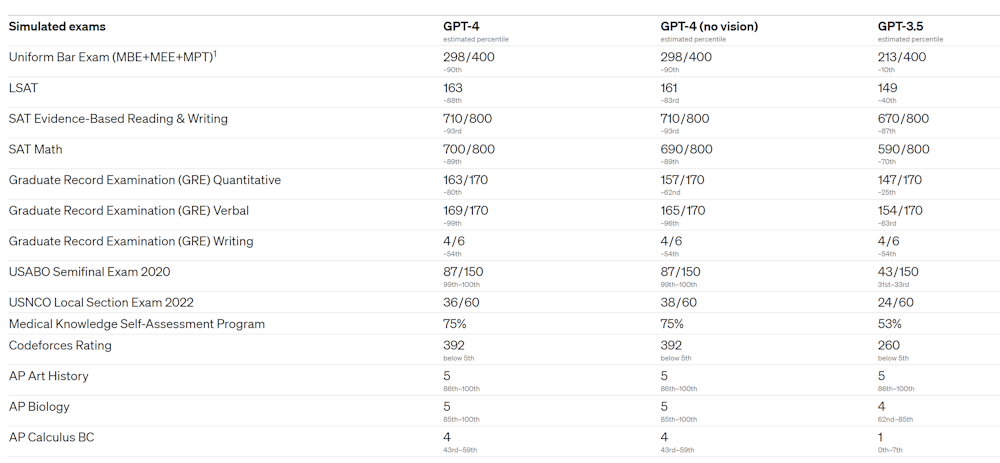
This table from the OpenAI technical report shows the performance of the model on a range of simulated standardised tests. GPT-4 often performs in the top 20% range. OpenAI

GPT-4 also outperforms GPT-3.5 on a range of writing, reasoning and coding tasks. The following examples illustrate how GPT-4 displays more reliable commonsense reasoning than GPT-3.5.

An AI model that sees the world Another significant development is that GPT-4 is multimodal, unlike previous GPT models. This means it accepts both text and image inputs. Samples provided by OpenAI reveal GPT-4 is capable of interpreting images, explaining visual humour and providing reasoning based on visual inputs. Such skills are beyond the scope of previous models. GPT-4 can explain the meaning behind funny memes. OpenAI This ability to “see” could provide GPT-4 a more comprehensive picture of how the world works – just as humans acquire enhanced knowledge through observation. This is thought to be an important ingredient for developing sophisticated AI that could bridge the gap between current models and human-level intelligence. In fact, GPT-4 isn’t the first language model with these capabilities. A few weeks ago, Microsoft released Kosmos-1, a language model that accepts visual inputs the same way GPT-4 does. Google also recently expanded its PaLM language model to be able to take in image data and sensor data collected from robots. Multimodality is a growing trend in AI research. Longer texts GPT-4 can take in and generate up to 25,000 words of text, which is much more than ChatGPT’s limit of about 3,000 words. It can handle more complex and detailed prompts, and generate more extensive pieces of writing. This allows for richer storytelling, more in-depth analysis, summaries of long pieces of text and deeper conversational interactions. In the example below, I gave the new ChatGPT (which uses GPT-4) the entire Wikipedia article about artificial intelligence and asked it a specific question, which it answered accurately. GPT-4 answers a question relating to a Wikipedia article on artificial intelligence. Author provided Limitations Even though the GPT-4 technical report controversially provides no details about how the model was developed, all signs indicate it’s essentially a scaled-up version of GPT-3.5 with safety improvements. In other words, it’s not a new paradigm in AI research. OpenAI has itself said GPT-4 is subject to the same limitations as previous language models, such as being prone to reasoning errors and biases, and making up false information. That said, OpenAI’s results on GPT-4 suggest it’s at least more reliable than previous GPT models. OpenAI used human feedback to fine-tune GPT-4 to produce more helpful and less problematic outputs. GPT-4 is much better at declining inappropriate requests and avoiding harmful content when compared to the initial ChatGPT release. Its arrival will continue a crucial debate among critics. That being whether alternative approaches are required to fundamentally solve issues of truthfulness and reliability, or whether throwing more data and resources at language models will eventually do the job. One could argue GPT-4 represents only an incremental improvement over its predecessors in many practical scenarios. Results showed human judges preferred GPT-4 outputs over the most advanced variant of GPT-3.5 only about 61% of the time. GPT-4 also shows no improvement over GPT-3.5 in some tests, including English language and art history exams. Bing AI Soon after GPT-4’s launch, Microsoft revealed its highly controversial Bing chatbot was running on GPT-4 all along. The announcement confirmed speculation by commentators who noticed it was more powerful than ChatGPT. This means Bing provides an alternative way to leverage GPT-4, since it’s a search engine rather than just a chatbot. Read more: Gaslighting, love bombing and narcissism: why is Microsoft's Bing AI so unhinged? However, as anyone looped in on AI news knows, Bing started to go a bit crazy. But I don’t think the new ChatGPT will follow since it seems to have been heavily fine-tuned using human feedback. In its technical report, OpenAI shows how GPT-4 can indeed go completely off the rails without this human feedback training. Commercial applications One notable aspect of GPT-4’s release has been that, in addition to Bing, it’s already being used by companies and organisations such as Duolingo, Khan Academy, Morgan Stanley, Stripe and the Icelandic government to build new services and tools. Its commercial deployment will further heat up competition between major AI labs, and fuel investors’ appetite for generative technologies.

Read more https://theconversation.com/evolution-not-revolution-why-gpt-4-is-notable-but-not-groundbreaking-201858

Top Electrical Safety Tips from Inner West Sydney Electricians

While it may not be the most exciting subject to discuss, having an electrically safe home is definitely one of the most critical. Knowing the basics could help you avoid accidents and ensure your home remains in good condition, whether... Read more

When to Escalate a Debt Recovery Matter to Legal Action

Knowing when to transition from informal debt collection efforts to formal legal proceedings is a decision that many creditors find difficult to navigate. Acting too early can damage commercial relationships, while waiting too long can reduce the likelihood of recovery... Read more

Why Slurry Hose Systems Are Essential for Handling Abrasive Industrial Materials

Transporting abrasive mixtures is a common challenge in industries such as mining, dredging, and construction. These mixtures, known as slurry, consist of solid particles suspended in water or other liquids. Moving slurry through pipelines requires specialised equipment that can withstand... Read more

Why Choosing the Right Dental Clinic Matters for Long Term Oral Health

Maintaining good oral health requires regular checkups, preventive care, and professional treatment when needed. Visiting a trusted Dental Clinic plays a vital role in keeping teeth and gums healthy while preventing more serious dental problems in the future. Many people only... Read more

Is Deep Plane Facelift Safe in Thailand?

When you ask whether a deep plane facelift is safe in Thailand, you’re really asking: “Can I get high-quality surgical care with strong safety standards and reliable follow-up while I’m traveling?” That’s a smart question. But the country name alone... Read more

Why Cloud Services Are Now Essential for Business Growth and Security

In today’s fast-moving digital environment, understanding how cloud services support long-term stability has become a priority for businesses across Australia. As expectations shift and workplaces adopt more flexible models, organisations are turning to cloud services to keep systems running smoothly... Read more