

Australia's 116 new coal, oil and gas projects equate to 215 new coal power stations
- Written by The Conversation
Australia has 116 new coal, oil and gas projects in the pipeline. If they all proceed as planned, an extra 1.4 billion tonnes of greenhouse gases would be released into the atmosphere annually by 2030.
To put that in perspective, Australia’s total domestic greenhouse gas emissions in 2021–22 were 490 million tonnes. So annual emissions from these new projects would be the almost three times larger than the nation’s 2021-22 emissions. That’s the equivalent of starting up 215 new coal power stations, based on the average emissions of Australia’s current existing coal power stations.
The reason we can get away with this is the current global framework for emissions accounting only considers emissions generated onshore. And almost all coal, oil and gas from these new projects would be exported. But as we share the atmosphere with the rest of the people on the planet, the consequences will come back to bite us.
This week the Synthesis Report from the Intergovernmental Panel on Climate Change (IPCC) described how fossil fuels are wreaking havoc on the planet. The science is clear: the IPCC says fossil fuel use is overwhelmingly driving global warming.
“The sooner emissions are reduced this decade, the greater our chance of limiting warming to 1.5℃ or 2℃. Projected CO₂ emissions from existing fossil fuel infrastructure (power plants, mines, pipelines) without additional abatement exceed the remaining carbon budget for 1.5℃,” the IPCC says, let alone new coal, oil and gas projects.
In the words of UN Secretary General António Guterres:
Every country must be part of the solution. Demanding others move first only ensures humanity comes last.
Guterres added that “the Acceleration Agenda calls for a number of other actions”, specifically:
No new coal and the phasing out of coal by 2030 in OECD countries and 2040 in all other countries
Ending all international public and private funding of coal
Ensuring net zero electricity generation by 2035 for all developed countries and 2040 for the rest of the world
Ceasing all licensing or funding of new oil and gas – consistent with the findings of the International Energy Agency
Stopping any expansion of existing oil and gas reserves
Shifting subsidies from fossil fuels to a just energy transition
Establishing a global phase down of existing oil and gas production compatible with the 2050 global net zero target.
Hidden in plain sight
Our new research, released today by the Australia Institute, reveals the pollution from Australia’s 116 new fossil fuel projects. These are listed among the federal government’s major projects.
Government analysts estimate each project’s start date and annual production figures. If they are correct, by 2030 the projects would produce a total of 1,466 million tonnes of coal and 15,400 petajoules of gas and oil.
Then it’s fairly straightforward to calculate emissions. We simply multiplied these enormous new fossil fuel volumes by their “emissions factors”. When one tonne of coal is burned it releases approximately 2.65 tonnes of carbon dioxide or its equivalent (CO₂-e) into the atmosphere, and burning one terajoule (0.001 petejoules) of natural gas results in 51.5 tonnes CO₂-e.
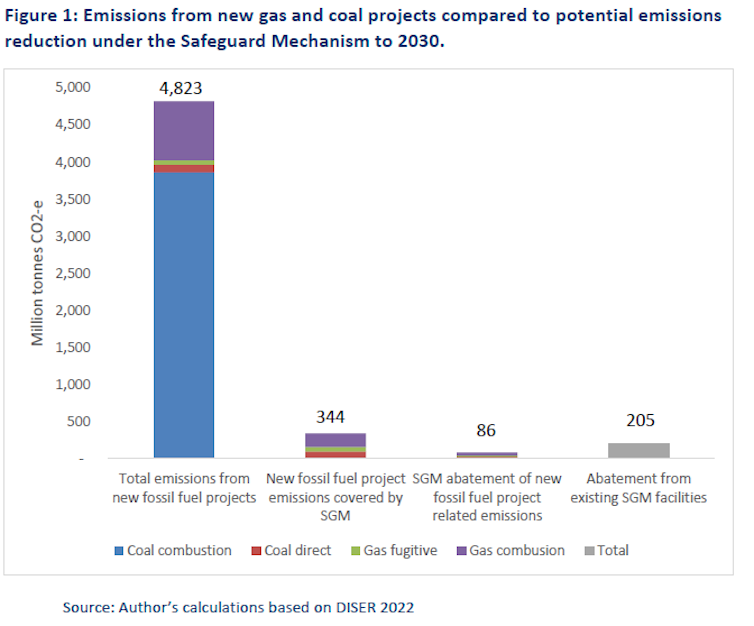
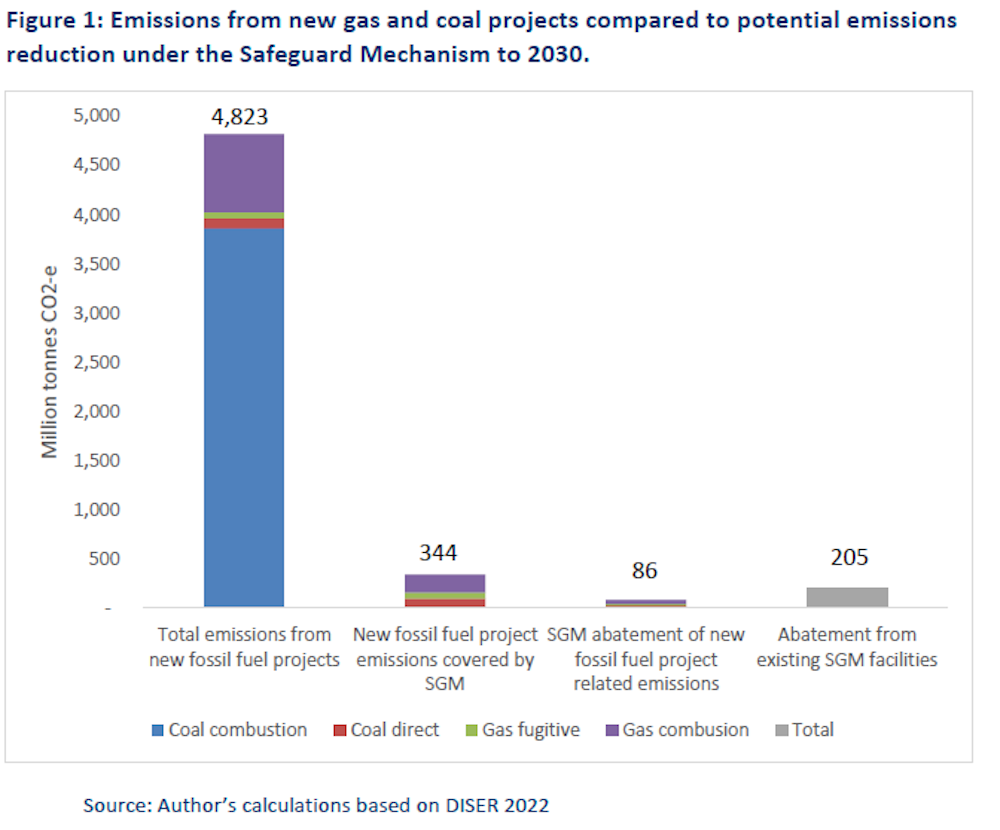
Combined with the 164 million tonnes of emissions that the mining of these fuels would cause, the result is a planet-warming, but spine-chilling, total of 4.8 billion tonnes by 2030.
This amount is 24 times greater than the ambition of the federal government’s key emissions reduction policy, the so-called Safeguard Mechanism. That aims to reduce emissions by 205 million tonnes over the same period.
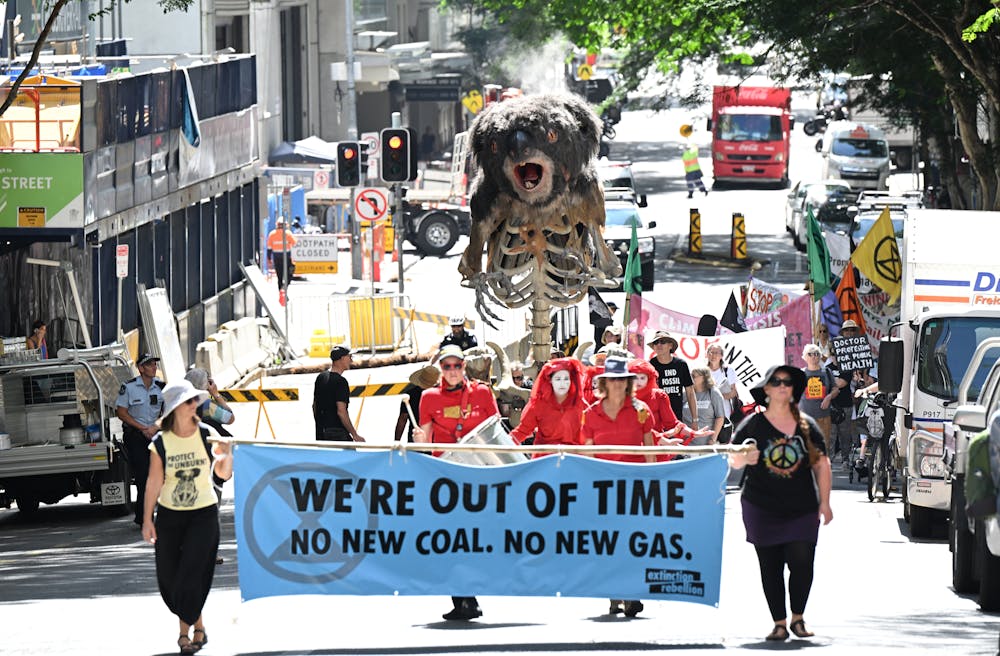 No matter where in the world Australian fossil fuels are burned, the emissions will harm our nation’s wildlife (including endangered koalas), people and properties.
DARREN ENGLAND/AAP
But if Bowen really wants to tackle climate change, there are three reasons both he and Australians should bear this responsibility:
First, there’s the moral argument. Australia didn’t ban whaling and asbestos mining because we wanted to stop Australians from eating whales or building hazardous homes. We stopped these activities because they were dangerous. Countries can and do shape the world they live in.
Second, even just the emissions in Australia from these 116 new fossil fuel projects (their methane leaks, fuel use and other relevant emissions in Australia) will pour 344 million tonnes of greenhouse gas emissions into the atmosphere by 2030. That dwarfs the 205 million tonnes of emissions the entire Safeguard Mechanism is supposed to save over that same period.
And finally, leaving aside the risks of catastrophic climate change, which is admittedly a big ask, it is hard to overstate the risks to the Australian economy of continuing to focus our investment on the expansion of export industries that the rest of the world is committed to transitioning away from. If we aimed the $11 billion per year we spend on fossil fuel subsidies at decarbonising our economy, we would slash emissions in no time.
No matter where in the world Australian fossil fuels are burned, the emissions will harm our nation’s wildlife (including endangered koalas), people and properties.
DARREN ENGLAND/AAP
But if Bowen really wants to tackle climate change, there are three reasons both he and Australians should bear this responsibility:
First, there’s the moral argument. Australia didn’t ban whaling and asbestos mining because we wanted to stop Australians from eating whales or building hazardous homes. We stopped these activities because they were dangerous. Countries can and do shape the world they live in.
Second, even just the emissions in Australia from these 116 new fossil fuel projects (their methane leaks, fuel use and other relevant emissions in Australia) will pour 344 million tonnes of greenhouse gas emissions into the atmosphere by 2030. That dwarfs the 205 million tonnes of emissions the entire Safeguard Mechanism is supposed to save over that same period.
And finally, leaving aside the risks of catastrophic climate change, which is admittedly a big ask, it is hard to overstate the risks to the Australian economy of continuing to focus our investment on the expansion of export industries that the rest of the world is committed to transitioning away from. If we aimed the $11 billion per year we spend on fossil fuel subsidies at decarbonising our economy, we would slash emissions in no time.


