

Measles has been identified in NSW, Qld and SA. 5 things to know about the virus
- Written by The Conversation
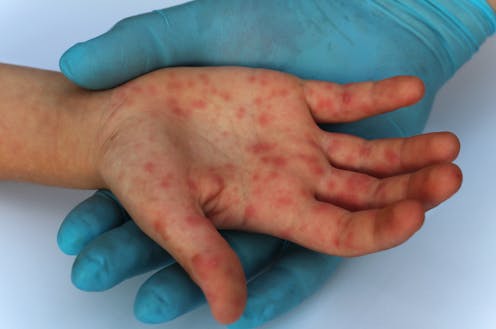
New South Wales health authorities have issued a measles alert after a baby who recently returned from overseas, and subsequently visited several sites in Western Sydney, tested positive to the virus.
This follows two cases of measles in a family on Queensland’s Sunshine Coast who returned from overseas on March 13, and a case in South Australia which was also acquired overseas.
Measles is an extremely contagious disease but, thanks to immunisation, is now rare in Australia. Here are five things you need to know about the virus – and why it’s important to get vaccinated.
1. Measles can cause severe illness and death
Measles is a viral infection that can cause a variety of complications, including encephalitis, or inflammation of the brain.
Before the development of effective vaccines, children’s author Roald Dahl gave a harrowing account of the death of his daughter Olivia from measles encephalitis.
A feared complication is a type of progressive encephalitis that can occur many years after infection called subacute sclerosing encephalitis.
Read more: How Roald Dahl became a passionate vaccine advocate
Deaths from measles are much more common in developing countries, where up to one in six infants with measles die from the infection. However, deaths are still reported in Australia.
Although deaths due to measles globally have fallen sharply since 2000, in 2018 the World Health Organization estimated there were more than 140,000 deaths due to measles, mostly in children aged under five.
Measles can also have indirect impacts on the immune system, with children being more susceptible to other bacterial and viral infections following measles.
2. Measles is highly infectious
Measles can spread quickly though susceptible populations. In unvaccinated people, a single case can result in more than 12 to 18 secondary cases.
After exposure, around nine out of ten people who are not protected by vaccination or past infection will become infected.
A person with measles is infectious even before symptoms develop – from four days before the appearance of a rash to four days after.
The measles virus remains infectious in air or on surfaces for up to two hours. This means transmission can occur in a hospital waiting room even after the person with measles has left.
3. The measles vaccine is very effective (though not perfect)
The measles vaccine has been estimated to have averted more than 23 million deaths between 2000 and 2018.
At a cost of less than US$2 per dose, it is thought to be one of the most cost-effective health interventions available.
It is highly effective. An Australian study estimated one dose of vaccine reduced the risk of measles by 96.7%, and two doses by 99.7%.
However, there are some limitations. The vaccine is less effective if given under the age of 12 months due to the baby’s immature immune system. (In outbreak situations, or when an infant is travelling to a country where measles is common, it is sometimes given from six months of age).
Another limitation is the measles vaccine is “live” (meaning it contains a very small amount of live – but weakened – virus), so pregnant women and some people with weakened immune systems cannot receive it.
In Australia, anyone born during or after 1966 should check they have had two doses of measles-containing vaccine, and if not, see their doctor to discuss vaccination.
Read more: 5 virus families that could cause the next pandemic, according to the experts
4. Vaccinating children can also protect those who aren’t vaccinated
“Herd immunity” occurs where high vaccination coverage stops a disease from spreading far in a population.
Because measles is so infectious, the vaccination threshold for herd immunity is high, and is the rationale for Australia’s target to vaccinate 95% of children against measles and other vaccine-preventable diseases.
Encouragingly, in 2022, 93% of two-year-old Australian children had received their first dose of the measles-mumps-rubella vaccine.
This high vaccination rate led to Australia being declared free from measles in 2014, reflecting an absence of ongoing local transmission of measles.
Maintaining Australia’s measles elimination status requires ongoing high vaccination rates, an effective surveillance system to detect imported and locally acquired cases, and a rapid public health response to cases.
The World Health Organization can withdraw the measles elimination status of a country or region if local transmission is re-established, as happened to the United Kingdom in 2019.
However, even where herd immunity is not achieved, high vaccine coverage tends to increase the average age that unvaccinated children get infected. This is important, as the chance of a baby being exposed to measles virus before they have an opportunity to be vaccinated is reduced.
5. COVID led to a resurgence of infection in many countries
The COVID pandemic has disrupted many health services, including immunisation programs. This has disproportionately affected countries where systems were under strain prior to the pandemic. One systematic review identified several countries where the number of vaccines given fell by more than 50%.
Before the COVID pandemic, global coverage of measles-containing vaccines was increasing. The proportion of children who received one dose of measles vaccine by their first birthday went from 72% in 2000 to 86% in 2018.
While these previous gains in coverage have provided some ongoing protection, as the number of unvaccinated younger children accumulate globally, the risk of measles outbreaks increases.
Many countries are now reporting outbreaks, including India, Yemen, Somalia, Ethiopia, Indonesia, Zimbabwe and Pakistan.
Read more: Measles: global increase in cases likely driven by COVID pandemic
In theory, measles could be a candidate for eradication, like was achieved for smallpox in the 1970s.
In addition to the benefits of eliminating deaths from measles, there is a compelling economic argument to eradicate measles, as vaccination would no longer be required. However, this goal seems to be slipping out of reach, and the longer we leave it the harder it will be.
Rob Hall, former senior lecturer of public health at Monash University, co-authored this article. Rob previously received research funding from the World Health Organization. He was previously a member of the Technical Advisory Group on Immunization and Vaccine-Preventable Diseases for the Western Pacific Region of the World Health Organization.


