

How milk tamed the Third Pole: research reveals a 3,500-year history of dairy consumption on the Tibetan Plateau
- Written by The Conversation
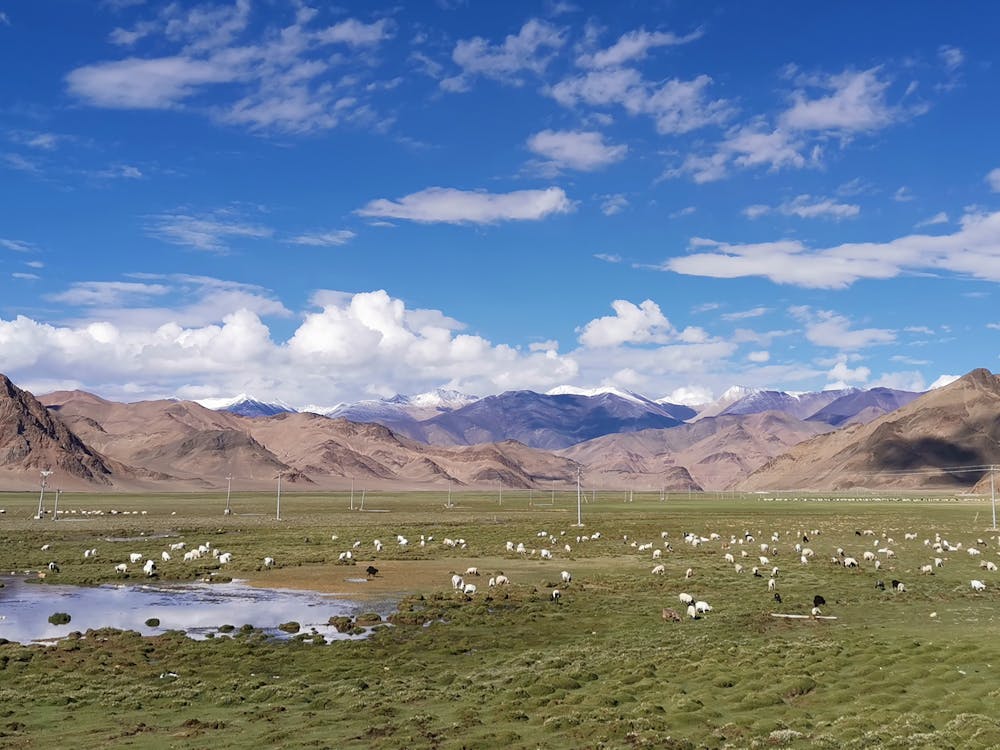
It’s not called the Third Pole for nothing. The Tibetan Plateau forms the major portion of a vast upland area of ice and glaciers that covers some 100,000 square kilometres of Earth’s surface.
It is a cold, arid and unforgiving landscape that couldn’t be more different from the warm plains and valleys that gave rise to our species.
Yet, for thousands of years the Tibetan Plateau has been occupied by Homo sapiens. It has seen the establishment of agricultural societies, and the growth of religions, kingdoms and even empire.
How humans managed not just to subsist but to thrive in this high-altitude landscape is a question that has challenged researchers for decades – and one that has captivated us too.
We know part of the answer lies in Tibetan genes, and a unique adaptation that enables people living in the region to use oxygen more efficiently, avoiding the potentially lethal effects of hypoxia (the condition that arises from a lack of oxygen).
But just as important as avoiding hypoxia was finding enough food in the plateau’s unpredictable, freezing and hyper-arid environment.
Our research, published today in Science Advances, set out to look more closely at early Tibetan diets. To do this, we examined ancient dental plaque, a rich source of dietary information.
Our results show one food in particular may have been crucial to sustained human occupation and expansion across the Tibetan Plateau: milk.
The benefits of not brushing
Without dentists, ancient people often accumulated thick layers of plaque – also known as calculus – on their teeth. Using a new method called palaeoproteomics, scientists can investigate the food proteins that became trapped and preserved in ancient people’s dental plaque.
Palaeoproteomics allows us to look at types of food, such as milk, that aren’t visible through traditional archaeological approaches, and to identify specific individuals who were consuming them.
Our study analysed all available human skeletal remains on the plateau: a total of 40 individuals, dating to between 3500 and 1200 years ago, from 15 widely dispersed sites.
 One of the individuals we studied was a woman, aged 40-55, buried at the Ounie site. Hers were the highest altitude (4654 masl) remains studied, dated to around 601-758 CE.
Li
Tang and Zujun Chen, Author provided
One of the individuals we studied was a woman, aged 40-55, buried at the Ounie site. Hers were the highest altitude (4654 masl) remains studied, dated to around 601-758 CE.
Li
Tang and Zujun Chen, Author provided
Our work yielded fascinating results. Preserved in the teeth of many of these people were fragments of proteins derived from milk products. The protein sequences showed the milk originated from domestic herd animals: sheep, goat and probably yak.
We could see dairy foods were consumed by a wide swathe of Tibetan Plateau society, including adults and children, elites and everyday people. Dairy was even present in the earliest Tibetan Plateau skeletons we looked at.
In fact, we found dairy was being consumed as far back as 3,500 years ago – pushing evidence for dairying on the plateau back 2,000 years earlier than records in historical sources, such as the 8th- and 9th-century Tongdian encyclopedia.
Evidence for dairying now corresponds with the earliest evidence for domesticated herd animals on the Tibetan Plateau, which suggests dairying and pastoralism spread together in this region.
Pushing beyond the cultivation boundary
Our results showed another interesting pattern: all the milk peptides we identified came from ancient individuals in the highest altitude parts of the plateau. These were the most inhospitable areas, where growing crops was difficult.
In the southern-central and southeastern valleys, where farmable land was available, we did not recover any dairy proteins from people’s calculus.
Dairy, it seems, was vital to human occupation of the parts of the plateau that lay beyond the reach of even frost-tolerant crops. This is a vast area, as less than 1% of the Tibetan Plateau supports crop cultivation.
In the lower-lying areas, long-term habitation has been sustained by cultivating plant foods. But across most of the plateau, the primary mode of subsistence has been pastoralism.
Dairy-free? Not an option
While dairy would eventually become central to Tibetan cuisine and culture, our results suggest it was initially adopted out of necessity. It allowed people in the Tibetan Plateau’s most extreme environments to turn the energy locked inside alpine meadow grasses into a protein-rich, nutritional food that was endlessly renewable – because animals weren’t killed to acquire it.
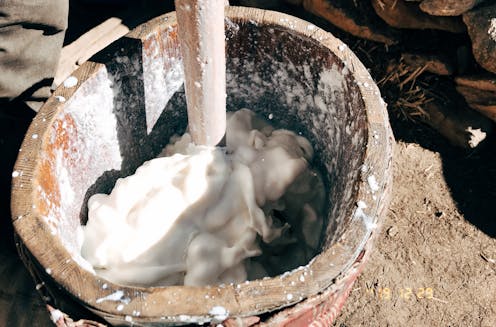
 Today, dairy is an important part of modern Tibetan food and culture.
Li Tang, Author provided
Today, dairy is an important part of modern Tibetan food and culture.
Li Tang, Author provided
Dairying opened up the Tibetan Plateau to the spread and sustained growth of human populations, which ultimately enabled the emergence of substantial cultural complexity.
In one of Earth’s most inhospitable environments, then, it would appear dairy-free was not an option.
Future work on the plateau will be vital to understanding how the human adoption of pastoralism and dairying reshaped Tibet’s landscapes. And just as critically, it will shed light on what human-induced climate change means for the future of the ecosystems present-day herders rely on.
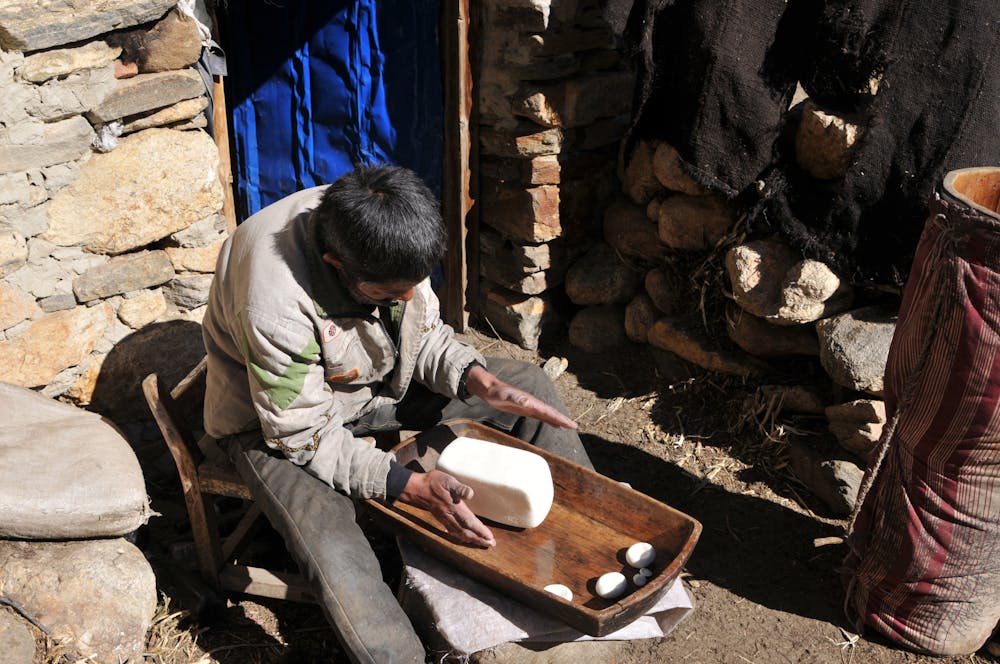
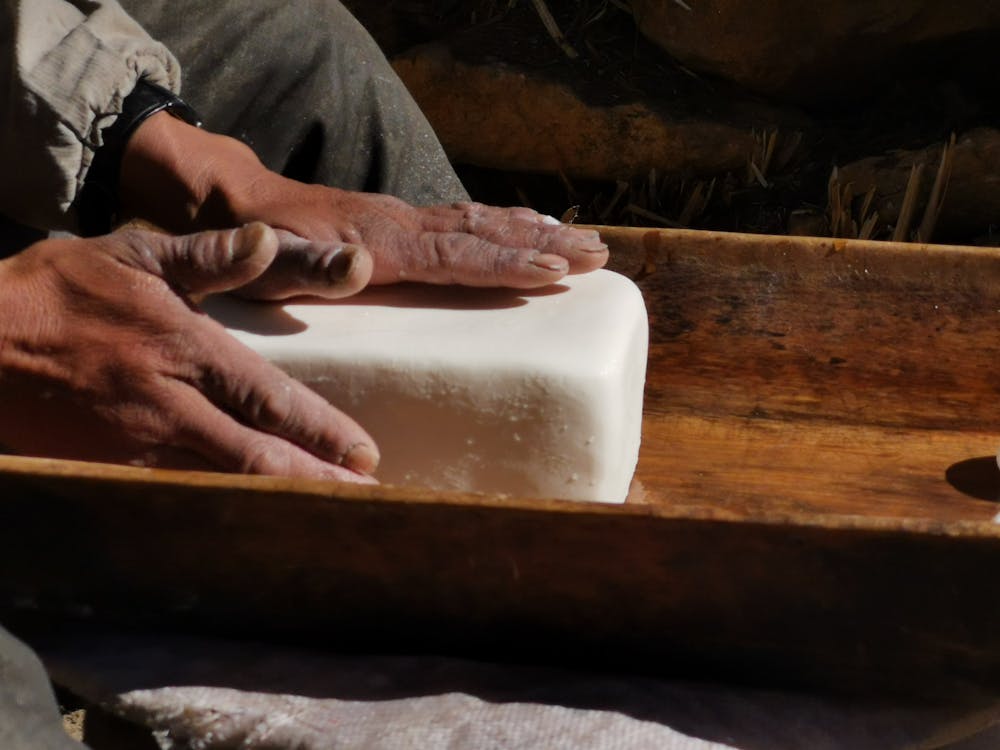 Modern Tibetan pastoralists make butter from yak milk.
Li Tang, Author provided
Modern Tibetan pastoralists make butter from yak milk.
Li Tang, Author provided


