

New look at 'Einstein rings' around distant galaxies just got us closer to solving the dark matter debate
- Written by The Conversation
Physicists believe most of the matter in the universe is made up of an invisible substance that we only know about by its indirect effects on the stars and galaxies we can see.
We’re not crazy! Without this “dark matter”, the universe as we see it would make no sense.
But the nature of dark matter is a longstanding puzzle. However, a new study by Alfred Amruth at the University of Hong Kong and colleagues, published in Nature Astronomy, uses the gravitational bending of light to bring us a step closer to understanding.
Invisible but omnipresent
The reason we think dark matter exists is that we can see the effects of its gravity in the behaviour of galaxies. Specifically, dark matter seems to make up about 85% of the universe’s mass, and most of the distant galaxies we can see appear to be surrounded by a halo of the mystery substance.
But it’s called dark matter because it doesn’t give off light, or absorb or reflect it, which makes it incredibly difficult to detect.
So what is this stuff? We think it must be some kind of unknown fundamental particle, but beyond that we’re not sure. All attempts to detect dark matter particles in laboratory experiments so far have failed, and physicists have been debating its nature for decades.
Read more: Why do astronomers believe in dark matter?
Scientists have proposed two leading hypothetical candidates for dark matter: relatively heavy characters called weakly interacting massive particles (or WIMPs), and extremely lightweight particles called axions. In theory, WIMPs would behave like discrete particles, while axions would behave a lot more like waves due to quantum interference.
It has been difficult to distinguish between these two possibilities – but now light bent around distant galaxies has offered a clue.
Gravitational lensing and Einstein rings
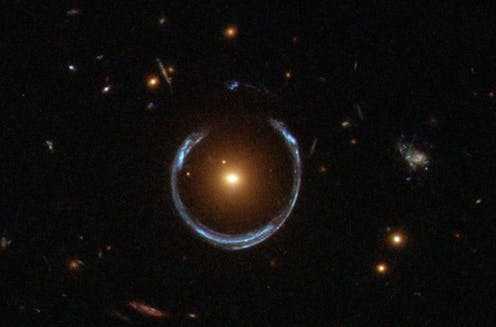
When light travelling through the universe passes a massive object like a galaxy, its path is bent because – according to Albert Einstein’s theory of general relativity – the gravity of the massive object distorts space and time around itself.
As a result, sometimes when we look at a distant galaxy we can see distorted images of other galaxies behind it. And if things line up perfectly, the light from the background galaxy will be smeared out into a circle around the closer galaxy.
This distortion of light is called “gravitational lensing”, and the circles it can create are called “Einstein rings”.
By studying how the rings or other lensed images are distorted, astronomers can learn about the properties of the dark matter halo surrounding the closer galaxy.
Axions vs WIMPs
And that’s exactly what Amruth and his team have done in their new study. They looked at several systems where multiple copies of the same background object were visible around the foreground lensing galaxy, with a special focus on one called HS 0810+2554.
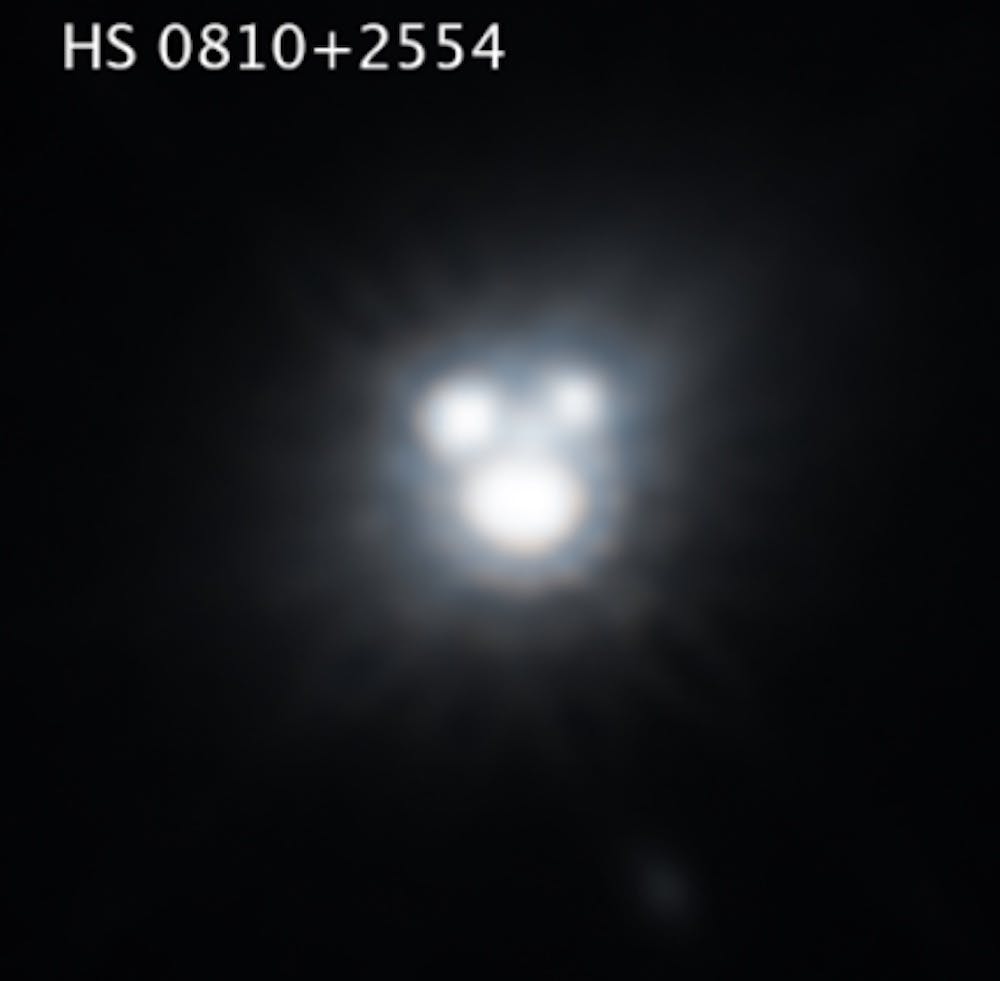
Using detailed modelling, they worked out how the images would be distorted if dark matter were made of WIMPs vs how they would if dark matter were made of axions. The WIMP model didn’t look much like the real thing, but the axion model accurately reproduced all features of the system.
The result suggests axions are a more probable candidate for dark matter, and their ability to explain lensing anomalies and other astrophysical observations has scientists buzzing with excitement.
Particles and galaxies
The new research builds on previous studies that have also pointed towards axions as the more likely form of dark matter. For example, one study looked at the effects of axion dark matter on the cosmic microwave background, while another examined the behaviour of dark matter in dwarf galaxies.
Although this research won’t yet end the scientific debate over the nature of dark matter, it does open new avenues for testing and experiment. For example, future gravitational lensing observations could be used to probe the wave-like nature of axions and potentially measure their mass.
A better understanding of dark matter will have implications for what we know about particle physics and the early universe. It could also help us to understand better how galaxies form and change over time.


