

Much wow, very meme: what the revival of the ancient doge meme tells us about the lifecycle of the internet
- Written by The Conversation
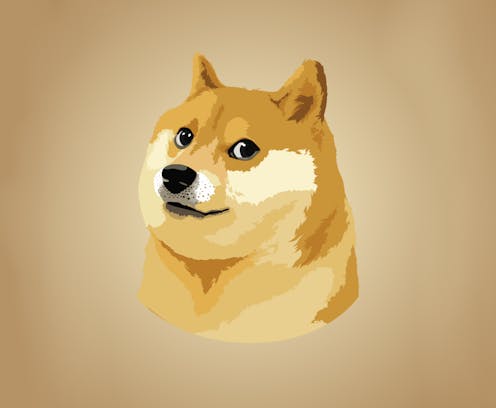
In early April, when Elon Musk randomly and very briefly replaced the Twitter bird logo with the face of the “doge” meme, the value of the dogecoin both rose and fell by a matter of billions of dollars in value on the cryptomarket.
Internet users revelled in the idea that a simple doge meme could impact the real world in such a dramatic way. This relative absurdity is also coupled with the fact that dogecoin itself was started in 2013 as a “joke coin”, but is now the seventh biggest cryptocurrency in the world.
The fact that a meme, based on a “peculiar” but largely unremarkable rescue dog, could rule over the fate of billions of dollars worth of market value speaks to the totally remarkable nature of the strange phenomenon of Internet memes.
At one time in our internet’s history, memes were perhaps regarded as mere playful and inconsequential byproducts of online culture. However, now, it is clear that memes have very real impacts on our world. Things that leave impacts also leave history.
So not only do memes play a clear role in public discourse, but we are now appreciating that the family tree of memes holds memory. Memes are simultaneously a fascinating historical record of digital culture as well as the detritus of the cyber age.
What’s a doge?
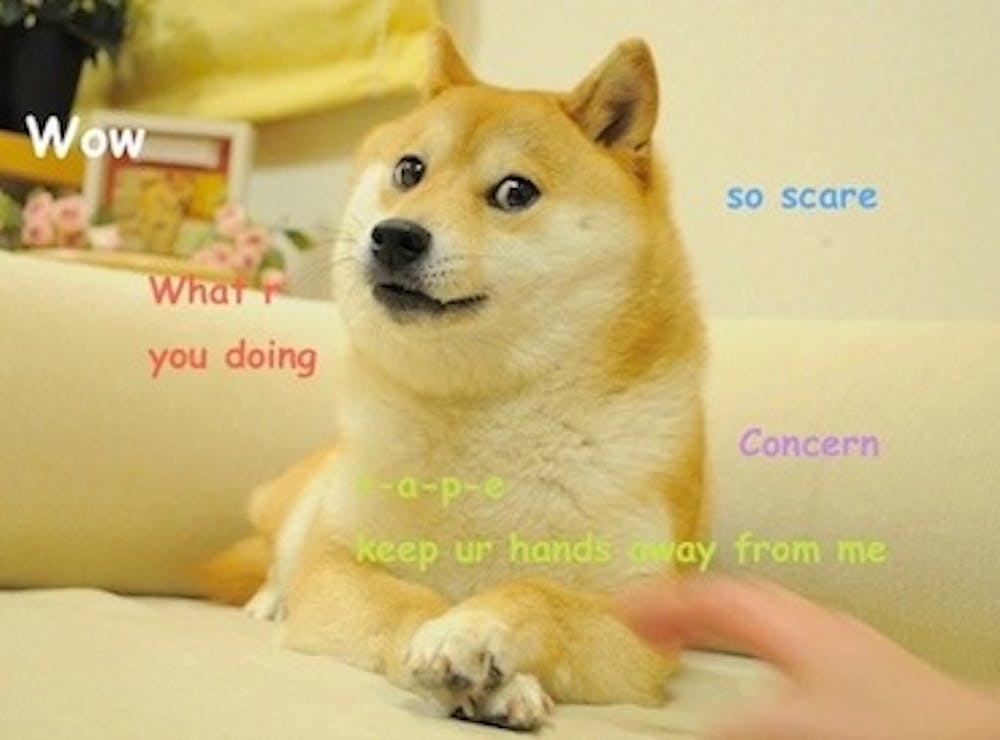
Originally, a random internet user posted a photograph of their shiba inu dog on their blog, after which another user saw the image and posted it to the Reddit platform. This is where the image was first paired with the word “doge” (and the word doge has its own separate history).
Some memes come and go, ending as cyber-waste in the internet graveyard – these are the cringe memes like Minions or Bad Luck Brian that haunt early Facebook timelines.
Other memes have the capacity to hold so much meaning that they have impressive longevity and traverse endless iterations, mutations and politics. The reasons for this are many and varied, but my research shows that in the case of doge, as in the case of Pepe the Frog, the anthropomorphic nature of the icon is part of the longevity and adaptability.
We laugh at animals because they remind us of the foibles of human nature. They are easy to laugh at because they are not us, but they are enough like us that we can project our weaknesses and vulnerability on them – and laugh about them.
What is a meme?
I say, of course, internet memes because the term “meme” actually existed prior to the home-based use of the internet.
In a research project by James Hall and myself, we explain that even though there is some contestation about the first uses of the term, as well as its usefulness in theoretical application, it is generally conceded that Richard Dawkins coined the term in the iconic book The Selfish Gene published in 1976.
We need a name for the new replicator, a noun that conveys the idea of a unit of cultural transmission, or a unit of imitation . ‘Mimeme’ comes from a suitable Greek root, but I want a monosyllable that sounds a bit like ‘gene’. I hope my classicist friends will forgive me if I abbreviate mimeme to meme.
At the time of writing, of course, Dawkins was not referring to the classic image macros usually thought of as memes. He was referring to other cultural units, such as: “…tunes, ideas, catchphrases, clothes fashions, ways of making pots or of building arches”.
Dawkins felt that:
Just as genes propagate themselves in the gene pool by leaping from body to body via sperms or eggs, so memes propagate themselves in the meme pool by leaping from brain to brain via a process which, in the broad sense, can be called imitation.
As many concepts do, the term finally leeched out of the academic realm and into the popular vernacular.
What’s in a meme?
So, what is it about memes that is so impactful?
The answer lies in understanding one of the most basic human drives: to communicate. The desire to reach out beyond the self. To be heard and, if we’re lucky, understood.
Tens of thousands of years ago, prehistoric humans painted on cave walls to communicate what was important to them. In 2023, we scrawl memes across the internet. These two practices are, essentially, the same thing.
Media theorist Mark Deuze has made this point before:
It’s like cave paintings; what are we painting on the wall – stories about who we are, where do we belong and what really matters to the community that we think we are a part of – that’s the definition of every status update […] it used to be that only a privileged few could paint the walls of the cave; now we’re all doing it.
Just as we use cave paintings today in order to reflect on the very origins of the human condition, in time, we will use the archive of memes as a tree of knowledge to appreciate the complex web of communication we are building for ourselves on the grand project of the internet. They will help to archive the very earliest incarnations of how humans felt about communicating on digital platforms.
For those of us who grew up before the internet, it is almost bizarre to think that not only are memes a legitimate genre that holds masses of cultural information, but they also have history, even memory.
They may not be high art and they may be totally organic and spontaneous, but perhaps that is why we feel they are so authentic. They document – in fantastically messy and complex ways – how cultural material moves around, grows, dies and, in the case of doge, becomes born again.


