

Even after his death, Rolf Harris' artwork will stand as reminders of his criminal acts
- Written by The Conversation
Australian entertainer and artist Rolf Harris has died at the age of 93.
After a prominent career as an artist, particularly in the UK, in 2014 Harris was convicted of 12 counts of indecent assault.
For his victims, his death might help to close a painful chapter of their lives.
However, what will become of the prodigious output of the disgraced artist?
Jack of all trades, master of none
Harris developed an interest in art from a young age. At the age of 15, one of his portraits was selected for showing in the 1946 Archibald Prize. Three years later, he won the Claude Hotchin prize.
These would be among the few accolades he would collect in the art world. In truth, he was never really recognised by his peers.
The Art Gallery of Western Australia in Perth, from where he hailed, never added any of his artworks to its collection.
Harris rose to prominence primarily as a children’s entertainer and then later as an all-round television presenter. There is a generation of Australians and Britons who grew up transfixed to their TV sets as Harris transformed blank canvases into paintings and cartoons in the space of just 30 minutes.
His creativity also extended to music. He played the didgeridoo and his own musical creation, “the wobble board”. He topped the British charts in 1969 with the single Two Little Boys. However, he is probably more famous for the song Tie Me Kangaroo Down, Sport.
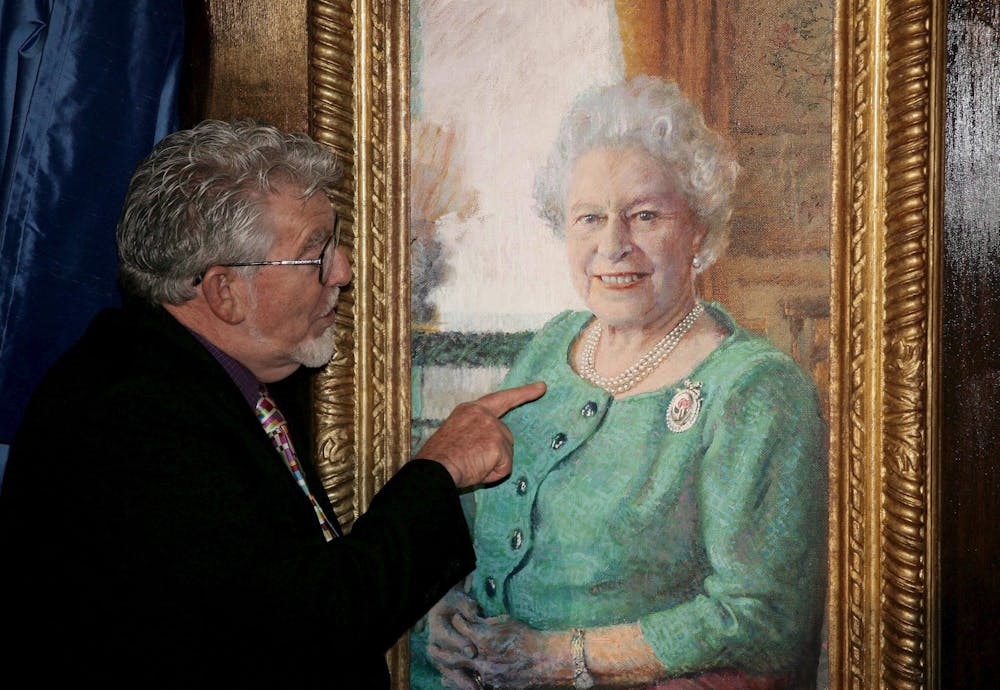
Perhaps the ultimate recognition came in 2005, when he was invited to paint Queen Elizabeth II. His audience with the queen was filmed for a BBC documentary starring Harris. His portrait of her majesty briefly adorned the walls of Buckingham Palace, before being displayed in prominent British and Australian galleries.
Read more: Dealing with the happy memories of a disgraced Rolf Harris
Criminal conviction and the quick retreat from his art
In 2014, Harris was found guilty of 12 counts of indecent assault against three complainants, aged 15, 16 and 19 years at the times of the crimes. These incidents occurred between 1978 and 1986.
Before sentencing Harris to five years and nine months imprisonment, the sentencing judge commented:
You took advantage of the trust placed in you, because of your celebrity status, to commit the offences […] Your reputation now lies in ruins.
What followed was a public retreat from his artwork.
It is worth asking why this was the public response, when the subject matter of his artwork was innocuous and unremarkable. Among his visual artworks were portraits and landscapes. None of them depicted anything particularly offensive or controversial.
Nevertheless, many of those who owned his works felt the need to dissociate themselves with Harris. His portrait of the queen seemed to vanish into thin air. In the wake of his convictions, no one claimed to know of its whereabouts.
Harris had also painted a number of permanent murals in Australia. Many these were removed or permanently obscured.
Read more: Rolf Harris guilty: but what has Operation Yewtree really taught us about sexual abuse?
The roles of guilt and disgust
Guilt seems to play a prominent role in explaining why owners remove such artworks from display.
Art is inherently subjective and so it necessarily forces the beholder to inquire into the artist’s meanings. When an artist is subsequently convicted of a crime, it is perhaps natural to wonder whether their art bore signs that there was something untoward about them.
Some artists even promote this way of thinking. In fact, Harris authored a book entitled Looking at Pictures with Rolf Harris: A Children’s Introduction to Famous Paintings.
In it, he wrote:
You can find out a lot about the way an artist sees things when you look at his paintings. In fact, he is telling us a lot about himself, whether he wants to or not.
When facing the artwork of a convicted criminal, our subjective feelings of guilt persist because we have, in some tiny way, shared a role in their rise and stay as an artist. This makes it difficult to overcome the feeling that the artwork contains clues to the artist’s criminality. We can also feel guilty deriving pleasure from a piece of art whose maker caused others great pain.
Disgust also plays a central role in our retreat from the criminal’s artwork.
Disgust is a powerful emotion that demands we withdraw from an object whose mere presence threatens to infect or invade our bodily integrity.
Related to disgust is a anthropological theory known as the “magical law of contagion”. An offensive person leaves behind an offensive trace that continues to threaten us. It is not based on reason but instinct.
In essence, the criminal has left their “negative” traces on their artwork.
This explains why Harris’ paintings, although of innocuous images, suddenly became eyesores and their market value dropped. Owners of such artwork might also feel compelled to show their disgust openly, to publicly extricate themselves from the artist.
No one wants to be seen to condone the behaviour of a sexual offender.
Even after his death, Harris’ artwork will continue to stand as reminders of his criminal acts.
If this article has raised issues for you, or if you’re concerned about someone you know, call 1800RESPECT on 1800 737 732. In an emergency call 000.


