

Holograms and AI can bring performers back from the dead – but will the fans keep buying it?
- Written by The Conversation
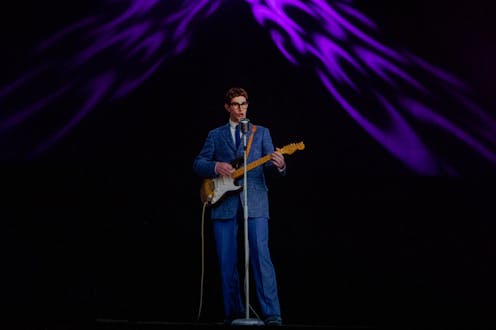
Fans can mourn the passing of music legends for years, the hits echoing long after the original voice is silenced. Little wonder, then, that recent advances in holographic technology and artificial intelligence have found a ready market for performances from beyond the grave.
But this ability to resurrect deceased artists in spectral form raises fascinating questions about the ethics, artistry and the economic implications of these modern revival shows.
Since a holographic Tupac Shakur headlined at Coachella in 2012, there have been similar tributes to Frank Zappa and Roy Orbison. Posthumous tours have also been staged or proposed for Whitney Houston, Amy Winehouse and Ronnie James Dio.
But it’s the holographic performance by a still-living act that stands as the landmark case. ABBA, the Swedish pop sensation that ruled the charts during the 1970s and 1980s, launched their ABBA Voyage virtual reunion tour in 2021, describing the holographic versions of themselves as “ABBAtars”.
Our recent study of the “tour” found a mixture of fan reactions, from some who found it emotionally satisfying to others who questioned its authenticity. The results suggest we need to know more about the enormous cultural implications of these holographic experiences.
Virtual success
While the music industry routinely uses the term “hologram” to describe such shows, it’s not strictly accurate. A true hologram is a 3D object produced by the intersection of light and matter, designed to be observed from all perspectives.
With the exception of ABBA’s recently developed holographic concert, today’s holograms are more akin to digital videos, where images are projected onto a translucent screen in front of real musicians, with the virtual artist seeming to interact with the band and audience. It’s similar to the theatrical optical illusion known as “Pepper’s Ghost” used by 19th-century magicians.
Creating a convincing audience experience is a challenge, however, as fans can be cynical about such events, and the technology doesn’t translate well to YouTube or in photographs. Some find these shows feel too much like watching a movie.
Still, the demand and enthusiasm for virtual concerts is rising steadily, with impressive crowd turnouts and fans paying as much as US$125 for a ticket. The Roy Orbison hologram tour sold an average of 1,800 seats per show.
Read more: Abba and Tupac in the metaverse: how digital avatars could be the bankable future of band touring
‘Ghost slavery’
Our ABBA Voyage study confirmed the reasons for this popularity. After analysing upwards of 34,000 online comments discussing the virtual concert, we found audience members reported positive responses overall.
People mainly appreciated the opportunity to witness the legendary band “perform” once more. Two comments are indicative of the general feeling:
I don’t care if they’re avatars. Nobody expected ABBA to ever reunite in any way, shape, or form, so this is amazing!
It would be so wonderful to see them as I remember them and transport myself back to my childhood. It’s like the closest thing to time travel.
Fans also appreciated the technical wizardry responsible for recreating the band in its 1979 prime:
I find the fact they use the Abbatars instead of themselves on stage simply an amazing idea. It keeps us feeling young and them timeless.
Not everyone was emotionally moved, though, with some questioning the authenticity of the shows. This echoed previous criticism of holographic shows as lacking the essential “live” element of performance, and also being exploitative – what one critic called “ghost slavery”.
Replacing the irreplaceable
Recreating an artist is one thing, but capturing their spirit, charisma and spontaneous performance style is where motion capture and AI technologies are starting to make a real difference.
The process involves a detailed scan of the artist to create a 3D digital model which AI then refines. Next, movements are digitised through motion capture and transferred onto the model (again using AI), recreating an artist’s distinctive performance. AI is also used to analyse vast recording archives to mimic the artist’s voice.
Read more: Holographic history is making 'Night at the Museum' a reality
For all that, AI’s ability to capture the spontaneity and charisma of live performances remains limited. The future of holographic concerts, then, will likely depend on continued technological progress, shifting audience reactions, and careful navigation of the ethical issues raised.
Future applications could also extend beyond music to educational displays of historical figures. Given the success of ABBA and their Voyage experience, it might even expand the touring capacity of living artists.
All this requires a delicate equilibrium: honouring the artist’s legacy, acknowledging fans’ emotions, and providing an experience that genuinely transcends present limitations. Replacing the irreplaceable may be possible at some level, but ultimately the audience will decide.


