

Why is my snot green? How deep are my sinuses? Fascinating facts about mucus, noses and sprays
- Written by The Conversation

Our noses perform important functions every day of our lives, but we often only notice when disease changes how they work.
Our sense of smell works when chemical molecules are sniffed into the nose and make contact with the sense organ called the “olfactory bulb” in the roof of the nasal cavity. The other main function of noses is to warm and moisten air going to the lungs (air conditioning) and to remove unwanted particles and viruses suspended in the air (filtering).
But what are sinuses? What about the snot colours? What’s that squeaky sound in your ears about? And is there a correct way to position nose spray? (Spoiler: yes and you are probably doing it incorrectly.)
Read more: Why has my cold dragged on so long? And how do I know when it's morphed into something more serious?
Anatomy of the nose
The nasal cavity is much larger inside than it seems from the outside.
Dual cavities extend up and also back from the nostrils, and have multiple bony folds (called turbinates) that create a larger surface area (150 square centimetres) for the nasal cavity to be an effective filter and air conditioner.
Turbinates also create turbulence of the airstream, causing about 80% of suspended particles to be filtered as they hit the skin of the nasal cavity.
The nose has a very rich blood supply just under the skin lining (mucosa) which acts as a heat exchange. This can be dialled up or down quickly by nerves controlling dilation or constriction of blood vessels.
There are a number of cavities with connections via narrow tubes to the nasal cavity. That’s four sets of sinuses (hollows) in the facial bones and the middle ear cavity.
The auditory or Eustachian tubes connect the middle ear cavity to the back of the lower nose, above the tonsils and adenoids. The Eustachian tubes are small and closed at rest. But if pressure is lower or higher in the middle ears than the outside world they “pop” open as air rushes through. You may sometimes hear other sounds like squeaks or crackles as an inflamed tube opens and closes, such as when we swallow.
When the nose is congested, the tubes connecting ears and sinuses can also become blocked, causing pain from pressure build up.
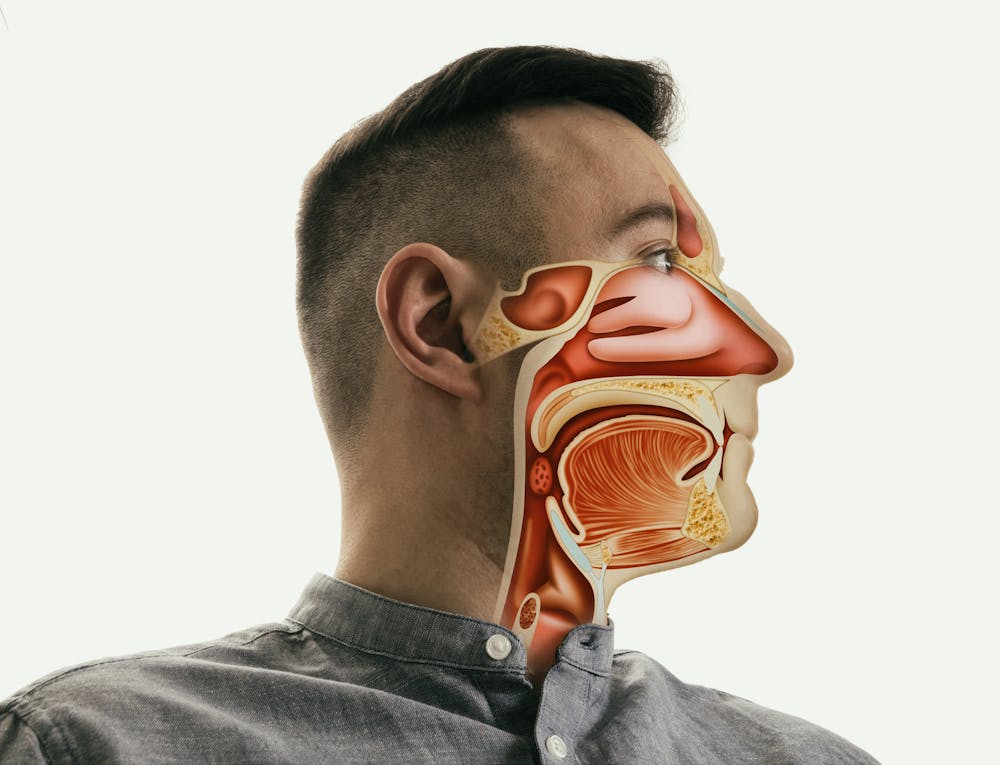
We don’t know why we have sinuses. One evolutionary theory is that they arose so humans could grow a larger face without adding too much weight to the head and they do help our immune defences, with nitrous oxide produced by lining cells in the paranasal sinuses that inhibits viral and bacterial growth.
The sticky stuff
The major passages of the upper respiratory tract are lined with a mucous membrane that also contain mucus-producing goblet cells.
Mucus (which we commonly call “snot”) is the main source of moisture to humidify the air we breathe in. It also traps smaller particles like pollen or smoke. Hairlike structures called cilia line the mucous membrane and transport the particles trapped in the mucus out of the back of the nose.
Cilia beat at ten to 12 times per second, propelling mucus at one millimetre per minute.
Mucus is around 95% water, 3% proteins (including mucin and antibodies) and 1% salt, plus other substances. Mucus strands form crosslinks to become a sticky, elastic gel. The nose produces over 100 millilitres of snot over the course of a day (less during sleep). It carries dead cells and other dust and debris to the stomach for recycling.
Mucus assists in fighting infection when white blood cells and antibodies are excreted into it and increases in volume to flush away infection, irritants or allergens. Watery mucus – such as from allergy or in the first days of a virus – tends to exit via the nostrils (a “runny nose”).
Thicker mucus tends to exit down the rear of the nasal cavity into the throat, moved by the action of cilia.
 The human body produces around 100 mls of snot each day.
Shutterstock
The human body produces around 100 mls of snot each day.
Shutterstock
My snot of many colours
Mucus can be colourful stuff, which can make people worry.
It might be orange and brown if it has some blood in it. Yellow and green hues come from white blood cells (leucocytes) that fight bacterial and viral infections. Colours are more prominent the longer the mucus has “stuck around” – so your morning nose blow might be more brightly coloured than later in the day.
A common misconception is that green mucus indicates bacterial infection and requires antibiotic treatment. But most upper respiratory tract infections (even with green mucus) resolve whether or not antibiotics are used.
Repeated studies show around 80% of patients with sinus infections recovered with no antibiotics, compared to 90% with antibiotics, after seven days.
Read more: Sore throats suck. Do throat lozenges help at all?
Making it better
The main purpose of treatment when you have a cold, flu or upper respiratory tract infection is to relieve symptoms. A nose spray can deliver an effective dose to where it is needed with few side effects.
A blocked nose from an acute viral infection is best treated with decongestant sprays, which are safe to use for at least seven days. They work by constricting swollen blood vessels and reducing excess mucus production.
However, they also slow the action of cilia, slowing the clearance of mucus and making it stickier. Regular sprays or irrigation with salt solutions (saline) wash away mucus and stimulate cilia to beat more effectively.
For the treatment of allergic rhinitis, oral antihistamines and/or nasal steroid sprays may be needed to control symptoms. The addition of saline nose spray to steroid sprays improves effectiveness, probably by flushing away allergens and mucus.
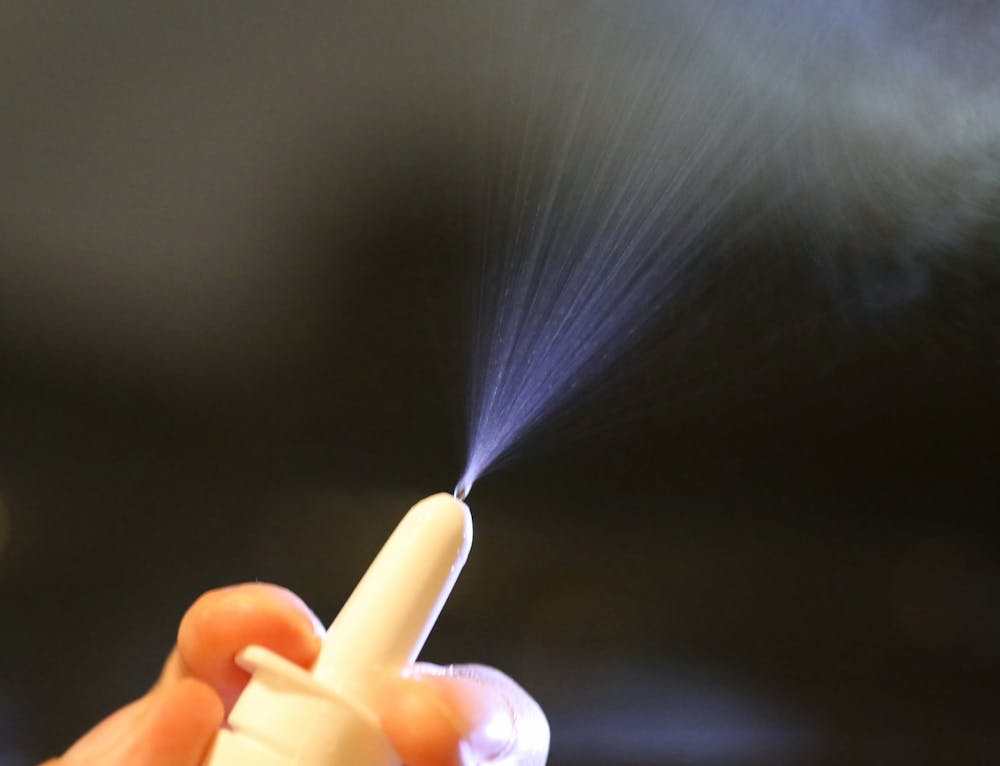 Don’t just jam it up there. Point nasal spray back and slightly outwards.
Shutterstock
Don’t just jam it up there. Point nasal spray back and slightly outwards.
Shutterstock
Yes, there’s a correct way to spray
Using nasal spray is not as simple as pointing it up your nose and pumping. Here’s how to get it right:
stay in an upright position with the head tilted forward slightly
hold the nasal spray in your hand with your thumb at the base of the bottle and the index and middle fingers on top
insert the tip of spray bottle into one nostril, blocking the other nostril gently with the other hand
squeeze the pump with your index and middle finger and breathe in slowly, just enough to keep the medication in place
use the right hand to deliver a spray into the left nostril, directing the spray towards the left ear. Repeat on the other side.


