

Can the new High Speed Rail Authority deliver after 4 decades of costly studies?
- Written by The Conversation
Australia’s new High Speed Rail Authority comes into being today. Created by the Albanese government, the authority and its newly named board have been set a challenging task: “bring high-speed rail to reality”.
Nearly four decades after it was first proposed, Australia must surely hold the world record for high-speed rail studies with no construction. I estimate the cost of all these studies to date to be about A$150 million (both public and private money, in 2023 dollars). Yet not one kilometre of a land corridor for a high-speed rail track has been reserved.
The challenge for the Albanese government is to go further than yet more studies and start construction.
Read more: More than ever, it’s time to upgrade the Sydney–Melbourne railway
How many countries have high-speed rail?
The International Union of Railways (UIC) defines high-speed rail as including “infrastructure for new lines designed for speeds of 250km/h and above; upgraded existing lines for speeds of up to […] 220 km/h”.
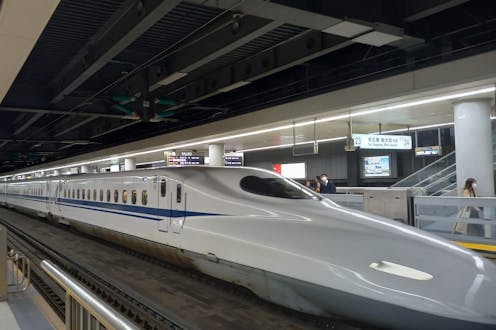
Starting in 1964 with the Tokaido Shinkansen in Japan linking Tokyo to Shin-Osaka, high-speed rail now operates in 20 countries. Another 14 countries are building or planning high-speed rail links.
In Indonesia, a high-speed rail service from the capital Jakarta to Bandung is due to begin this August. Construction of high-speed rail in India and Thailand is advanced.
And Australia? It only rates a mention by the UIC of long-term planning for high-speed rail.
Read more: Don't abandon plans for high-speed rail in Australia – just look at all the benefits
A history of projects that came to nothing
In 1984, CSIRO proposed the Very Fast Train connecting Sydney, Canberra and Melbourne. A consortium undertook many studies. A Senate committee inquiry was held. However, the proposal failed to win government support and did not proceed.
Next was the pragmatic Speedrail proposal. This was to link Sydney to Canberra using existing track from Sydney to Macarthur and new track to Canberra. Prime Minister John Howard enthusiastically endorsed the project before the 1998 election, saying:
The very fast train will rival airline flight as the preferred means of travel for countless millions of Australians for decades to come.
The Howard government gave approval to the Speedrail consortium to “prove up” their proposal. The cost was to be about $4.5 billion. About $1 billion would have been required from government, but this was denied. It was a lost opportunity for Australia.
Instead, the Howard government funded yet another study, which effectively found high-speed rail to be too expensive. So also did a two-stage study by the Gillard government, in which Anthony Albanese was the minister overseeing the planning process until Labor lost office in 2013. It costed a high-speed rail network for the east coast at $114 billion (in 2012 dollars).
More parliamentary inquiries have since followed. And the National Faster Rail Agency formed in 2019 has expended further funds. This agency now falls under the High Speed Rail Authority.
The NSW factor
In 2018, the New South Wales government began its own investigations into faster rail. Launched by the then premier, Gladys Berejiklian, the resulting report by UK rail expert Andrew McNaughton has not been released. It was reported last year to have recommended new tracks between Newcastle, Sydney and Wollongong, along with a Sydney-Canberra upgrade and better services to the state’s central west.
Other NSW reports also remain under wraps. In late 2022, the former NSW government stopped investigating high-speed rail or the upgrading of existing lines. These studies were reported to have cost about a further $100 million (my estimate of $150 million doesn’t include this figure, as it was for studies of both high-speed and faster rail).
Read more: NSW on a slow track to fast trains: promised regional rail upgrades are long overdue
NSW now lags far behind Queensland, Victoria and Western Australia. All these states have trains moving at 160km/h over upgraded tracks. This includes the Queensland electric tilt train, which has been running between Brisbane and Rockhampton since 1998.
There are also questions about the supply of new intercity trains for NSW. These and other questions are the subject of a review set up by the recently elected state Labor government.
So, what happens next?
There is some opposition to high-speed rail in Australia. In 2020, the Grattan Institute said:
The east-coast bullet train advocated by the federal ALP would be an expensive folly.
Last December, the shadow minister for infrastructure, Bridget McKenzie, said:
While very fast trains has great appeal, the reality is that it is decades away from being built – even if governments were to get serious about it.
McKenzie favours upgrades of existing lines.
The minister for infrastructure and transport, Catherine King, said last week the first priority of the High Speed Rail Authority is planning and corridor works for the Sydney-to-Newcastle section of the network. The government is providing $500 million for this. In addition, this project will require a much-improved, in-house, rail engineering capability.
Read more: Vital Signs: Sydney to Newcastle fast rail makes sense. Making trains locally does not
The project will also need to be delivered without the problems that the Inland Rail freight line project has encountered. The Albanese government ordered an independent review of Inland Rail, which found serious shortcomings. It will now only proceed this decade on a rail link between Melbourne and Parkes. Questions remain over the section from Parkes to Brisbane.
The government is also reviewing other major infrastructure projects.
One project that would produce many benefits is to build a new track between Macarthur and near Mittagong. This would be close to the reconstructed section of the Hume Motorway that opened in 1980. The benefits include faster, more energy-efficient train travel between Sydney and each of Melbourne and Canberra. It would also lower emissions.
A Macarthur-Mittagong deviation could be the start of a staged process to construct high-speed rail between Sydney and Melbourne. High-speed rail advocacy group Fastrack and others have proposed this approach. It would give regional Australia “more trains, and faster trains, to get us on our way”.
A growing population is waiting for Australia to join the 34 countries that have or are about to get high-speed rail.
Read more: Transport is letting Australia down in the race to cut emissions


