

Why does grass grow more slowly in winter?
- Written by The Conversation
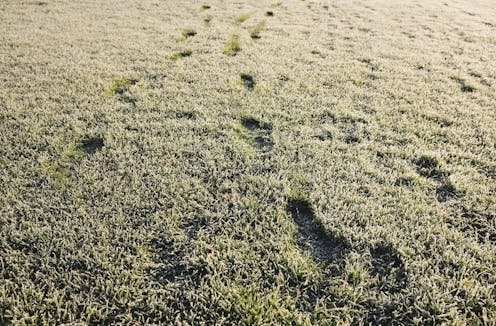
A reader of The Conversation recently wrote in to ask:
Why does grass grow slower in winter?
It is a great question and at first the answer might seem obvious. There is less sunlight and it is colder in the winter months. This affects grass and plant growth in general.
However, there is more to it than meets the eye. Different grasses respond to and cope with winter in different ways.
Read more: I’ve created a monstera! How to care for the ‘Swiss cheese plant’ in your life
Grass: a recent arrival
Grasses are relatively recent arrivals in plant evolution, first appearing in fossil records about 65 million years ago and becoming widespread in parts of Asia by about 30 million years ago.
Geologically, and in plant evolutionary time scales, this is quite recent. It means much of grass evolution has occurred under modern geological, environmental and climatic conditions. So, more than most plants, grasses have adapted to a modern, if pre-human, world. This affects their climatic responses.
Some of our best-known grasses evolved from ancestors that first appeared on Earth hundreds of millions of years ago.
Their physiology developed to cope with an Earth that had a very different atmosphere from that of today.
These plants have a type of photosynthesis called C3 metabolism.
What is C3 metabolism?
C3 metabolism is about how the plant does the job of turning light, water and air into food (photosynthesis).
About 95% of all plants you can think of – trees, shrubs, annuals, fruits, vegetables and many traditional (often called cool season) grasses – have C3 metabolism.
Plants with this form of photosynthesis tend to grow well in a wide range of environmental conditions, even if the temperature is cooler and there are higher than usual levels of carbon dioxide in the air.
They tend to remain green all year round if water is available, and may continue to grow well through late autumn. Many are frost-tolerant, but they may become dormant in hot dry weather.
C3 grasses, such as ryegrass, do slow their growth for the winter months as sunlight becomes less intense. Their metabolic processes (in this case, photosynthesis) slow down when the temperature drops.
Biological reactions are chemical reactions, after all. The rate of a reaction is temperature-dependent – speeding up when it’s warmer and slowing down or even stopping when it gets colder.
But they tend to do better in winter than their cousins, the C4 grasses.
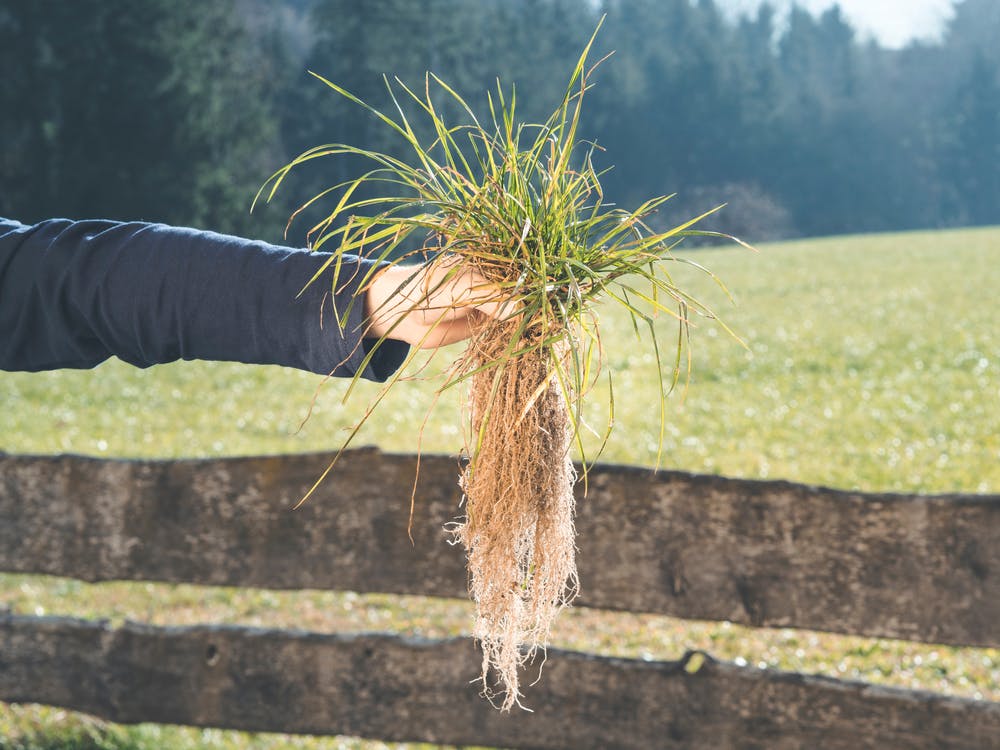 Some grasses struggle in the cold more than others.
Shutterstock
Some grasses struggle in the cold more than others.
Shutterstock
I’ve heard many lawn grasses are C4 grasses. What does that mean?
As the level of CO₂ in the atmosphere declined and geological events led to the development of tropical regions around the equator, a different group of plants evolved. These plants used a form of photosynthesis called C4 metabolism.
C4 plants grow very well under lower CO₂ levels in the atmosphere, use water more efficiently, and can cope with poor soils better than C3 grasses.
But they struggle in the cold. They grow best in warmer, wetter conditions.
While only about 5% of all plants have C4 photosynthesis, some of them are important grass species, such as:
bermuda grass
buffalo grass
paspalum
couch grass, and
zoysia grass.
So if your lawn is sown with one of these grasses, you will definitely see a slowdown in winter, when they become dormant.
Their leaves tend to turn from bright green to a dull pale green or even yellow. Their growth slows quickly and dramatically in early autumn as the light levels fall, temperatures cool and chlorophyll production starts to decline.
The upside, of course, is they usually grow very well when the weather warms up again.
Read more: Trees can be weeds too – here's why that's a problem
Read more https://theconversation.com/why-does-grass-grow-more-slowly-in-winter-206616


