

Wallaby joeys and platypus puggles are tiny and undeveloped when born. But their mother's milk is near-magical
- Written by The Conversation
You’re a mammal. So is a kangaroo. We’ve got much in common. But one of the most interesting is we all feed our newborns with milk. The word mammal comes from mamma, which is Latin for breast.
In Australia, we have many placental mammal species, like bats and native rodents. Humans are placental mammals too. But our country is far better known for our marsupials and monotremes, which have different reproductive strategies to placental mammals. We have around two-thirds of all living marsupial species, and two of the five remaining monotreme species on the planet – the platypus (Ornithorhynchus anatinus) and short-beaked echidna (Tachyglossus aculeatus). The other three echidna species live on the island of New Guinea.
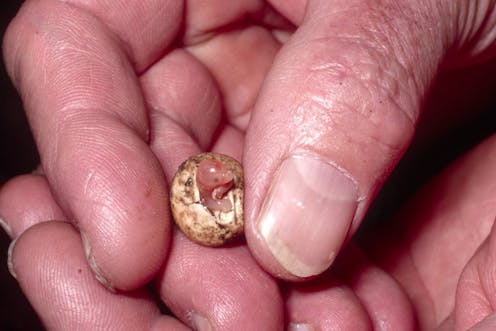
Monotremes are the only mammals to lay eggs. When an echidna egg hatches, the baby is very underdeveloped. Marsupials, too, give birth to underdeveloped young. When a wallaby gives birth to a tiny pink joey, it’s the equivalent to us giving birth to an eight week old foetus. Most of their development happens outside the womb or egg.
To overcome this, female marsupials and monotremes produce truly remarkable milk. Their milk not only supplies nutrients for sustenance, but also has factors essential for growth and immunological protection. Their milk likely has chemicals serving to attract newborns to the teat even though they have very little sensory or movement ability at this stage.
Echidnas and platypuses lay eggs, which hatch revealing underdeveloped puggles.It can be a fight to find a teat
All mammals possess mammary glands. These specialised glands evolved 166–240 million years ago and have diversified into a wide range of sizes and shapes.
While marsupials have teats for their joeys to suckle from, monotremes have milk patches which secrete milk directly onto the pigmented skin of the areola where their baby puggles can lap the milk from the pores. For marsupials, the number of teats equates to the number of mammary glands. The larger the marsupial, the fewer teats they have. Smaller marsupials have more teats. The highest number of mammary glands recorded in a marsupial is 13, in the gray short-tailed opossum (Monodelphis domestica), while the largest surviving marsupial, the red kangaroo (Osphranter rufus), only has four teats.
Read more: Some animals pause their own pregnancies, but how they do it is still a mystery
As you’d expect, teat numbers align with the maximum number of young a marsupial mother can sustain. Newborn marsupials have to seek out and firmly attach themselves to the teat. In some species, the first hours are brutal as more young can be born than there are teats for them, and only those able to latch on in the first few hours can survive. The red-tailed phascogale (Phascogale calura) – a tree-living insect eating marsupial – can give birth to up to 13 young but females only have eight teats.
So what’s in their magic milk?
Monotremes and marsupials produce different milk at different stages of lactation.
Early on, their milk is more dilute. As the joeys and puggles get bigger, it becomes more concentrated, with more protein and fat. This peaks towards the end of lactation when the young are weaned. Carbohydrate levels peak in mid to late lactation and then decrease to weaning. Interestingly, iron levels in marsupial and monotreme milk are three times higher than in placental mammal milk. That’s because joeys and puggles are so undeveloped – they have to rely on iron-rich milk to construct proteins to build, carry and store oxygen until their liver matures.
Macropod (big foot in Latin) marsupials like kangaroos and wallabies are capable of an even more remarkable feat. They can produce tailor-made milk with different nutrients from different teats so they can feed, say, a newborn joey at the same time as feeding her older brother who is about to leave the pouch.
Producing milk takes effort and energy
As anyone who has breastfed a child will know, it’s tiring – and you get hungry. Marsupial mums need double or triple their usual amount of energy by boosting how much they eat, while echidnas have to rely on their fat stores at first, because they stay in the nursery burrow all the time when the puggles are tiny. When their offspring are a bit older, the mother leaves them alone and goes on a hunt for ants and termites.
More milk means faster growth rates for the young. Monotreme puggles, particularly echidnas, are fed infrequently. Their growth is clustered around feedings. They grow faster after having a big feed and slower when their mother is out foraging. Marsupial and monotreme milk also provides essential nutrients and additional factors required to support growth.
Milk, the immunological superhero
Marsupial joeys cannot fully defend themselves against bacteria and viruses at birth in the same way we can, because they lack mature immune tissues and cells.
That means their immune system is bolstered by milk. All mammals produce colostrum in their milk in the first few days of lactation. This milk often looks different, because it contains billions of antibodies to help defend the newborn.
In marsupials, milk carries antibodies as well as immunological cells from the mother. In marsupials with pouches, the pouch itself secretes antibacterial proteins to reduce the growth of opportunistic pathogens. For some species, such as the tammar wallaby (Notamacropus eugenii), licking and cleaning the pouch by the mother and the work of her saliva-borne digestive lysozymes are also likely to protect against bacterial attack.
Milk is essential to the survival of all mammals – but it’s especially important for puggles and joeys. The miracle and magic of marsupial and monotreme milk is how it’s tailored to help these tiny, underdeveloped creatures survive in the outside world – and how the milk changes throughout the process to match their changing requirements.
Read more: Doctor's pouch: Australian mammals hold the key to fighting superbugs


