

A neutrino portrait of our galaxy reveals high-energy particles from within the Milky Way
- Written by The Conversation
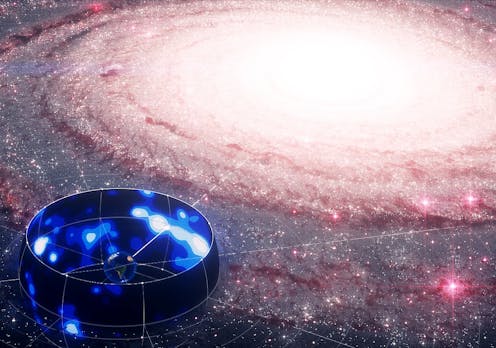
Our Milky Way galaxy is an awe-inspiring feature of the night sky, viewable with the naked eye as a hazy band of stars stretching from horizon to horizon.
For the first time, the IceCube Neutrino Observatory in Antarctica has produced an image of the Milky Way using neutrinos – tiny, ghost-like astronomical messengers.
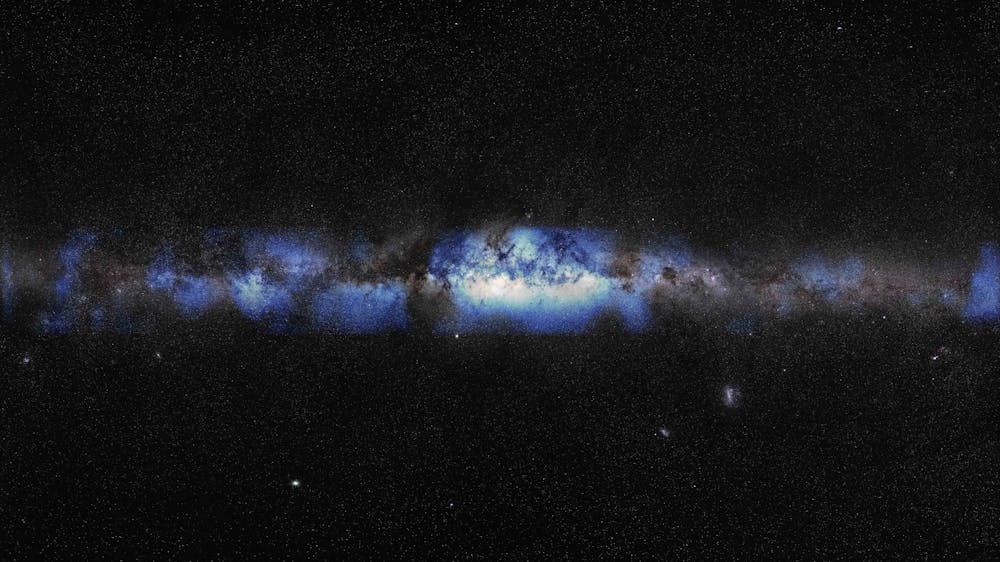
In research published today in the journal Science, the IceCube Collaboration – an international group of more than 350 scientists – presents evidence of high-energy neutrino emission coming from the Milky Way.
We have not yet figured out exactly where in our galaxy these particles are coming from. But today’s result brings us closer to finding some of the galaxy’s most extreme environments.
Neutrino astronomy
Neutrinos offer a unique view of the cosmos as they can travel directly from places no other radiation or particles can escape from. This makes them very interesting to astronomers, because neutrinos offer a window into the extreme cosmic environments that create another kind of particle called cosmic rays.
Cosmic rays are high-energy particles that permeate our Universe, but their origins are difficult to pin down. Cosmic rays are electrically charged, which means their path through space is scrambled by magnetic fields, and by the time one arrives at Earth there is no way to tell where it came from.
Read more: Spotting astrophysical neutrinos is just the tip of the IceCube
However, the environments that accelerate cosmic rays to extraordinary energies also produce neutrinos – and neutrinos have no electric charge, so they travel in nice straight lines. So if we can detect the path of neutrinos arriving at Earth, this will point back to where the neutrinos were created.
But detecting those neutrinos is not so easy.
How to hunt neutrinos
The IceCube Neutrino Observatory is not far from the South Pole. It uses more than 5,000 light sensors arrayed throughout a cubic kilometre of pristine Antarctic ice to search for signs of high-energy neutrinos from our galaxy and beyond.
Vast numbers of neutrinos are streaming through Earth all the time, but only a tiny fraction of them bump into anything on their way through.
Each neutrino interaction makes a tiny flash of light – and those tiny flashes are what the IceCube sensors look out for. The direction and energy of the neutrino can be determined from the amount and pattern of light detected.
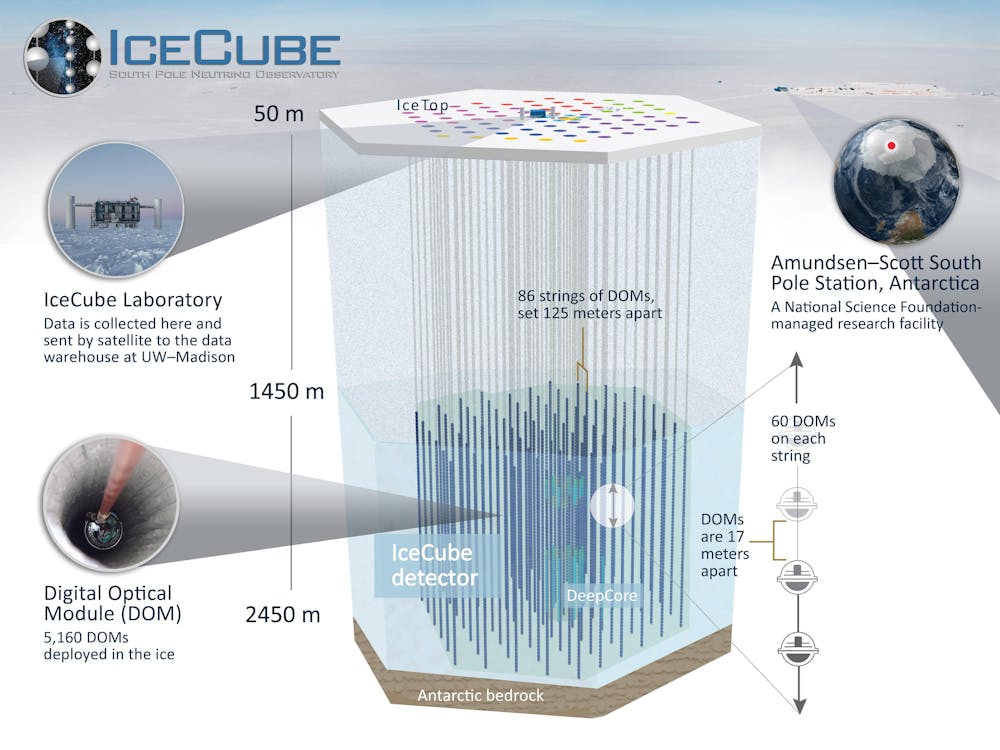 IceCube Collaboration
IceCube has previously detected high-energy neutrinos coming from outside the Milky Way. However, it has been more challenging to isolate the lower-energy neutrinos coming from within our galaxy.
This is because some flashes IceCube detected can be traced to cosmic rays hitting Earth’s atmosphere, which create neutrinos and other particles called muons. To filter out these flashes, IceCube researchers have developed ways to distinguish particles created in the atmosphere and those from further afield by the shape of the light patterns they create in the ice.
Read more:
An Antarctic neutrino telescope has detected a signal from the heart of a nearby active galaxy
Filtering out the unwanted detections has made IceCube more sensitive to astrophysical neutrinos. The final breakthrough that allowed the creation of a neutrino image of the Milky Way came from machine-learning methods that improve the identification of cascades of light produced by neutrinos, as well as the determination of the neutrino’s direction and energy.
Closing in on cosmic rays
The new neutrino lens on our galaxy will help reveal where the most powerful accelerators of galactic cosmic rays are located. We hope to learn how energetic these particles can get, and the inner workings of these high-energy galactic engines.
However, we are yet to pinpoint these accelerators within the Milky Way. The new IceCube analysis found evidence for neutrinos coming from broad regions of the galaxy, but was not able to discern individual sources.
Our team, at the University of Canterbury in New Zealand and the University of Adelaide in Australia, has a plan to realise that next step.
IceCube Collaboration
IceCube has previously detected high-energy neutrinos coming from outside the Milky Way. However, it has been more challenging to isolate the lower-energy neutrinos coming from within our galaxy.
This is because some flashes IceCube detected can be traced to cosmic rays hitting Earth’s atmosphere, which create neutrinos and other particles called muons. To filter out these flashes, IceCube researchers have developed ways to distinguish particles created in the atmosphere and those from further afield by the shape of the light patterns they create in the ice.
Read more:
An Antarctic neutrino telescope has detected a signal from the heart of a nearby active galaxy
Filtering out the unwanted detections has made IceCube more sensitive to astrophysical neutrinos. The final breakthrough that allowed the creation of a neutrino image of the Milky Way came from machine-learning methods that improve the identification of cascades of light produced by neutrinos, as well as the determination of the neutrino’s direction and energy.
Closing in on cosmic rays
The new neutrino lens on our galaxy will help reveal where the most powerful accelerators of galactic cosmic rays are located. We hope to learn how energetic these particles can get, and the inner workings of these high-energy galactic engines.
However, we are yet to pinpoint these accelerators within the Milky Way. The new IceCube analysis found evidence for neutrinos coming from broad regions of the galaxy, but was not able to discern individual sources.
Our team, at the University of Canterbury in New Zealand and the University of Adelaide in Australia, has a plan to realise that next step.
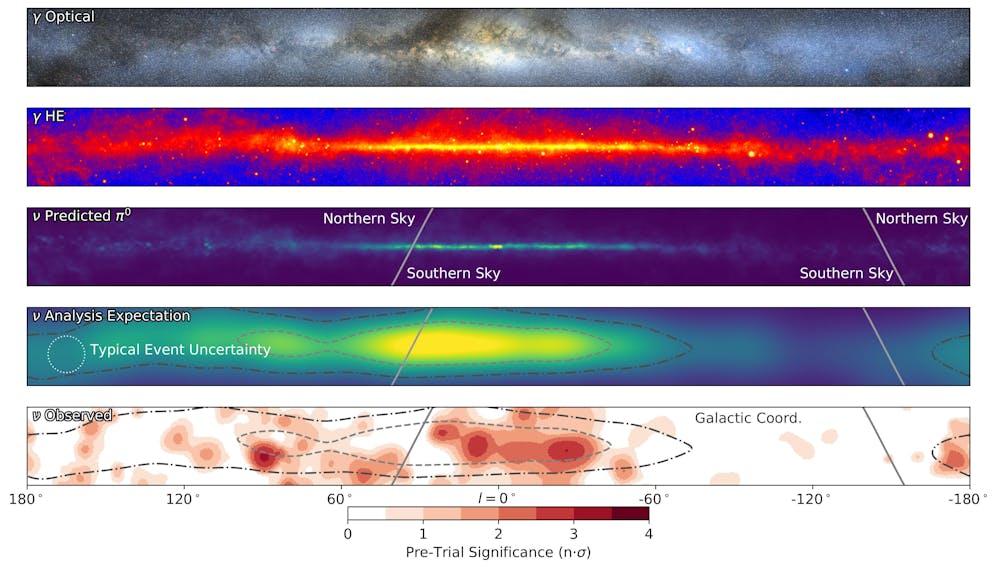 Five views of the Milky Way: the top two bands show visible light and gamma rays, while the lower three show expected and real neutrino results, plus a measure of the significance of neutrino events detected by IceCube.
IceCube Collaboration
We are making models to predict the neutrino signal close to likely particle accelerators so we can target our searches for neutrinos.
Undergraduate student Rhia Hewett and PhD student Ryan Burley are examining pairs of accelerator candidates and molecular dust clouds. They plan to estimate the flux of neutrinos produced by cosmic rays interacting in the clouds, after the neutrinos travel from the accelerators.
They will use their results to enable a focused search of IceCube data for the sources of neutrino emissions. We believe this will provide the key to using IceCube to unlock the secrets of the most energetic processes in the Milky Way.
Five views of the Milky Way: the top two bands show visible light and gamma rays, while the lower three show expected and real neutrino results, plus a measure of the significance of neutrino events detected by IceCube.
IceCube Collaboration
We are making models to predict the neutrino signal close to likely particle accelerators so we can target our searches for neutrinos.
Undergraduate student Rhia Hewett and PhD student Ryan Burley are examining pairs of accelerator candidates and molecular dust clouds. They plan to estimate the flux of neutrinos produced by cosmic rays interacting in the clouds, after the neutrinos travel from the accelerators.
They will use their results to enable a focused search of IceCube data for the sources of neutrino emissions. We believe this will provide the key to using IceCube to unlock the secrets of the most energetic processes in the Milky Way.
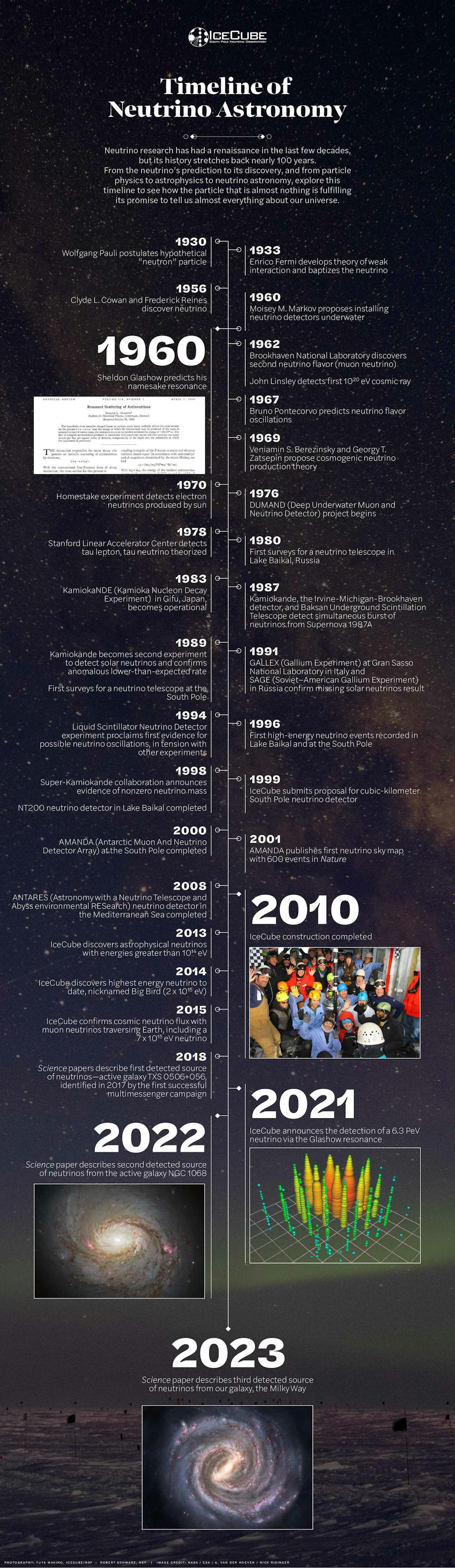 A timeline of neutrino astronomy.
IceCube Collaboration
A timeline of neutrino astronomy.
IceCube Collaboration


