

Curious Kids: what does a nuclear bomb actually do?
- Written by The Conversation
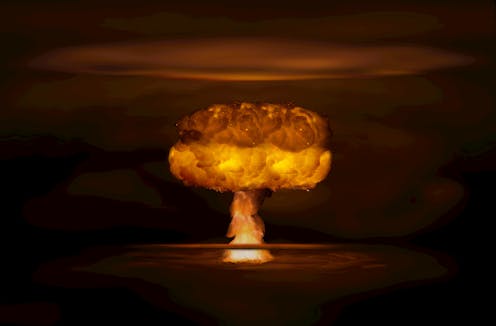
I would like to know what a nuclear bomb actually does – Rafael, age 11, Melbourne
Hi Rafael!
A nuclear bomb, like any bomb, makes an explosion by releasing an enormous amount of energy at once. Nuclear bombs just use a different process from other bombs.
You may have heard of atoms. These are the super-tiny particles that make up matter – which in turn makes everything around us (and us).
Nuclear bombs work by changing the cores of atoms to turn them into other types of atoms. This process releases a lot of heat energy, which quickly gets converted into a big wave of pressure: an explosion!
What are nuclei?
Nuclear bombs release much more energy than normal bombs that use chemicals such as TNT. This is because the cores of atoms are held together very strongly. But before I get into that, let me explain some of the basics.
Atoms themselves are made up of even smaller particles called protons, neutrons and electrons. A cloud of electrons surrounds a tiny inner core made of protons and neutrons. This core is called the nucleus, and more than one nucleus are called nuclei.
Chemical reactions happen when electrons are rearranged, whereas nuclear reactions happen when protons and neutrons inside the nucleus are rearranged.
There are two types of nuclear bombs. In the case of “fission” bombs, nuclei that have a lot of protons and neutrons – such as those in a very dense metal called uranium – are split apart.

In another type of nuclear bomb called a “fusion” bomb, two very small nuclei – such as the cores of two hydrogen atoms – are stuck together.
But fission bombs are simpler and more common, so let’s talk about those.
Chain reactions
Some nuclei don’t take very much energy at all to split apart, such as those in some types of uranium or plutonium atoms (plutonium is another dense metal which has 94 protons in its nuclei).
These nuclei will sometimes fission even when they’re just sitting around. When a nucleus fissions, it turns into two smaller nuclei and spits out a few neutrons.
However, one nucleus doing this isn’t a big deal. To make an explosion, you need to have a certain amount of uranium together in one spot.
For instance, a fission bomb would usually use a very purified sphere of uranium weighing about 52kg. Even this would have to use certain types of uranium in which the atoms have a specific number of neutrons.
If you have enough of these atoms together in one spot, the neutrons that are spit out during fission will hit other nuclei, which then also fission and spit out more neutrons – and so it continues in a chain reaction that sets off a massive explosion.
An unexploded fission bomb will usually be holding separate pieces of uranium (or plutonium) that are too small to start the chain reaction on their own. A chemical explosive is used to smash the pieces together – triggering the chain reaction that sets the bomb off.
Fallout
After fission happens, the two smaller nuclei that are left over are radioactive. Having enough of them in one spot can be very harmful to human health.
These leftovers after a nuclear explosion are called “fallout”. Besides the huge size of the explosion itself, the fallout in particular is what makes nuclear bombs more dangerous than other bombs. The technology used to make nuclear weapons is some of the most secret information in the world.
Nuclear bombs have only ever been used twice. Both of these bombs were detonated during World War II, by the United States against Japan. People around the world are working hard to make sure they are never used again.
Read more https://theconversation.com/curious-kids-what-does-a-nuclear-bomb-actually-do-208475


