

In the depths of Hobart's MONA, a volcano is stirring
- Written by The Conversation
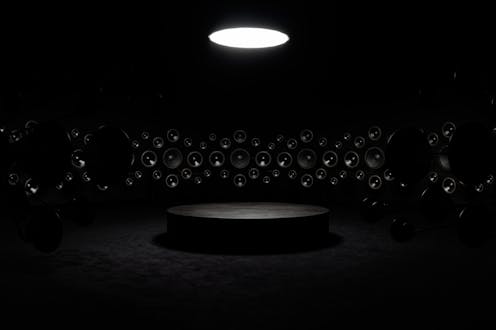
In the darkness, a rumble. A sonorous boom. Deep within the subterranean caverns of MONA, a volcano stirs. This is Hrafntinna (Obsidian), an immersive installation by Icelandic artist and musician Jónsi.
While living in Los Angeles in 2021, pandemic restrictions prevented Jónsi (frontman of Sigur Rós) from experiencing firsthand the eruption of Fagradalsfjall, 40 km from his hometown of Reykjavik, Iceland.
Dormant for nearly 800 years, the volcano became a symbol of isolation for the artist, provoking a sense of disconnection with his homeland.
Inspired by this event, Hrafntinna (Obsidian) employs sensory triggers, sound and scent as vehicles for longing and connection across time and geographical distance.
Read more: A volcano is erupting again in Iceland. Is climate change causing more eruptions?
To sense before seeing
Stepping into the blackened space, we wait for a burst of light to linger long enough to guide our path into the centre of the room, where a circular wooden bench awaits. A dim, round light, like an open crater above, provides the only illumination. Its brightness and hue subtly shift in synchronicity with the sound – flickering and flashing during moments of intensity.
An almost 360-degree installation of nearly 200 speakers offers true immersion into a sonic structure of choral harmonies, ethereal and reverent, accompanied by machinic vibrations of tectonic shifts, and simmering pops and hisses.
The bench vibrates with the low frequencies of a hidden subwoofer, transmitting the sound into our bones. A smoky scent settles upon us. It is the earthen aroma of fossilised amber, extracted from ancient tree resin that has been buried for millennia.
The installation is deeply affecting, with eyes open or closed.

Obsidian emerges from a growing wave of sensory-based works that signals a shift away from ocularcentrism (a prioritising of what we can see) within contemporary art and visual culture.
Rather than maintaining the primacy of sight, these works decentre the visual experience, instead creating affective encounters through sonic, tactile and olfactory elements.
Sight is often considered synonymous with our human objective reality. Understanding sensory experiences opens up the possibility of contemporary art that is firmly posthumanist.
As Jónsi’s Obsidian shows (whether intentionally or incidentally), experiential and sensory works create new opportunities for understanding or knowing, and new possibilities for art to facilitate empathetic connections across great distances – and beyond the human.
 Hrafntinna (Obsidian), 2021, Jónsi. Courtesy of the artist and Tanya Bonakdar Gallery, New York/Los Angeles.
Photo Credit: Mona/Jesse Hunniford Image Courtesy Museum of Old and New Art, Hobart, Tasmania, Australia
Hrafntinna (Obsidian), 2021, Jónsi. Courtesy of the artist and Tanya Bonakdar Gallery, New York/Los Angeles.
Photo Credit: Mona/Jesse Hunniford Image Courtesy Museum of Old and New Art, Hobart, Tasmania, Australia
Through surround sound installation and vibration, Jónsi creates what composer Trevor Wishart might call a “virtual acoustic space” in which we can create an internal landscape. Here, we are deep inside the belly of a far away volcano, which neither the artist nor we have seen.
As I sit and feel the resonance of the work in my body, I am reminded of historian Donna Haraway’s notion of “intimacy without proximity” as a “practice of caring without the neediness of touching”.
While Jónsi may have been motivated by a feeling of longing, perhaps, through the making process, he did (in some loopy material way) pull himself closer to the source of his desire.
Transcending thresholds of time and place
The smoky aroma combined with the sound is transporting – not only across distance, but through time.
The scent of fossilised amber conjures an ancient memory from the earth. The low frequency sounds evoke transcendence from human timescales into deep, geological time.
In a more intimately embodied way, this sense of primal knowing is also carried through the choral sections of the piece. When I spoke to Jónsi, he described the voice as “the very first instrument we had”:
it touches on something deep within us all, without us knowing why. It makes us feel, somehow, something primitive.
Sensorial triggers may transport us, but here, they are facilitated by raw emotion – through the yearning expressly conjured by exquisite vocal melodies, and by the throbbing bass rumbling of geological discontent.
 Jónsi.
Photo Credit: Mona/Jesse Hunniford Image Courtesy Museum of Old and New Art, Hobart, Tasmania, Australia
Jónsi.
Photo Credit: Mona/Jesse Hunniford Image Courtesy Museum of Old and New Art, Hobart, Tasmania, Australia
I stay in the space for two cycles of Obsidian’s 20-minute sound piece. The second time through, I lie down to feel the vibrations more intensely.
Looking up at the glowing light above me, I experience a shifting perspective, moving between looking into and out of the volcano’s interior. As the light extinguishes, I am brought to my body’s own interior, and an underlying, subtle feeling of familiarity.
During our interview, Jónsi commented on the similarities between Tasmania and Iceland: places where cities are surrounded by “intense, beautiful, and brutal nature”. Perhaps this plays a part in my sense of already-knowing. I recognise the relationship and have felt the same longing.
As a multi-sensory, immersive installation, Hrafntinna (Obsidian) is a transporting experience, but it is also a grounding one. In the dark, it shines a light on our inherent, embodied connection to place, and to the world.
Hrafntinna (Obsidian) is at MONA, Hobart, until April 1 2024.
Read more: Living near the fire – 500 million people worldwide have active volcanoes as neighbors
Read more https://theconversation.com/in-the-depths-of-hobarts-mona-a-volcano-is-stirring-214550


