

565-million-years-old, some of the oldest UK fossils are eerily similar to famous Australian ones
- Written by The Conversation
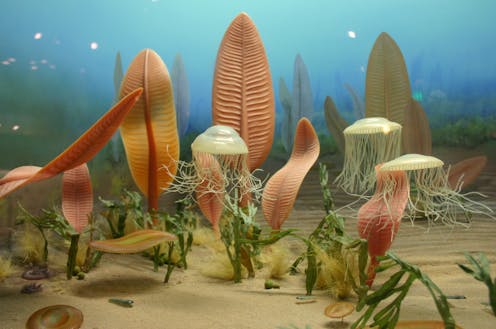
Some half a billion years ago, life on Earth went through a huge transformation. In what is called the Ediacaran period, after billions of years of single-celled organisms, large multicellular organisms emerged in the fossil record.
These traces of the oldest complex ecosystems have been found in only a handful of locations around the world. The fossils were made by soft-bodied creatures covered by sand, creating impressions of their squashed remains imprinted into rock.
Evidence of these creatures was first found in the Ediacara Hills, in South Australia’s Flinders Ranges. The discovery was pivotal in defining the Ediacaran period: a time in Earth’s past characterised by a specific layer of rock which symbolises a significant change in history.
What was happening elsewhere at this time? Similar-looking fossils have been found in a disused quarry in a farmer’s field at Llangynog in Wales, but until now their precise age was unknown.
In a new study published in Journal of the Geological Society, we have dated these Welsh remnants of ancient marine life. Now, we can confirm they were near contemporaries of the famous South Australian fossils.
A bookmark for rocks
How do geologists figure out the age of fossils? Understanding the age of fossils is extremely useful for correlation and understanding how biological communities evolved.
Luckily, at least for us today, an environmental catastrophe loomed in the shallow sea where these Welsh organisms lived.
Volcanic explosions threw mineral particles over the surrounding landscape and polluted the atmosphere with toxic gases.
The billowing red hot clouds created ash layers. These ash layers contain mineral grains that are isotopically datable, acting like miniature stopwatches that record the time elapsed since they crystallised in a volcano. Hence, volcanic ash acts much like a bookmark in a sequence of rocks, tracking the moment of eruption.

A clock for rocks
A clock tick-tocks every second, but how do we measure time when each tick takes a million years? We use a mineral called zircon.
Trapped within zircon is some uranium that undergoes nuclear decay to lead over millions of years. Scientists know the rate at which this change occurs, so by analysing the composition of the crystal we can use the zircon as a geological clock.
The more precisely we measure the amount of uranium and lead, the more precise the clock. By carefully dissolving, heating and analysing zircon, we have dated the rocks in Wales to 565 million years (plus or minus 0.1%). That is a precise death certificate for the fossils.
Read more: Scientists can't agree on when the first animals evolved – our research hopes to end the debate
It’s life, but not as we know it
Evidence from Ediacaran fossils implies that after four billion years of oceans containing single-celled microbes, suddenly – in geological terms at least – the seas teemed with new complex life. Ediacaran life is odd, with strange soft-bodied forms whose interaction with the environment is unclear.
Were the creatures stationary, or did they move around and eat each other? In some ways these creatures would be strangely familiar, yet in another way, bizarre.
Some appeared fern-like, others like cabbages, and yet others were similar to modern sea pens, resembling fat, old-fashioned writing quills.
Nevertheless, fossils from this time preserve the earliest evidence for large-scale multicellular organisms, including the first animals.
 The rolling countryside of mid-south Wales – hidden away in these hills is evidence of ancient life.
Parkerspics
The rolling countryside of mid-south Wales – hidden away in these hills is evidence of ancient life.
Parkerspics
A tropical paradise?
Half a billion years ago, Wales was not green and sheep covered and looked much more like a barren volcanic island. The Llangynog fossils are fascinating because they record a shallow marine ecosystem.
In contrast, other famous fossil sites like Charnwood Forest in the United Kingdom and Mistaken Point, Canada record deep-marine conditions.
 Aspidella, one of the weird and wonderful fossils of Llangynog, Wales.
Anthony Clarke
Aspidella, one of the weird and wonderful fossils of Llangynog, Wales.
Anthony Clarke
In the shallow waters of the chain of tropical volcanic islands that’s now Wales, a creature called Aspidella terranovica felt the warmth of sunlight and the sway of the tides 565 million years ago. This fossil is rare and valuable because it shows evidence of movement.
Alongside Aspidella, other disc-like organisms are preserved; these could represent the anchor for fern-shaped filter feeders.
Hidden away in an unassuming quarry in Wales are the remnants of a diverse shallow marine ecosystem containing some of Britain’s oldest fossils, which we have proved have cousins of a similar age in Australia. This time in Earth’s history was just after a global glaciation so severe and widespread that some researchers consider the entire planet froze into a “snowball”.
The Ediacaran fossils show this thaw-out heralded evolutionary change, demonstrating a profound link between our planet’s geological processes and its biological cargo.
Read more: Friday essay: the silence of Ediacara, the shadow of uranium


