

Sentinels of the sea: ancient boulder corals are key to reef survival in a warmer world
- Written by The Conversation
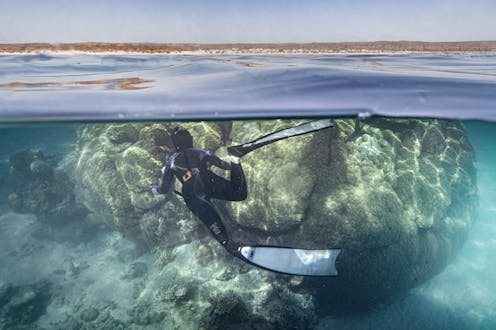
Seas surrounding Australia this month hit an alarming level of warming. It comes on the back of serious marine heatwaves in the Northern Hemisphere summer.
Such warming is highly dangerous for corals. Every half a degree of ocean warming increases their risk of bleaching and potential death.
The best long-term strategy to protecting Earth’s coral reefs is to dramatically cut greenhouse gas emissions and so limit global warming. But in the meantime, we must urgently make corals more resilient and protect those that are vulnerable.
That is particularly true for the huge, ancient features of reefs known as boulder corals. Research suggests they will be a vital part of reef survival in a warmer world.
The old-growth trees of the sea
Boulder corals (Porites) can grow to more than 10m high and live for more than 600 years. In Australia they are often referred to as “bommies”. Each bommie can comprise multiple species, but they’re often a single massive individual.
The corals play a crucial role in reefs, including providing habitat for marine life. Importantly, they can maintain these functions even when other coral species are absent.
Some species are thought to be resistant to stress. Old corals have likely experienced – and survived – past warming episodes, proving their resilience.
For example, a paper in 2021 described a giant boulder coral discovered on the Great Barrier Reef which was thought to be more than 400 years old. It has survived 80 major cyclones, numerous coral bleaching events and centuries of exposure to other threats.
This resilience can benefit the whole reef ecosystem. We can think of boulder corals as akin to old-growth trees in a forest. Just like forests containing big, old trees are more resistent to fire, studies show a mix of different growth forms, including old and large boulder corals, fare better in the long-term under marine warming.
Older and bigger corals may also produce more offspring, so can more rapidly replenish the reef after disturbances.
Clearly, as our oceans face unprecedented pressures under climate change, we must protect – and learn from – these sentinels of the sea.
Read more: Snorkellers discover rare, giant 400-year-old coral – one of the oldest on the Great Barrier Reef
Preparing for the challenges ahead
Understanding boulder corals is crucial to predicting how they might cope under climate change, and planning for their protection.
But scientists still have much to learn about boulder corals. In particular, we don’t know exactly how many species exist, their life histories and how they evolved.
My colleagues and I are aiming to overcome this knowledge gap. We are studying reefs across Australia, with a particular focus on boulder corals at Ningaloo Reef off Western Australia.
We are creating maps of what species of boulder corals exist and where they are located. And using cutting-edge genomics technology, such as DNA sequencing, we are measuring the tolerance of each species to warming and trying to predict when they will reproduce.
Importantly, we are also examining the mutually beneficial relationship between the corals and algae. This relationship provides algae with shelter, gives corals their colour and provides nutrients to both partners. It may also be a main factor in coral resistance to warmer temperatures.
So far, we have found more diversity than initially expected. This is exciting because it may signal an increased capacity to resist different types of stress. But the work to fully map Ningaloo’s coral diversity has only just begun.
We hope our findings, once finalised, can inform local community management actions such as:
- public education campaigns and signs
- managing visitor numbers to reefs
- installing public moorings to reduce harm from boat anchoring, especially during coral spawning.
The information can also be used in broader management actions such as:
- establishing “baseline” conditions from which to measure change
- zoning decisions, including the establishment or ramping up of of marine park protections, especially for resilient coral species and individuals
- impact assessments following events such as heatwaves
- direct conservation actions for iconic, at-risk bommies, such as providing shade to diminish stress from heat
- the development of national reef management plans.
Read more: Photos from the field: why losing these tiny, loyal fish to climate change spells disaster for coral
Something worth fighting for
The stress to coral wrought by recent marine heatwaves compounds damage incurred over decades. The Great Barrier Reef, for example, has experienced five major heatwaves in 30 years.
Broadly, making reefs more resilient to these pressures involves:
- resisting, recovering, managing and adapting to shocks across ecosystems
- improving governance structures
- preparing human communities for change.
Awareness of the need to increase reef resilience is growing. For example, it formed the basis of a 2017 blueprint for the Great Barrier Reef and a strategy for the Ningaloo Coast released last year. But more work is required.
There’s also a need for coordination across Australia’s reef areas. This might include the exchange of knowledge and data between researchers and combined lobbying efforts to better protect reef ecosystems.
What’s more, Traditional Owners must be offered the opportunity to be consulted about, and meaningfully engaged in, protection of reef areas, including co-management of Sea Country.
The Australian Coral Reef Society, of which I am a councillor, last week released an open letter to the federal government, calling for action on climate change to protect reefs. The task has never been more urgent.
There is still a lot of reef worth fighting for – but only if we act now.
The author would like to acknowledge the contribution of Ningaloo marine park managers – in particular, Dr Peter Barnes – to the research she and her colleagues are undertaking.


