

NZ started discussing AUKUS ‘Tier 2’ involvement in 2021, newly released details reveal
- Written by The Conversation
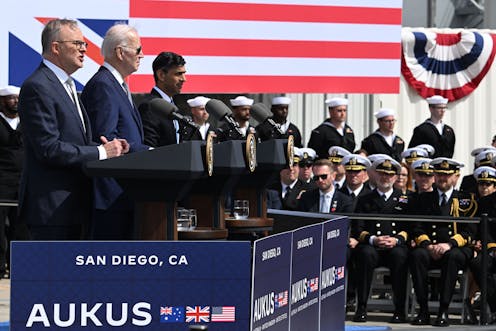
Details released by the Department of the Prime Minister and Cabinet under the Official Information Act reveal New Zealand officials have been considering involvement in AUKUS from the outset.
On the same day the AUKUS security pact between Australia, the United Kingdom and United States was announced on September 16 2021 (New Zealand time), New Zealand officials gathered in Wellington for the first of two joint-agency meetings to discuss “Tier 2 AUKUS” – since restyled in official parlance as “pillar two”.
At the time, New Zealand’s non-involvement was put down to the pact’s central purpose of supplying nuclear-powered submarines to Australia, and New Zealand’s prohibition of nuclear-powered vessels in its territorial waters.
Then Prime Minister Jacinda Ardern said: “We weren’t approached, nor would I expect us to be.”
It wasn’t until March 2023 that possible “non-nuclear” involvement in technology sharing was publicly discussed in New Zealand, during a visit by US National Security Council coordinator for the Indo-Pacific, Kurt Campbell.
However, the newly released information – provided following an Official Information Act request – shows “Tier 2 AUKUS” meetings took place at Defence House in Wellington on September 16 and 23, 2021.
A month later, on October 22, New Zealand government ministers were advised
there are likely to be significant opportunities [for] future cooperation with AUKUS […] beyond the submarines, particularly in the cyber and artificial intelligence areas.
Lack of detail and transparency
The existence of these previously undisclosed meetings and their “tier 2” agenda suggest AUKUS was always intended to expand.
They also raise significant questions about whether associate members might be subordinated within the pact, and whether accommodating associates is intended to add a multilateral legitimacy that enhances both the pact’s authority and credibility.
The notion of a “tiered” system runs counter to recent rhetoric around AUKUS. “Pillar two” has been presented as a standalone technology-sharing arrangement, carefully delineated from pillar one’s nuclear-powered submarine deal.
Read more: Have New Zealanders really been 'misled' about AUKUS, or is involvement now a foregone conclusion?
This also highlights the lack of specific detail around the proposed benefits of pillar two involvement. As it stands, we know remarkably little about the “advanced capabilities” being developed through AUKUS, due to the secrecy surrounding the pact from the beginning.
Initially conceived as enhancing “joint capabilities and interoperability” between the three AUKUS members, what became pillar two has since been presented as an industrial programme focused on emerging technologies and job creation.
Now, it appears the technology is being used to draw in prospective members with promises of opportunities for their aerospace and research sectors.
Technology sharing in practice
Australian critics have argued AUKUS is not a jobs programme, but a strategic initiative that could lock members into exclusive US trade controls, jeopardise research independence, and prevent international research and development collaboration.
These concerns recently led former Australian foreign minister Bob Carr to describe pillar two as “cobbled together” and no more than “fragrant, methane-wrapped bullshit”.
Pillar two technologies are also designed to be interoperable with US forces. So far, there are no assurances that intelligence or data from AUKUS partners would not be used by autonomous weapons systems or nuclear command, control and communications infrastructure.
Indeed, the US has made “integrated deterrence” a core objective of its defence policy, including how it works with “allies and partners”.
Pillar one of AUKUS sets a precedent whereby Australia will be the first non-nuclear weapons state to receive highly-enriched, weapons-grade fissile material and nuclear-powered submarines.
Read more: Joining AUKUS could boost NZ’s poor research and technology spending – but at what cost?
Pillar two technologies, including AI, are already contributing to the modernisation of US and UK nuclear weapons command and delivery systems.
Broader AUKUS interoperability will see foreign nuclear-capable bombers and submarines “rotated” indefinitely through Australia.
Opponents of AUKUS argue this violates the spirit and the letter of the Treaty of Rarotonga, which establishes a nuclear-free zone in the South Pacific and bans the use, possession, storage and – crucially – stationing of nuclear weapons.
No limited involvement
AUKUS has clear implications for New Zealand’s non-nuclear security and close defence relationship with Australia. But to date, New Zealand has not sought to challenge Australian assurances around non-proliferation and compliance with the Treaty of Rarotonga.
Strikingly, it appears New Zealand officials – not AUKUS members – designated pillar two as “non-nuclear”, while formulating public messaging about potential involvement in March 2023.
New Zealand has taken a leading role in nuclear disarmament, through domestic nuclear-free legislation and support for international treaties. Framing pillar two as technically “non-nuclear” could compromise such advocacy in future.
Read more: Moving closer to Australia is in New Zealand’s strategic interest – joining AUKUS is not
Prospective partners under pillar two must recognise there can be no genuinely limited involvement in AUKUS. Participation tacitly supports Australian acquisition of nuclear-powered submarines, the maintenance of US primacy in the Pacific region, and potentially dangerous confrontation with China.
It also puts New Zealand offside with other key partners.
Few Pacific nations see AUKUS as addressing the principal security threat of climate change, or accept it as having a “non-nuclear” component. ASEAN states view it as establishing an unhelpfully adversarial relationship with China.
AUKUS aims to expand a tiered, de facto alliance through integrated, nuclear-enabling technologies. For New Zealand, this raises serious questions about whether there is any meaningful distinction between pillar one and pillar two.


