

Where did money come from?
- Written by The Conversation
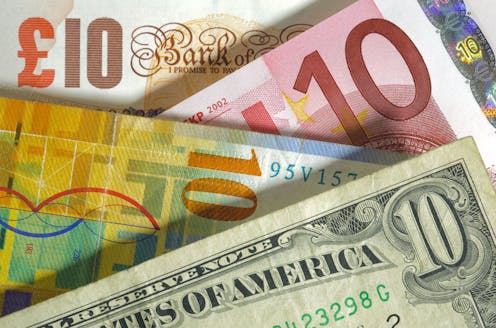
This article is part one of The Conversation’s “Business Basics” series where we ask leading experts to discuss key concepts in business, economics and finance.
For the most part, economists continue to believe a story of money told to generations of students by a series of textbooks over the past 150 years.
This story asks us to imagine a pre-monetary barter economy, where people bought goods and services by trading them for other goods and services.
Eventually a suitable commodity – perhaps gold or silver – emerged as both an acceptable means of exchange for conducting trade and a convenient unit of account for expressing value.
Later, coins were issued – eventually to be monopolised by governments – and later still paper money, credit, and banking systems.
The problem with this story is that there is no historical evidence to support it. As was noted by prominent anthropologist Caroline Humphreys:
No example of a barter economy, pure and simple, has ever been described, let alone the emergence from it of money … all available ethnography suggests that there has never been such a thing.
So where did money come from exactly? One difficulty we face is that writing about money – what gives it value, and how monetary systems work – is not something young economists are generally encouraged to do.
As a consequence, among the best articles ever written about money are two now more than 100 years old by British economist Alfred Mitchell-Innes, entitled “What is Money?” and “The Credit Theory of Money”.
These papers, until recently almost completely ignored by the economics profession, tell a different story, rejecting the idea that money evolved naturally from barter.
We can now be confident this version is closer to the truth. And it has big implications for how we think about the role of governments within monetary systems, and what gives money value. Acknowledging the true story of money would force a paradigm shift among economists – no wonder a lot of them don’t want to think about it.
Actually, early governments invented money
The truth is that money predates markets. Governments invented money – it did not emerge independently from pre-existing barter systems.
Market economies simply could not develop until money existed. For much of history, the currency tokens people regarded as money had little or no intrinsic value, taking the form of clay tablets, hazelwood tally sticks, base metals, shells or paper.
The earliest forms of what Keynes called “modern money” – to distinguish it from gift tokens used for ceremonial purposes in communal groups – go back to the origins of taxation, accounting, and even literacy and numeracy. These early currencies were units of account used to assess the tributes that had to be paid to early governmental institutions in the Middle East.
The word shekel is still used as a currency unit, but dates to ancient Babylon and the emergence of money itself, over 5,000 years ago.
The idea that the need to pay taxes is what creates a demand for a currency was well understood by colonial governments. They knew how to introduce their currencies into countries they had invaded. To force locals to supply labour or goods to the government, they imposed a tax liability – often, a hut tax. This tax could only be paid using the currency of the colony.
Locals had to either work for the colonial government or supply goods to others who did, else they wouldn’t have the specific currency needed to pay taxes. This created a demand for the colonial power’s currency, which the government could then spend.
If such a government spent more overall than it withdrew in taxation – running a budget deficit – the community could add the remaining currency to its savings. Taxation and the legal system created a demand for the government’s money and provided the impetus for the development of a monetary economy.
Even today, it’s the tax system that drives the monetary system. Demand for a government’s money is guaranteed because people need it to pay federal taxes.
But banks create money too
Actual physical cash makes up a tiny proportion of the money in circulation. Most of what we regard as money is held in our bank deposits, effectively a bunch of numbers on a ledger. Most of these bank deposits are created by banks when they make loans to us, and this is not government money at all – it is private money, created by the banks themselves.
When a bank makes a loan to you, that loan becomes an asset for the bank, because you have to pay it back with interest. But at the same time, the loan appears as a deposit of funds in your account, which is a liability for the bank. Technically, you both owe each other.
On paper, this means there’s now money in the system that wasn’t there before. The bank hasn’t actually lent you someone else’s money, the loan deposited in your account represents an IOU to the bank’s other depositors.
Both the loan and the deposit are created by the bank, using nothing more than a computer keyboard. The bank has promised to use its holdings of government money to make payments on your behalf, including tax payments to the government, or to provide you with government money in the form of physical cash.
As economist Hyman Minsky once said, “anyone can create money – the problem lies in getting it accepted”.
Obviously, private banks don’t issue government currency. The Commonwealth government and its agent, the Reserve Bank of Australia, sit at the top of our own monetary system.
Government-issued currency will always have value because it’s the unit of account needed to assess and pay our taxes. How much value the currency holds depends on how much the economy produces, how difficult it is to obtain the currency and on how much tax we have to pay.
Here is some food for thought. If we accept that money and markets did not emerge naturally but had to be created by governmental institutions and legal systems, this means that there is no such thing as a genuinely free market, no such thing as a natural rate of unemployment, and no such thing as a natural distribution of income and wealth.
The theory that money emerged naturally in the private sector encourages people to believe that free markets are natural systems in which governments only interfere. But in truth, early governments invented the very institutions of money and markets, and the regulatory frameworks that determined how those markets work and in whose interests.
Exchange economies have always depended on systems of law and they always will. The more pertinent question concerns who writes those laws – and in whose interests those regulations are applied.
Read more https://theconversation.com/where-did-money-come-from-229481


