

Green industry yes, conservation no: a budget for people, not for nature
- Written by The Conversation
Last night’s budget is another missed opportunity to arrest the poor and deteriorating state of the Australian environment.
Subsidising green industry in Labor’s Future Made in Australia policy may offer economic advantages if implemented well, but there is nothing in this budget to help address the immediate environmental crisis facing Australia.

The story so far
After being elected in 2022, Labor made a number of good promises. The new government legislated an emissions reduction target – a 43% cut by 2030 on 2005 figures and net zero by 2050. Last year, Labor reformed the Coalition’s only emissions monitoring program, the safeguard mechanism, to help deliver these reductions. (Recent research has cast doubt on the integrity of the system’s carbon credits). And the government signed an international biodiversity pact, which commits us to protect 30% of our land (currently at 22%) and halt biodiversity loss by 2030.
But Labor also promised to rewrite Australia’s main environment laws, the Environmental Protection and Biodiversity Conservation Act, which governs the protection of places and species, and approvals for significant projects. This was motivated by the horrendous bushfires in 2019–20 and a damning review, which found the laws were not up to the task of stopping environmental decline.
In the lead-up to tonight’s budget, Labor announced that the stronger laws had been indefinitely delayed. Instead, Australia would get a national environmental protection agency, Environment Protection Australia. While a strong and independent agency would improve compliance and monitoring, it will be enforcing ineffective laws until reforms are passed. Labor also shocked environmental groups by supporting a future for fossil gas, including opening up new gas fields.
Made in Australia
So if we’re not getting new environment laws, what is in the budget for the environment?
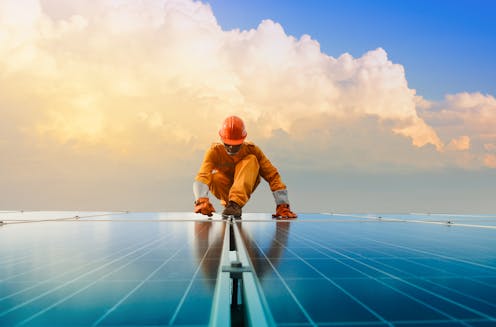
A whole lot for green industries. The 2024 budget’s centrepiece is the Future Made in Australia policy, a series of initiatives costing A$23 billion over ten years that focuses on subsidies for manufacturing industries including solar panels and green hydrogen.
 Labor’s Future Made in Australia policy is aimed at bringing manufacturing back, especially green manufacturing. But will it prove more than a sop to its voters?
Labor Party of Australia, CC BY
Here, the Government is actively intervening in the market to push the economy towards specific ends – boosting green industries and making supply chains more resilient. As the budget papers state, one goal is to make Australia “an indispensable part of global net zero supply chains.”
In recent years western governments have embraced industrial subsidies, most notably seen in the CHIPS and Science Act and Inflation Reduction Act in the United States.
So what’s the government planning? Included in the announced package is:
$3.2 billion over ten years in additional funding to the Australian Renewable Energy Agency. This includes $1.7 billion in grants for innovation in green metals, low carbon liquid fuels, and batteries.
$1.7 billion over 10 years for an additional round of Hydrogen Headstart. This will fund the difference between the cost to produce renewable hydrogen and the current market price for eligible firms. Also planned is an additional $2 a kilogram tax incentive for renewable hydrogen produced from 2027–28.
$7 billion over the medium term for tax incentives in critical mineral production. Firms will be eligible to rebate 10% of refining and processing costs of 31 critical minerals from 2027-28.
$1.5 billion over ten years for solar PV and battery manufacturing. This will fund grants to firms for manufacturing solar PV components at all stages of the supply chain and batteries.
Is this the right thing to do? Economists are usually pessimistic about government efforts to guide industry in this way, pointing to the difficulty of picking winners and the potential for funding to flow in the direction lobbyists want rather than on merit.
Nevertheless, there’s recent evidence industry policy can be effective in spurring long-term structural change to an economy – when done well. After all, targeted assistance and direction by government may have played a role in how East Asian nations such as Japan, Korea and China became manufacturing titans.
But what about the environmental outcomes of these subsidies? Will they turn Australia into a green export giant, shipping green hydrogen instead of LNG and make homegrown solar panels a reality? Will they help drive the green transition?
This is even less clear. Australia’s once-significant manufacturing sector began its sharp decline after we dropped tariffs and opened up to international competition from the 1980s.
Could Labor turn the tide? That will depend on whether the subsidies succeed in creating manufacturing sectors able to compete with international competition. It’s far from guaranteed. But it is possible.
And what about trade-offs between green industry and conservation? In the rush to secure lithium and critical minerals for the green transition, the government has invested $566 million to give mining companies free data and maps. This could do further damage to the environment, if new projects are built on land home to threatened species.
 The government is pitching a future where Australia makes value-added green products such as carbon-free steel production.
Dean Lewins/AAP
Where’s the “Conserved in Australia” policy?
Nothing is in the budget to tackle our biodiversity and extinction crisis.
This is another missed opportunity. The postponed environment laws aside, the government could have addressed the severe lack of funding for conservation.
What about the goal of protecting 30% of land and seas by 2030? This will take funding to expand protected areas – and to actually conserve species in existing protected areas. Invasive species from deer to blackberries run riot in many national parks.
How much should the government be spending and for what? To give some examples:
– $5 billion would fund the purchase of private land for conservation and long-term management. Australia previously had a fund like this, which is why our protected area estate has grown so much.
– $1.7 billion a year is the expert estimate for how much it would cost to bring all of Australia’s threatened species under active management and recover their numbers.
– $2 billion a year for 30 years would restore 13 million hectares of degraded land, without touching farms or urban areas – about twice the size of Tasmania.
Our natural environment affects our national identity, our mental health, and even our future economic prosperity.
Yes, conservation costs money. But the costs may turn out to be very small relative to the benefits, not only for the diverse species we share Australia with but for its people too. People don’t just need manufacturing jobs – they need nature, too.


