

Fast-track laws, parliamentary urgency, Treaty tension, media retreat: warning signs for NZ’s ‘brittle’ democracy
- Written by The Conversation
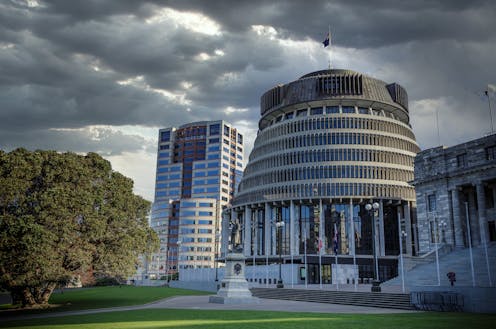
There have been so many submissions on the government’s proposed Fast-track Approvals Bill – 27,000 written, with 2,900 wanting to appear before the select committee in person – that a ballot system has been introduced to manage the process.
Given the already widespread disquiet over the bill’s shape and intent, it’s a fair assumption most of the submissions will be critical of its potential environmental and democratic impacts.
For those with memories long enough, it also calls to mind the original “fast-track” methods used by the then prime minister, Robert Muldoon, to expedite his “Think Big” projects in the 1970s. Then, too, special laws were passed to circumvent normal planning mechanisms.
Later governments have done similar things, from the Christchurch and Kaikoura earthquake rebuilds to the COVID-19 Fast-Tracking Consenting Act rushed through to stimulate the economy during the pandemic.
The current proposed law goes even further. It expands what laws can be bypassed, while increasing ministerial powers and opening up conflict-of-interest risks. And it’s happening at a time when other democratic checks and balances are fragile, if not fading.
Missing safeguards
According to the democracy watchdog Freedom House, there is a global trend towards democratic decline. The Economist Intelligence Unit estimates less than 8% of the world’s population live in a full democracy, while almost 40% live under authoritarian rule.
New Zealand is clearly not in the high-risk group. Compared to others, its political and civil rights are exceptionally good. And its legal system, which safeguards many of those rights, is among the best in the world. Other checks and balances, such as the Ombudsman, are also robust.
Unlike many other countries, however, New Zealand lacks robust safeguards against abuses of power. It is one of only five countries (along with Saudi Arabia, Israel, Canada and the United Kingdom) without a written constitution.
But the Commonwealth cousins within that group both have bicameral (two-chamber) parliaments that can balance a government’s agenda and ambition. New Zealand’s Legislative Council, a weak version of an upper house, was broken up in 1951.
Freedom and trust
Politicians and others have defended this status quo by pointing to New Zealand’s largely stable political culture and the existence of a strong fourth estate to hold power to account.
But while New Zealand is still considered a good model of public interest journalism, its ranking in the latest Reporters Without Borders Press Freedom Index has fallen six points since last year (from 13th to 19th).
The decline is driven by a shrinking diversity of reliable media (with cuts and closures happening on an alarming scale), as well as falling trust in news overall. The combative approach to journalists and news media from the current deputy prime minister extends to other areas, too.
Take the current debate over te Tiriti o Waitangi/Treaty of Waitangi, for example. A remarkable document (some liken it to New Zealand’s Magna Carta), the Treaty’s political and legal rehabilitation is still relatively recent.
Since the 1975 Treaty of Waitangi Act and later establishment of the Waitangi Tribunal, meticulous cross-party work has gone into stitching the “principles” of the Treaty back into the shared national fabric.
The ACT Party’s Treaty Principles Bill (and the referendum it would trigger if successful) and recent attacks on the Waitangi Tribunal by senior government ministers suggest that shared fabric can tear more easily than some might have hoped.
A ‘brittle’ democracy
The supposed robustness, integrity and established due process of New Zealand’s legal system is likewise up for scrutiny – in particular, the government’s reliance on executive power and use of urgency to pass legislation.
No MMP government has passed more bills under urgency in its first 100 days than the present coalition, far outstripping previous administrations.
It is not necessarily a bad thing for parliament to have the option to pass laws urgently when circumstances demand it. The problem arises when there is no definition of, or required justification for, the use of urgency.
Instead, it becomes a normalised way to sidestep the mechanisms that help create better laws.
Speed and political advantage, not democratic quality, become the determining factors. The majority in parliament determines the foot on the legislative accelerator (and neither the left nor right has held a monopoly on its use).
None of this is to say New Zealand is sliding towards tyranny. But, equally, none of these trends is positive. Power is not being abused, but it is not being well managed either. New Zealand democracy, unique and currently brittle, should be handled with greater care.


