

Who really was Mona Lisa? More than 500 years on, there’s good reason to think we got it wrong
- Written by The Conversation
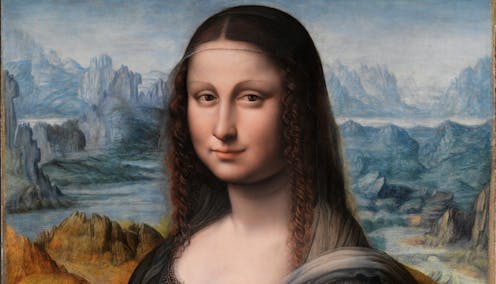
In the pantheon of Renaissance art, Leonardo da Vinci’s Mona Lisa stands as an unrivalled icon. This half-length portrait is more than just an artistic masterpiece; it embodies the allure of an era marked by unparalleled cultural flourishing.
Yet, beneath the surface of the Mona Lisa’s elusive smile lies a debate that touches the very essence of the Renaissance, its politics and the role of women in history.
A mystery woman
The intrigue of the Mona Lisa, also known as La Gioconda, isn’t solely due to Leonardo’s revolutionary painting techniques. It’s also because the identity of the subject is unconfirmed to this day. More than half a century since it was first painted, the real identity of the Mona Lisa remains one of art’s greatest mysteries, intriguing scholars and enthusiasts alike.
The painting has traditionally been associated with Lisa Gherardini, the wife of Florentine silk merchant Francesco del Giocondo. But another compelling theory suggests a different sitter: Isabella of Aragon.
Isabella of Aragon was born into the illustrious House of Aragon in Naples, in 1470. She was a princess who was deeply entwined in the political and cultural fabric of the Renaissance.
Her 1490 marriage to Gian Galeazzo Sforza, Duke of Milan, positioned Isabella at the heart of Italian politics. And this role was both complicated and elevated by the ambitions and machinations of Ludovico Sforza (also called Ludovico il Moro), her husband’s uncle and usurper of the Milanese dukedom.

Scholarly perspectives
The theory that Isabella is the real Mona Lisa is supported by a combination of stylistic analyses, historical connections and reinterpretations of Leonardo’s intent as an artist.
In his biography of Leonardo, author Robert Payne points to preliminary studies by the artist that bear a striking resemblances to Isabella around age 20. Payne suggests Leonardo captured Isabella across different life stages, including during widowhood, as depicted in the Mona Lisa.
US artist Lillian F. Schwartz’s 1988 study used x-rays to reveal an initial sketch of a woman hidden beneath Leonardo’s painting. This sketch was then painted over with Leonardo’s own likeness.
Schwartz believes the woman in the sketch is Isabella, because of its similarity with a cartoon Leonardo made of the princess. She proposes the work was made by integrating specific features of the initial model with Leonardo’s own features.
 An illustration of Isabella of Aragon from the Story of Cremona by Antonio Campi.
Library of Congress
This hypothesis is further supported by art historians Jerzy Kulski and Maike Vogt-Luerssen.
According to Vogt-Luerssen’s detailed analysis of the Mona Lisa, the symbols of the Sforza house and the depiction of mourning garb both align with Isabella’s known life circumstances. They suggest the Mona Lisa isn’t a commissioned portrait, but a nuanced representation of a woman’s journey through triumph and tragedy.
Similarly, Kulski highlights the portrait’s heraldic designs, which would be atypical for a silk merchant’s wife. He, too, suggests the painting shows Isabella mourning her late husband.
The Mona Lisa’s enigmatic expression also captures Isabella’s self-described state post-1500 of being “alone in misfortune”. Contrary to representing a wealthy, recently married woman, the portrait exudes the aura of a virtuous widow.
Late professor of art history Joanna Woods-Marsden suggested the Mona Lisa transcends traditional portraiture and embodies Leonardo’s ideal, rather than being a straightforward commission.
This perspective frames the work as a deeply personal project for Leonardo, possibly signifying a special connection between him and Isabella. Leonardo’s reluctance to part with the work also indicates a deeper, personal investment in it.
Beyond the canvas
The theory that Isabella of Aragon could be the true Mona Lisa is a profound reevaluation of the painting’s context, opening up new avenues through which to appreciate the work.
It elevates Isabella from a figure overshadowed by the men in her life, to a woman of courage and complexity who deserves recognition in her own right.
 The painting Hermitage Mona Lisa, oil on canvas, is a 16th century copy of Leonardo’s work with noticeable differences.
Wikimedia
Through her strategic marriage and political savvy, Isabella played a crucial role in the alliances and conflicts that defined the Italian Renaissance. By possibly choosing her as his subject, Leonardo immortalised her and also made a profound statement on the complexity and agency of women in a male-dominated society.
The ongoing debate over Mona Lisa’s identity underscores this work’s significance as a cultural and historical artefact. It also invites us to reflect on the roles of women in the Renaissance and challenge common narratives that minimise them.
In this light, it becomes a legacy of the women who shaped the Renaissance.


