

Spending too much time on social media and doomscrolling? The problem might be FOMO
- Written by The Conversation
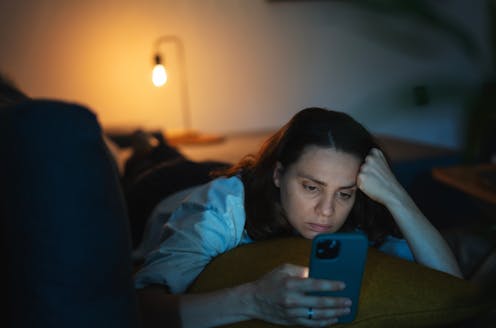
For as long as we have used the internet to communicate and connect with each other, it has influenced how we think, feel and behave.
During the COVID pandemic, many of us were “cut off” from our social worlds through restrictions, lockdowns and mandates. Understandably, many of us tried to find ways to connect online.
Now, as pandemic restrictions have lifted, some of the ways we use the internet have become concerning. Part of what drives problematic internet use may be something most of us are familiar with – the fear of missing out, or FOMO.
In our latest research, my colleagues and I investigated the role FOMO plays in two kinds of internet use: problematic social media use and “doomscrolling”.
What are FOMO, problematic social media use and doomscrolling?
FOMO is the fear some of us experience when we get a sense of “missing out” on things happening in our social scene. Psychology researchers have been studying FOMO for more than a decade, and it has consistently been linked to mental health and wellbeing, alcohol use and problematic social media use.
Social media use becomes a problem for people when they have difficulty controlling urges to use it, try to cut back but fail, and find using it is having a negative effect on things like work, study and relationships.
Doomscrolling is characterised by a need to constantly look at and seek out “bad” news. Doomscrollers may constantly refresh their news feeds or stay up late to read bad news.
While problematic social media use has been around for a while, doomscrolling seems to be a more recent phenomenon. Researchers first saw it popping up during the pandemic.
What we tried to find out
In our study, we wanted to test the idea that FOMO was a cause of problematic social media use and doomscrolling. We tried a novel approach to see if we could find out just how FOMO leads individuals to engage in problematic internet use behaviours.
The key factor, we thought, was emotion regulation – our ability to deal with our emotions. We know some people tend to be good at this, while others find it difficult. In fact, greater difficulties with emotion regulation was linked to experiencing greater acute stress related to COVID.
Read more: Why am I online? Research shows it's often about managing emotions
However, an idea that has been gaining attention recently is interpersonal emotion regulation. This means looking to others to help us regulate our emotions.
Interpersonal emotion regulation can be helpful (such as “affective engagement” that teachers may try to foster with students) or unhelpful (such as the “co-rumination” that occurs when friends repeatedly rehash their problems together).
In our analyses, we sought to uncover how both intrapersonal emotion regulation (ability to self-manage our own emotional states) and interpersonal emotion regulation (relying on others to help manage our emotions) accounted for the link between FOMO and problematic social media use, and FOMO and doomscrolling, respectively.
What we found – and what it might mean for the future of internet use
Our findings indicated that people who report stronger FOMO engage in problematic social media use because of difficulty regulating their emotions (intrapersonally), and they look to others for help (interpersonally).
Similarly, people who report stronger FOMO are drawn to doomscrolling because of difficulty regulating their emotions intrapersonally (within themselves). However, we found no link between FOMO and doomscrolling through interpersonal emotion regulation.
We suspect this difference may be due to doomscrolling being more of a solitary activity, occurring outside the denser social context that lends itself to interpersonal regulation. For instance, there are probably fewer people with whom to share your emotions while staying up trawling through bad news.
While links between FOMO and doomscrolling have been observed before, our study is among the first to try and account for this theoretically.
We suspect the link between FOMO and doomscrolling may be more about having more of an online presence while things are happening. This would account for intrapersonal emotion regulation failing to help manage our reactions to “bad news” stories as they unfold, leading to doomscrolling.
Problematic social media use, on the other hand, involves a more complex interpersonal context. If someone is feeling the fear of being “left out” and has difficulty managing that feeling, they may be drawn to social media platforms in part to try and elicit help from others in their network.
Getting the balance right
Our findings suggest the current discussions around restricting social media use for young people, while controversial, are important. We need to balance our need for social connection – which is happening increasingly online – with the detrimental consequences associated with problematic internet use behaviours.
It is important to also consider the nature of social media platforms and how they have changed over time. For example, adolescent social media use patterns on different platforms can be used to predict a range of mental health and socialisation outcomes.
Public health policy experts and legislators have quite the challenge ahead of them here. Recent work has shown how loneliness increases a person’s overall risk of death.
Read more: Doomscrolling is literally bad for your health. Here are 4 tips to help you stop
We have long known, too, that social connectedness is good for our mental health. Last year, the World Health Organization established a Commission on Social Connection to promote the importance of socialisation to our lives.
The recent controversy in the United States around the ownership of TikTok illustrates how central social media platforms are to our lives and ways of interacting with one another. We need to consider the rights of individuals to use them as they please, but understand that governments carry the responsibility of protecting users from harm and safeguarding their privacy.
If you feel concerned about problematic social media use or doomscrolling, you can speak to a healthcare or mental health professional. You can also call Lifeline on 13 11 14, or 13 YARN (13 92 76) to yarn with Aboriginal or Torres Strait Islander crisis supporters.


