

What’s that in my nest? How the evolutionary arms race between cuckoos and hosts creates new species
- Written by The Conversation
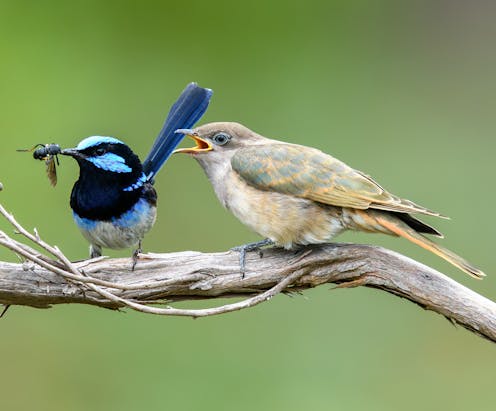
How do new species arise? And why are there so many of them? One possible reason is the arms race between animals such as predators and parasites, and the victims they exploit.
Many predators and parasites have evolved specialised strategies to avoid detection, such as mimicking their prey or host. In these cases, when the exploiter adopts a new victim, it needs to mimic the new victim to succeed.
As a result, the exploiter can diverge from its original population and ultimately become a new species. Charles Darwin proposed this process more than 160 years ago, but it has been difficult to observe in practice.
In new research published in Science, we show how this process drives the creation of new species of cuckoos. These birds lay their eggs in the nests of other species, and their chicks mimic the appearance of their host’s chicks to avoid detection.
An escalating arms race
The deceptive behaviour of bronze-cuckoos imposes heavy costs on their hosts. They lay their eggs in the nests of small songbirds, such as fairy wrens and gerygones, and abandon their young to the care of the host.
Soon after hatching, the cuckoo evicts the host eggs or chicks from the nest to become the sole occupant. The host parents not only lose all their own offspring, but also invest several weeks rearing the cuckoo, which eventually grows to around twice the size of its foster parents.

Not surprisingly, given these high costs, hosts have evolved the ability to recognise and reject odd-looking chicks from their nests.
Only the cuckoo chicks that most closely resemble the host’s chicks will evade detection, and so with each generation, the cuckoo chicks become a closer and closer match to the host chicks. This is why the chicks of each species of bronze-cuckoo look almost identical to their hosts’ chicks.
 Each bronze-cuckoo species mimics the appearance of its host’s chicks.
Naomi Langmore
Each bronze-cuckoo species mimics the appearance of its host’s chicks.
Naomi Langmore
Divergence between populations that exploit different hosts
This exquisite mimicry has evolved to an even more fine-tuned level. Within a single species of bronze-cuckoo that exploits several different hosts, the appearance of the chicks tracks that of their hosts.
In response to chick rejection by hosts, both the little bronze-cuckoo and the shining bronze-cuckoo have diverged into several separate subspecies. Each subspecies exploits a different host and produces a chick that matches that of the host.
 Subspecies of the little bronze-cuckoo and the shining bronze-cuckoo track the appearance of their host’s chicks across their geographic range. A. Little bronze-cuckoo and mangrove gerygone host. B. Little bronze-cuckoo and large-billed gerygone host. C. Little bronze-cuckoo and fairy gerygone host. D. Shining bronze-cuckoo and yellow-rumped thornbill host. E. Shining bronze-cuckoo and fan-tailed gerygone host. F. Shining bronze-cuckoo and grey warbler host.
Naomi Langmore, Hee-Jin Noh, Rose Thorogood, Alfredo Attisano
Subspecies of the little bronze-cuckoo and the shining bronze-cuckoo track the appearance of their host’s chicks across their geographic range. A. Little bronze-cuckoo and mangrove gerygone host. B. Little bronze-cuckoo and large-billed gerygone host. C. Little bronze-cuckoo and fairy gerygone host. D. Shining bronze-cuckoo and yellow-rumped thornbill host. E. Shining bronze-cuckoo and fan-tailed gerygone host. F. Shining bronze-cuckoo and grey warbler host.
Naomi Langmore, Hee-Jin Noh, Rose Thorogood, Alfredo Attisano
This divergence can happen even when two hosts live in the same geographic area. In northern Queensland, the little bronze-cuckoo exploits both the large-billed gerygone and the fairy gerygone. The cuckoos have undergone selection to match the chicks of their respective hosts, leading to genetic divergence into two separate subspecies.
This shows the split into subspecies cannot be explained by geographic separation.
A higher cost for hosts leads to more new species
It was difficult to find out exactly what was happening with these birds, because we couldn’t easily find cuckoo chicks in host nests in the wild. So we developed a non-destructive method for extracting DNA from the shells of tiny cuckoo eggs (2.5cm long), which allowed us to sample museum egg specimens that have been collected over many decades.
 A museum cuckoo eggshell specimen, showing the original blowhole in the specimen and the tiny expansion of the blowhole to extract DNA.
Naomi Langmore
A museum cuckoo eggshell specimen, showing the original blowhole in the specimen and the tiny expansion of the blowhole to extract DNA.
Naomi Langmore
Our results also suggest that the evolution of cuckoos and their hosts is most likely to drive the creation of new species when the cuckoos impose a high cost on their hosts – such as by killing off all the host’s own offspring. This leads to an “evolutionary arms race” between the host’s defences and the cuckoo’s counter-adaptations.
This finding was supported by our broad analysis using evolutionary modelling across all cuckoo species. We found lineages that are most costly to their hosts split into new species more often than less costly cuckoo species (those that live alongside their host’s chicks) and their non-parasitic relatives.
Interactions between exploiters and their victims may be one of the main drivers of biodiversity. The process of speciation we described, in which the exploiter shows very specialised adaptations to their victim, may occur in other parasites and hosts, and in predators and prey. These tightly coupled interactions might even explain why there are millions, rather than thousands, of uniquely specialised species across the globe.


