News Daily

The Times

Australia

  • Written by The Conversation
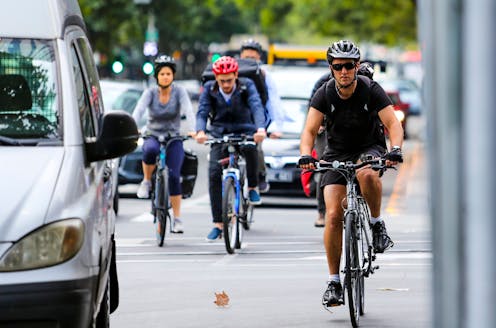
Why do so few people cycle for transport in Australia? 6 ideas on how to reap all the benefits of bikes

Less than 1% of the 12 million Australians who travelled to work on Census Day in 2021 rode a bicycle to get there.

Bicycles are readily available and affordable. Cycling also supports healthy, liveable and sustainable cities.

Yet most of us shun this form of transport in Australia. The number of people cycling to work fell by 26.4% between 2016 and 2021.

So, on World Bicycle Day, we ask why is this form of transport so undervalued and neglected?

We offer the following ideas about what needs to happen so more of us use bicycles for everyday transport.

Vertical bar chart showing numbers in Australia who used active transport – cycling and walking – to get to work at each census date from 1976 to 2021
Chart: The Conversation. Data: Australian Bureau of Statistics, Australia's journey to work, CC BY 1. Improve cycling infrastructure across our cities Remember the pop-up cycling lanes during COVID and how quickly many of them vanished? With multiple local and state governments managing roads across the country, we have no way of knowing where all the painted or separated cycling lanes currently exist. Better-connected cycling infrastructure is needed to increase the use of bicycles for transport. At present we don’t understand how well, safely and equitably cycling routes connect up across Australian cities. 2. Use AI to help fill the gaps Deep-learning artificial intelligence (AI) methods can help pinpoint areas with limited or no cycling infrastructure across the nation. The Australian Urban Observatory will lead a new research project to trial this technology. AI could help governments identify neighbourhoods lacking cycling infrastructure and end-of-trip facilities, street signs, measure cycling participation and monitor cycling lanes to ensure they’re well marked and maintained. Deep-learning AI is already used to improve cycling performance. It has huge potential to support detailed, cost-effective, real-time identification, management and maintenance of cycling infrastructure. A big advantage of AI is it can be scaled up. Once trained, AI models can be replicated across many neighbourhoods to identify urban design features that support cycling. It’s even more useful when combined with citizen science and rider experiences, as we plan to do. This AI technology requires high-resolution satellite imagery and spatial data to identify objects and features. Imagery collected by organisations such as Australia Post, transport departments and road maintenance companies would be perfect for AI analysis. We welcome approaches from potential industry partners for our project. 3. Use simulations to evaluate decisions on cycling Our cities are growing fast. This creates many challenges, including climate change, traffic congestion, air quality and health. To tackle these challenges, we need evidence to minimise trial-and-error decision-making. Virtual laboratories can be very useful for evaluating policies and investments before they are put into effect. The key question for decision-makers is where to invest for maximum benefit and minimal harm. Computer transport simulation models can help answer this question. These models can calculate changes in traffic, cycling uptake and emissions before infrastructure is built. They have traditionally been used to build business cases for infrastructure investment. However, these models have often neglected cycling. The result is a lack of quantitative, case-specific evidence to support investment decisions on cycling infrastructure. That’s why we developed the Transport Health Assessment Tools for Brisbane and Melbourne. The results show the health benefits of walking and cycling. A smiling older man ride a bicycle along a cycle path through a park Policymakers’ decision-making has neglected cycling’s benefits for health, wellbeing and liveability. IndianFaces/Shutterstock 4. Plan with a focus on cycling Australia will have to do more than set up a Net Zero Economy Authority to get to net zero. Electric vehicles won’t solve the problem soon. Transport produces about a fifth of Australia’s emissions but its share is predicted to grow, becoming the largest source of emissions by 2030. Cycling offers transport that’s almost free, sustainable, time-efficient and healthy. Walking and cycling are no-brainer options to get to net zero sooner. We can measure basic walkability across neighbourhoods, but where is the connected urban policy support for cycling? We need academics, policymakers and cycling advocates to work together on these problems. It would be great to see “bicycle mayors” such as Chennai’s Felix John in our cities. Places like the Netherlands and New Zealand give priority to cycling through planning policies and infrastructure such as bike paths and dedicated cycle lanes. The result is high rates of cycling, including children, women and older people who are considered more vulnerable road users. Australian rates of cycling for transport are dismally low. There’s also a huge gender gap. Cyclists wait in line on a cycle path for the lights to change Commuters cycle home from work in London. Joe Kuis/Shutterstock 5. Make active transport a funding priority Government infrastructure policies prioritise large, costly road megaprojects, such as Victoria’s A$26 billion North East Link. They entrench many harms of car use, including carbon emissions and other pollution, and displace more active and sustainable forms of travel. By comparison, walking and cycling infrastructure is cheap and small scale. But to get the greatest benefit it must be broadly spread and connected. We need comprehensive cycling infrastructure plans for our cities that put cycling projects ahead of megaroads for funding. The federal budget provided an extra $3.2 billion for the over-budget North East Link in Victoria. It announced $100 million for a National Active Transport Fund and a national approach to sustainable urban development. Halting or deferring funding for massive road projects could free up enough money to transform metropolitan cycling networks. That would support a shift away from cars, creating savings as road projects could be deferred or cancelled. 6. Connect cycling to long-term health benefits A lack of safe cycling infrastructure denies vulnerable road users the use of this sustainable and healthy transport. This has a long-term and compounding effect: if people don’t take up cycling when young it translates into fewer adult cyclists later. They miss out on being physically active through cycling and its life-long health benefits. Cycling improves physical and mental health. Some studies suggest cyclists are happier and more productive workers. There’s an incentive for employers to support cycling – even at their desks. Cycling also benefits children by improving their health, social wellbeing and academic performance. For all these reasons, cycling is an undervalued mode of transport that needs urgent support. It’s critical for healthy, sustainable and liveable cities of the future.

Read more https://theconversation.com/why-do-so-few-people-cycle-for-transport-in-australia-6-ideas-on-how-to-reap-all-the-benefits-of-bikes-229811

Split Corrugated Conduit for Flexible Cable Protection

For wiring assemblies in vehicles, machinery and equipment, choosing suitable cable protection helps keep cables organised and reduces direct contact with surrounding parts. Mojak Plastics supplies plastic tubing and conduit options for different installation needs, and split corrugated conduit can... Read more

Trailers Melbourne Buyers Can Compare: When Box Trailers Make Sense

For many homeowners, businesses and tradespeople, trailers Melbourne customers use every week need to be versatile enough for changing loads. A box trailer can be particularly useful because its enclosed sides help contain cargo while providing a straightforward loading area... Read more

Office Cleaning Melbourne: Planning a Consistent Workplace Routine

Businesses looking for office cleaning Melbourne need a plan that reflects the way their workplace operates. A clean office supports day-to-day organisation, helps shared spaces remain presentable and gives employees and visitors a more orderly environment. Eco Green Cleaning Management... Read more

Pinboard Solutions for Offices, Schools and Shared Information Spaces

Why a Pinboard Remains Useful A pinboard provides a simple way to display information that needs to remain visible without being rewritten. Lawdex supplies fabric and cork options for offices, schools, staff areas and other environments. A pinboard can be used... Read more

Retractable Hose Reel: A Practical Guide To Choosing The Right Hose Storage

A retractable hose reel can make hose storage more organised, accessible and practical in workshops, commercial facilities, service areas and other working environments. Instead of leaving a hose coiled across the floor or requiring staff to manually wind it after... Read more

Car Removal Melbourne: What To Know Before Selling An Old Or Damaged Car

Start By Assessing Why The Car Needs To Go An old or damaged car can become difficult to justify keeping when repairs, registration, storage or ongoing maintenance outweigh its usefulness. Car removal Melbourne services can help owners arrange both the sale... Read more