

With all this bird flu around, how safe are eggs, chicken or milk?
- Written by The Conversation
Recent outbreaks of bird flu – in US dairy herds, poultry farms in Australia and elsewhere, and isolated cases in humans – have raised the issue of food safety.
So can the virus transfer from infected farm animals to contaminate milk, meat or eggs? How likely is this?
And what do we need to think about to minimise our risk when shopping for or preparing food?
How safe is milk?
Bird flu (or avian influenza) is a bird disease caused by specific types of influenza virus. But the virus can also infect cows. In the US, for instance, to date more than 80 dairy herds in at least nine states have been infected with the H5N1 version of the virus.
Investigations are under way to confirm how this happened. But we do know infected birds can shed the virus in their saliva, nasal secretions and faeces. So bird flu can potentially contaminate animal-derived food products during processing and manufacturing.
Indeed, fragments of bird flu genetic material (RNA) were found in cow’s milk from the dairy herds associated with infected US farmers.
However, the spread of bird flu among cattle, and possibly to humans, is likely to have been caused through contact with contaminated milking equipment, not the milk itself.
The test used to detect the virus in milk – which uses similar PCR technology to lab-based COVID tests – is also highly sensitive. This means it can detect very low levels of the bird flu RNA. But the test does not distinguish between live or inactivated virus, just that the RNA is present. So from this test alone, we cannot tell if the virus found in milk is infectious (and capable of infecting humans).

Does that mean milk is safe to drink and won’t transmit bird flu? Yes and no.
In Australia, where bird flu has not been reported in dairy cattle, the answer is yes. It is safe to drink milk and milk products made from Australian milk.
In the US, the answer depends on whether the milk is pasteurised. We know pasteurisation is a common and reliable method of destroying concerning microbes, including influenza virus. Like most viruses, influenza virus (including bird flu virus) is inactivated by heat.
Although there is little direct research on whether pasteurisation inactivates H5N1 in milk, we can extrapolate from what we know about heat inactivation of H5N1 in chicken and eggs.
So we can be confident there is no risk of bird flu transmission via pasteurised milk or milk products.
However, it’s another matter for unpasteurised or “raw” US milk or milk products. A recent study showed mice fed raw milk contaminated with bird flu developed signs of illness. So to be on the safe side, it would be advisable to avoid raw milk products.
How about chicken?
Bird flu has caused sporadic outbreaks in wild birds and domestic poultry worldwide, including in Australia. In recent weeks, there have been three reported outbreaks in Victorian poultry farms (two with H7N3 bird flu, one with H7N9). There has been one reported outbreak in Western Australia (H9N2).
The strains of bird flu identified in the Victorian and Western Australia outbreaks can cause human infection, although these are rare and typically result from close contact with infected live birds or contaminated environments.
Therefore, the chance of bird flu transmission in chicken meat is remote.
Nonetheless, it is timely to remind people to handle chicken meat with caution as many dangerous pathogens, such as Salmonella and Campylobacter, can be found on chicken carcasses.
Always handle chicken meat carefully when shopping, transporting it home and storing it in the kitchen. For instance, make sure no meat juices cross-contaminate other items, consider using a cool bag when transporting meat, and refrigerate or freeze the meat within two hours.
Avoid washing your chicken before cooking to prevent the spread of disease-causing microbes around the kitchen.
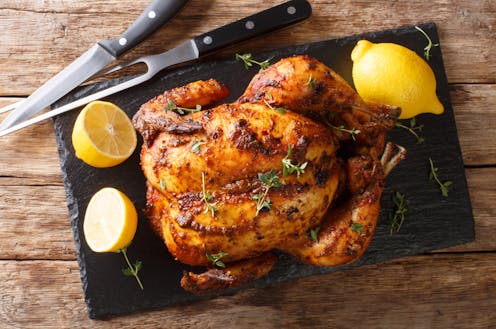
Finally, cook chicken thoroughly as viruses (including bird flu) cannot survive cooking temperatures.
Are eggs safe?
The recent Australian outbreaks have occurred in egg-laying or mixed poultry flocks, so concerns have been raised about bird flu transmission via contaminated chicken eggs.
Can flu viruses contaminate chicken eggs and potentially spread bird flu? It appears so. A report from 2007 said it was feasible for influenza viruses to enter through the eggshell. This is because influenza virus particles are smaller (100 nanometres) than the pores in eggshells (at least 200 nm).
So viruses could enter eggs and be protected from cleaning procedures designed to remove microbes from the egg surface.
Therefore, like the advice about milk and meat, cooking eggs is best.
The US Food and Drug Administration recommends cooking poultry, eggs and other animal products to the proper temperature and preventing cross-contamination between raw and cooked food.
In a nutshell
If you consume pasteurised milk products and thoroughly cook your chicken and eggs, there is nothing to worry about as bird flu is inactivated by heat.
The real fear is that the virus will evolve into highly pathogenic versions that can be transmitted from human to human.
That scenario is much more frightening than any potential spread though food.
Read more https://theconversation.com/with-all-this-bird-flu-around-how-safe-are-eggs-chicken-or-milk-231280


