

Are Australians socially inclusive? 5 things we learned after surveying 11,000 people for half a decade
- Written by The Conversation
As Australians across the country prepare to vote, many will be reflecting on what can help build a prosperous and inclusive society.
Over the last five years, we have been measuring social inclusion by surveying more than 11,000 Australians on prejudice, experiences of discrimination, sense of belonging and well-being, contact with diverse groups of people, and willingness to volunteer and advocate for social inclusion.
Our findings, released today in the Inclusive Australia Social Inclusion Index 2021-22, show discrimination remains common for some groups. Australians are identifying less with their country than before and there are signs prejudice towards some groups is dropping.
Social inclusion matters. Research in 2016 found racism alone had an economic cost of A$44.9 billion per year. In 2020, The Brotherhood of St Laurence estimated 1.2 million Australians suffer “deep social exclusion”.
Our report provides a snapshot of a changing Australia and highlights areas to improve our sense of belonging, well-being, and opportunity to have a “fair go”. Here is what we learned:
1. Experiences of discrimination remain common, especially for some groups
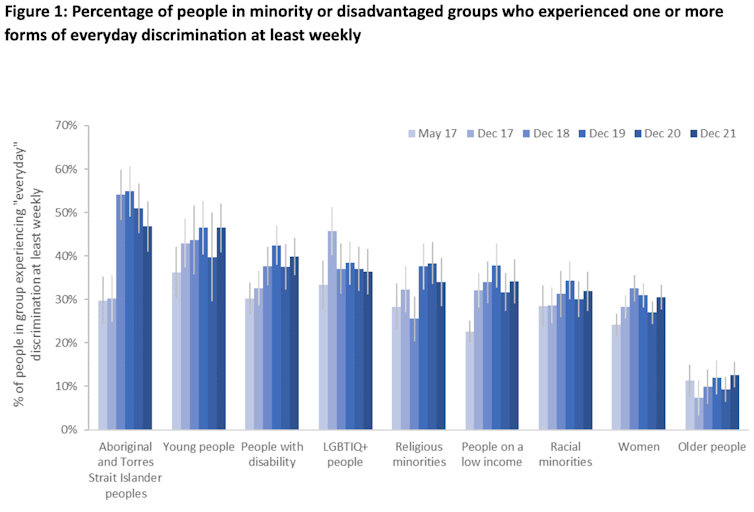
Half of Aboriginal and Torres Strait Islander peoples surveyed experienced major discrimination in the past two years, such as being unfairly fired from a job. And nearly half experienced “everyday” discrimination at least weekly, such as being called names or receiving poor service.
Over time, we have also seen changes in discrimination alongside significant societal events. We are all too aware of the impact that debate around legislation such as the Racial Discrimination Act can have on members of the communities they are designed to support.
In our own data, during the time of the federal government’s same sex marriage survey in 2017, the percentage of LGBTIQ+ people who experienced “everyday” discrimination jumped from 33% to 46%. Since then, experiences of discrimination have returned to levels seen before the same sex marriage survey.
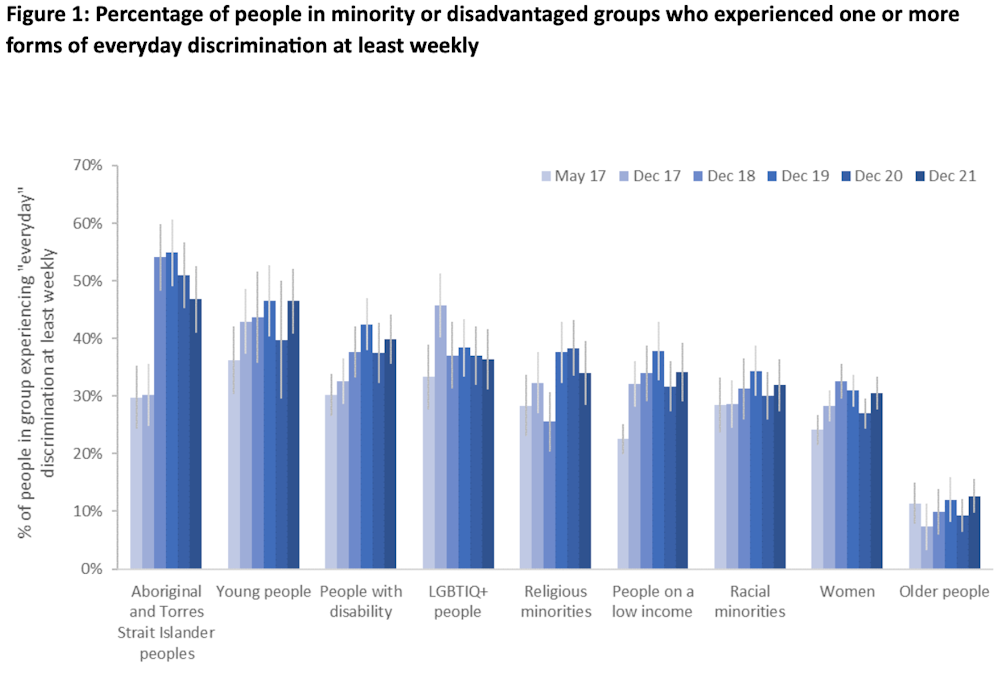 Experiences of discrimination remain common, especially for some groups.
Author provided.
Experiences of discrimination remain common, especially for some groups.
Author provided.
2. Australians are identifying less with their country and local communities
One emerging trend is the steady decline in Australians’ identification and feelings of belonging with their country and local community.
We measured this by asking respondents how close they felt to or identified with their local community, other Australians, and people all over the world.
While it is tempting to point to the role of the COVID-19 pandemic in influencing this, these changes go back to the start of the index in 2017.
Having a strong social identity with a group is important for taking action to benefit that group – as well as for our own well-being.
Despite identity declining with local community and Australia, it is reassuring that Australians’ identification with people all over the world has remained mostly unchanged, as this has been linked to reduced prejudice, greater empathy, and deeper humanitarian concerns.
3. People who identify with multiple minority groups are more vulnerable
By examining multiple dimensions of diversity simultaneously, our data helps shed light on intersectionality – the fact that different aspects of a person’s identity exposes them to overlapping and reinforcing forms of inequality.
We found people who identified with two or more minority or disadvantaged groups experienced greater levels of discrimination and lower well-being than those identifying with one group alone.
For example, two-thirds of Aboriginal and Torres Strait Islander peoples who were also LGBTIQ+ in our survey experienced major discrimination (such as being discouraged from continuing education) in the last two years.
4. We don’t regularly mix with some groups
A great deal of research in social psychology has pointed to contact with different groups of people as a remedy for prejudice.
Our data also showed the more contact people had with a minority group, the more they perceived that contact as pleasant.
In reality, however, many Australians had limited contact with people from minority groups.
Almost one in five (17%) of respondents reported “never” having any contact with Aboriginal and Torres Strait Islander peoples.
One in five also said they “never” had any contact with religious minorities.
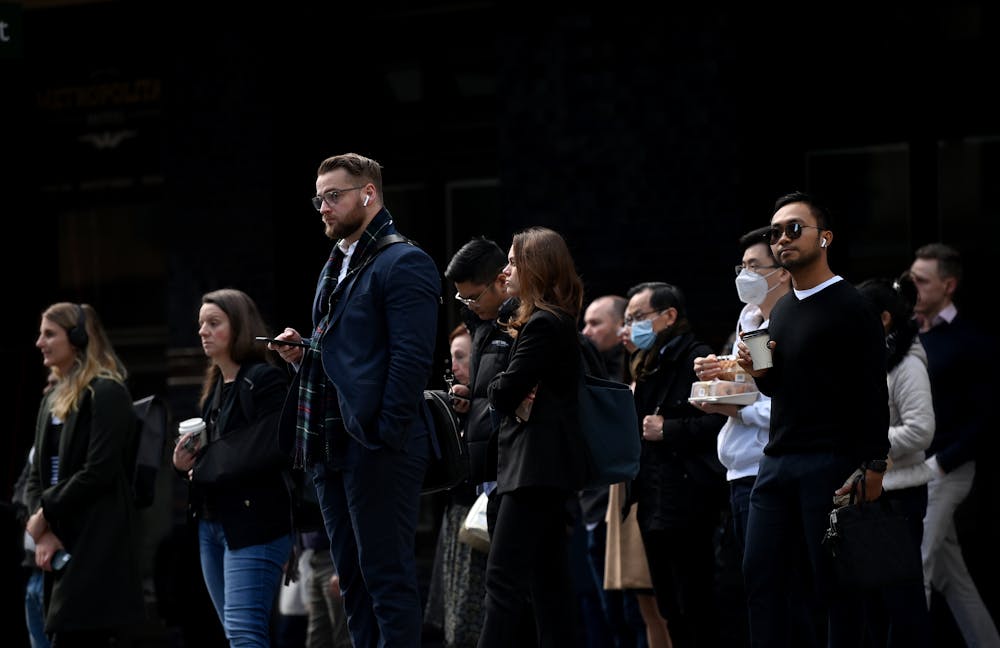
 One emerging trend is the steady decline in Australians’ identification and feelings of belonging with their country and local community.
AAP Image/Tony McDonough
One emerging trend is the steady decline in Australians’ identification and feelings of belonging with their country and local community.
AAP Image/Tony McDonough
5. Positive signs of change are afoot
In addition to discrimination, we also measured people’s agreement with statements tapping into blatant or subtle prejudice, such as “If young people would only try harder they could be as well off as other Australian people”.
While religious and racial minorities remained the target of high levels of prejudice, this has dropped since the start of the index. In December 2021, 17% of people were highly prejudiced (meaning on average they “moderately” or “strongly” agreed with prejudiced statements) against racial minorities, down from 24% five years earlier.
Another promising finding in our data was the number of people willing to volunteer and take action to ensure that all people are treated equally.
At least half of respondents were “moderately” or “very willing” to speak up when they saw discrimination or validate the experiences of those who had been discriminated against.
This is important because it creates norms that prejudice is not acceptable, and amplifies the voices of minority groups.
As Australians head to the polling booth, hopefully it also means voters will be looking for policies that unite us and support those from minority and disadvantaged groups.
Read more: Racism is still an everyday experience for non-white Australians. Where is the plan to stop this?


