

Just 15 centimetres of water can float a car – but we are failing to educate drivers about the dangers of floodwaters
- Written by The Conversation
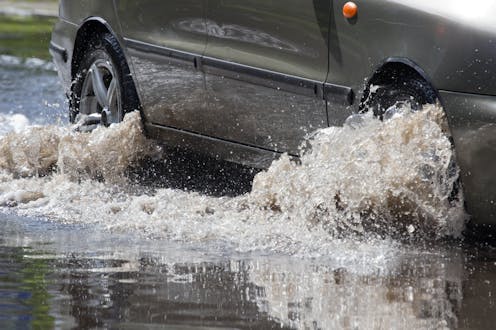
Every year in Australia, people driving into floodwaters drown and many more are rescued. Do you know what to do when there’s water on the road?
We searched all state and territory learner and driver handbooks for information about floodwaters, including signage. Our findings, published in the Journal of Safety Research, are disturbing.
Across half of Australia’s states and territories, the driver handbook ignores flooding. That’s a missed opportunity, considering the handbook contains road rules and provides advice on how to navigate safely. While some states fail to provide any flood-related information, others give detailed practical guidance. Only the New South Wales handbook includes explanation of the meaning and purpose of flood signage.
This is despite almost all states and territories experiencing vehicle-related flood deaths, including drowning, between 2001 and 2017. It’s a major problem that is only going to get worse as the climate changes. So our research shows driver education needs to come up to speed, fast.
Why do people drive into floodwaters?
Our previous research revealed motorists can feel compelled to drive into floodwaters for a range of reasons. These include time pressures such as being late for work or school, or needing to get home to family or pets. Sometimes they feel pressured by their passengers, or motorists behind them on the road, urging them to cross.
People also report having been encouraged or instructed as learners to drive into floodwaters. Past experience as a passenger also influences a learner driver’s future willingness to drive into floodwaters.
So the views of significant others, such as their supervising driver, strongly influence decisions around driving into floodwaters.
Avoid driving into floodwaters, for life’s sake.What we did and what we found
We assessed all publicly available, government-issued learner and driver handbooks (12 documents) across all six Australian states and two territories. We also looked for flood-related signage. We used a method for reviewing online material through a systematic search including in-document key words and imagery.
Four jurisdictions provided no information on flooding in the handbook. In the ACT, South Australia, Tasmania and Victoria, drivers need to look elsewhere for information on floodwaters and driving safety.
Only one jurisdiction provided information on flood signage such as depth markers and “road subject to flooding”. Hats off to the NSW Road User Handbook, which warns:
Floodwater is extremely dangerous. Find another way or wait until the road is clear. It’s safer to turn around than to drive in floodwater.
For the states and territories that did provide information on floodwaters in the handbook, the content varied.
NSW, Queensland and the Northern Territory warned against entering floodwaters in a vehicle. They highlighted the dangers and financial penalties associated with driving on closed roads.
In the NT and Western Australia, handbooks provided practical information on when and how to cross floodwaters safely, such as how to gauge safe water depth based on vehicle size, and to avoid fast-flowing water.
Although well-intentioned, judgements around what constitutes fast-flowing water are subjective and hard for any driver to assess, let alone learner drivers. Even drivers of larger vehicles such as four-wheel drives are regularly involved in flood-related vehicle drowning fatalities.
Just 45cm of water can float a large 4WD, and considerably less for smaller vehicles.
A small car can float in just 15cm of water.Handbooks represent valuable sources of safety information, particularly for new drivers who must learn important road rules to progress from one licence to another. Such graduated driver licensing schemes reduce road traffic injury, particularly among young people.
However, many of these handbooks fail to provide consistent, practical evidence-based information about flooding. There is an opportunity here to support safer driving behaviours.
Safety tips for all drivers
We encourage drivers to follow these safety tips:
- avoid driving into floodwaters
- identify alternative routes, so you have a plan B
- familiarise yourself, and any learner drivers in the household or under your care, with the meaning and purpose of flood signage
- understand the legal consequences of crossing a road closed sign
- discuss the dangers of driving into floodwaters with learner drivers and help them formulate their own plan B
- model safe driving for all passengers, including children.
Time to lift our game
Driving into floodwaters remains the main cause of flood-related drowning in Australia.
For our emergency service personnel, driver behaviour, including people ignoring road closed signs, significantly complicates the already dangerous act of performing a flood rescue.
Extreme weather and flooding are likely to become more frequent and intense in the future. That means the chance of being faced with a flooded road is growing. So information about driving during floods is vital for all, from the newly licensed to the experienced driver.
We hope our research will encourage all states and territories to include provide practical, evidence-based advice on floods in driver handbooks as soon as possible.


