

No croutons, no anchovies, no bacon: the 100-year-old Mexican origins of the Caesar salad
- Written by The Conversation
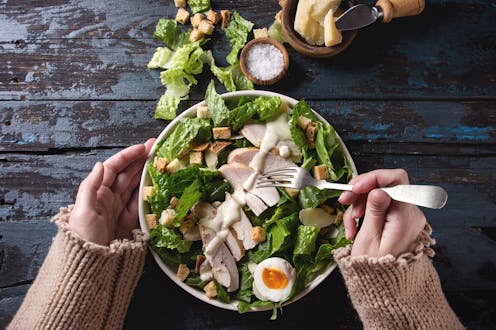
The most seductive culinary myths have murky origins, with a revolutionary discovery created by accident, or out of necessity.
For the Caesar salad, these classic ingredients are spiced up with a family food feud and a spontaneous recipe invention on the Fourth of July, across the border in Mexico, during Prohibition.
Our story is set during the era when America banned the production and sale of alcohol from 1919–1933.
Two brothers, Caesar (Cesare) and Alex (Alessandro) Cardini, moved to the United States from Italy. Caesar opened a restaurant in California in 1919. In the 1920s, he opened another in the Mexican border town of Tijuana, serving food and liquor to Americans looking to circumvent Prohibition.
Tijuana’s Main Street, packed with saloons, became a popular destination for southern Californians looking for drink. It claimed to have the “world’s longest bar” at the Ballena, 215 feet (66 metres) long with ten bartenders and 30 waitresses.
The story of the Caesar salad, allegedly 100 years old, is one of a cross-border national holiday Prohibition-era myth, a brotherly battle for the claim to fame and celebrity chef endorsements.

Necessity is the mother of invention
On July 4 1924, so the story goes, Caesar Cardini was hard at work in the kitchen of his restaurant, Caesar’s Place, packed with holiday crowds from across the border looking to celebrate with food and drink.
He was confronted with a chef’s worst nightmare: running out of ingredients in the middle of service.
As supplies for regular menu items dwindled, Caesar decided to improvise with what he had on hand.
 The Caesar salad was tossed together with what was on hand in the dwindling kitchen.
EPA/Joebeth TerrÃquez
He took ingredients in the pantry and cool room and combined the smaller leaves from hearts of cos lettuce with a dressing made from coddled (one-minute boiled) eggs, olive oil, black pepper, lemon juice, a little garlic and Parmesan cheese.
The novel combination was a huge success with the customers and became a regular menu item: the Caesar salad.
Et tu, Alex?
There is another version of the origin of the famous salad, made by Caesar’s brother, Alex, at his restaurant in Tijuana.
Alex claims Caesar’s “inspiration” was actually a menu item at his place, the “aviator’s salad”, named because he made it as a morning-after pick-me-up for American pilots after a long night drinking.
His version had many of the same ingredients, but used lime juice, not lemon, and was served with large croutons covered with mashed anchovies.
When Caesar’s menu item later became famous, Alex asserted his claim as the true inventor of the salad, now named for his brother.
Enter the celebrity chefs
To add to the intrigue, two celebrity chefs championed the opposing sides of this feud. Julia Child backed Caesar, and Diana Kennedy (not nearly as famous, but known for her authentic Mexican cookbooks) supported Alex’s claim.
By entering the fray, each of these culinary heavyweights added credence to different elements of each story and made the variations more popular in the US.
While Child reached more viewers in print and on television, Kennedy had local influence, known for promoting regional Mexican cuisine.
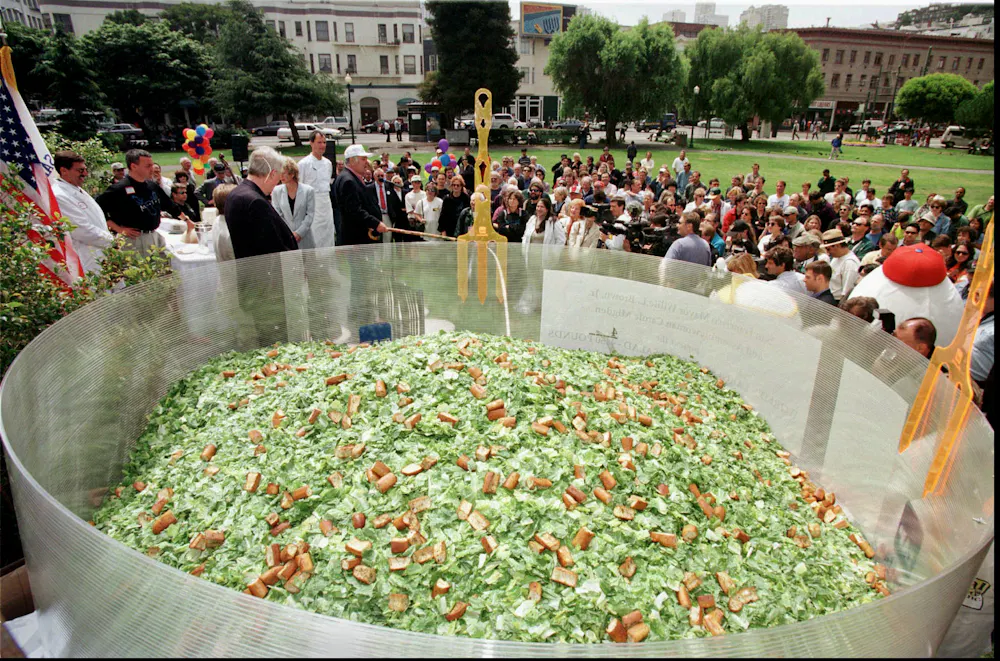 The world’s biggest Caesar salad was made in San Francisco in 1998. It weighed in at over two tons.
Ben Margot/AP Photo
While they chose different versions, the influence of major media figures contributed to the evolution of the Caesar salad beyond its origins.
The original had no croutons and no anchovies. As the recipe was codified into an “official” version, garlic was included in the form of an infused olive oil. Newer versions either mashed anchovies directly into the dressing or added Worcestershire sauce, which has anchovies in the mix.
Caesar’s daughter, Rosa, always maintained her father was the original inventor of the salad. She continued to market her father’s trademarked recipe after his death in 1954.
Ultimately she won the battle for her father’s claim as the creator of the dish, but elements from Alex’s recipe have become popular inclusions that deviate from the purist version, so his influence is present – even if his contribution is less visible.
No forks required – but a bit of a performance
If this weren’t enough, there is also a tasty morsel that got lost along the way.
Caesar salad was originally meant to be eaten as finger food, with your hands, using the baby leaves as scoops for the delicious dressing ingredients.
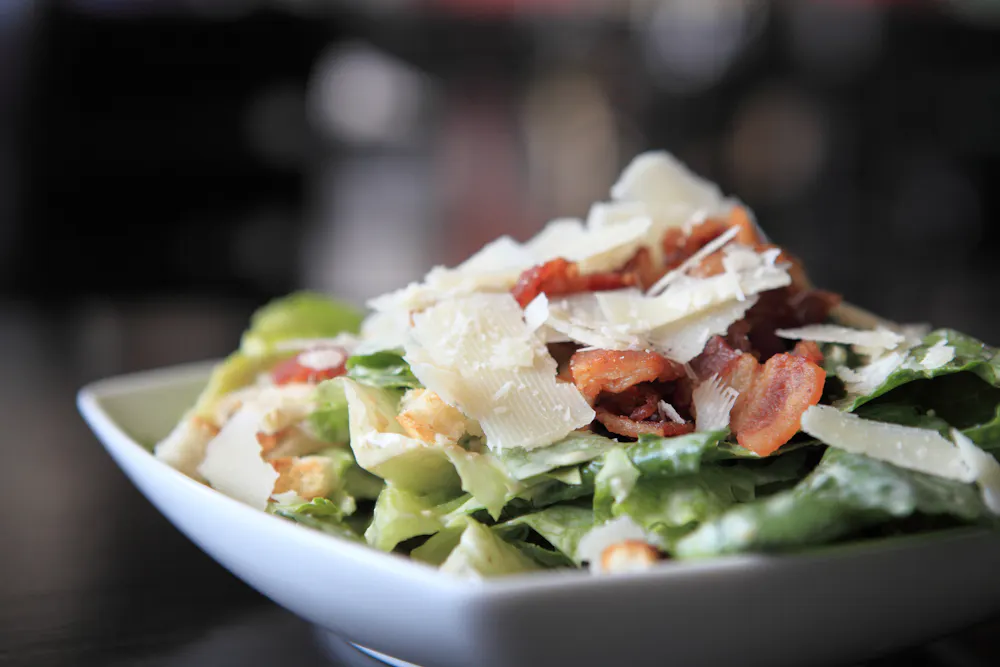 There was no bacon to be seen in the original Caesar salad.
Piyato/Shutterstock
For presentation in a restaurant, the salad was also created in front of the diners’ table, on a rolling cart, with some recommending a “true” Caesar salad was tossed only seven times, clockwise.
This extra level of drama, performance and prescribed ritual was usually limited to alcohol-doused flaming desserts.
To have a humble salad, invented in desperation, elevated to this kind of treatment made it a very special dish – even without any bacon.


