

65,000 years of food scraps found at Kakadu tell a story of resilience amid changing climate, sea levels and vegetation
- Written by The Conversation
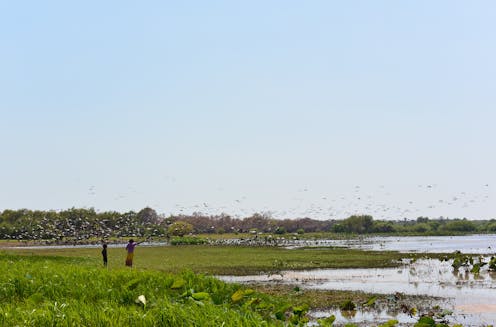
For 65,000 years, Bininj – the local Kundjeihmi word for Aboriginal people – have returned to Madjedbebe rock shelter on Mirarr Country in the Kakadu region (in the Northern Territory).
Over this immense span of time, the environment around the rock shelter has changed dramatically.
Our paper, published last week in Quaternary Science Reviews, uses ancient scraps of plant foods, once charred in the site’s fireplaces, to explore how Aboriginal communities camping at the site responded to these changes.
This cooking debris tells a story of resilience in the face of changing climate, sea levels and vegetation.
A changing environment
The 50-metre-long Madjedbebe rock shelter lies at the base of a huge sandstone outlier. The site has a dark, ashy floor from hundreds of past campfires and is littered with stone tools and grindstones.
The back wall is decorated with vibrant and colourful rock art. Some images – such as horsemen in broad-brimmed hats, ships, guns and decorated hands – are quite recent. Others are likely many thousands of years old.
Today, the site is situated on the edge of the Jabiluka wetlands. But 65,000 years ago, when sea levels were much lower, it sat on the edge of a vast savanna plain joining Australia and New Guinea in the supercontintent of Sahul.
At this time, the world was experiencing a glacial period (referred to as the Marine Isotope Stage 4, or MIS 4) . And while Kakadu would have been relatively well-watered compared with other parts of Australia, the monsoon vine forest vegetation, common at other points in time, would have retreated.
This glacial period would eventually ease, followed by an interglacial period, and then another glacial period, the Last Glacial Maximum (MIS 2).
Cut to the Holocene (10,000 years ago) and the weather became much warmer and wetter. Monsoon vine forest, open forest and woodland vegetation proliferated, and sea levels rose rapidly.
By 7,000 years ago, Australia and New Guinea were entirely severed from each other and the sea approached Madjedbebe to a high stand of just 5km away.
What followed was the rapid transformation of the Kakadu region. First the sea receded slightly, the river systems near the site became estuaries, and mangroves etched the lowlands.
By 4,000 years ago, these were partially replaced by patches of freshwater wetland. And by 2,000 years ago, the iconic Kakadu wetlands of today were formed.
Unlikely treasure
Our research team, composed of archaeologists and Mirarr Traditional Owners, wanted to learn how people lived within this changing environment.
To do this, we sought an unlikely archaeological treasure: charcoal. It’s not something that comes to mind for the average camper, but when a fireplace is lit many of its components – such as twigs and leaves, or food thrown in – can later transform into charcoal.
Under the right conditions, these charred remains will survive long after campers have moved on. This happened many times in the past. Bininj living at Madjedbebe left a range of food scraps behind, including charred and fragmented fruit, nuts, palm stem, seeds, roots and tubers.

Using high-powered microscopes, we compared the anatomy of these charcoal pieces to plant foods still harvested from Mirarr Country today. By doing so, we learned about the foods past people ate, the places they gathered them from, and even the seasons in which they visited the site.
Read more: Burnt ancient nutshells reveal the story of climate change at Kakadu — now drier than ever before
Ancient anme
From the earliest days of camping at Madjedbebe, people gathered and ate a broad range of anme (the Kundjeihmi word for “plant foods”). This included plants such as pandanus nuts and palm heart, which require tools, labour and detailed traditional knowledge to collect and make edible.
The tools used included edge-ground axes and grinding stones. These were all found in the oldest layers at the site – making them the oldest axes and some of the earliest grinding stones in the world.
Our evidence shows that during the two drier glacial phases (MIS 4 and 2), communities at Madjedbebe relied more on these harder-to-process foods. As the climate was drier, and food was probably more dispersed and less abundant, people would have had to make do with foods that took longer to process.
Highly prized anme such as karrbarda (long yam, Dioscorea transvera) and annganj/ankanj (waterlily seeds, Nymphea spp.) were significant elements of the diet at times when the monsoon vine forest and freshwater vegetation got closer to Madjedbebe – such as during wetland formation in the last 4,000 years and earlier wet phases. But they were also sought from more distant places during drier times.
A change of seasons
The biggest shift in the plant diet eaten at Madjedbebe occurred with the formation of freshwater wetlands. About 4,000 years ago, Bininj didn’t just start to include more freshwater plants in their diet, they also began to return to Madjedbebe during a different season.
Rather than coming to the rock shelter when local fruit trees such as andudjmi (green plum, Buchanania obovata) were fruiting, from Kurrung to Kunumeleng (September to December), they began visiting from Bangkerrang to Wurrkeng (March to August).
Read more: Explainer: the seasonal 'calendars' of Indigenous Australia
This is a time of year when resources found at the edge of the wetlands, now close to Madjedbebe, become available as floodwaters recede. With the emergence of patchy freshwater wetlands 4,000 years ago, communities changed their diet to make the best use of their environments.
Today, the wetlands are culturally and economically significant to the Mirarr and other Bininj. A range of seasonal animal and plant foods feature at dinner time, including magpie geese, turtles and waterlilies.
The burning question
It’s likely the First Australians not only responded to their environment but also shaped it. In the Kakadu region today, one of the main ways Bininj modify their landscape is through cultural burning.
Fire is a cultural tool with a multitude of functions – such as, hunting, generating vegetation growth, and cleaning up pathways and campsites.
One of its most important functions is the steady reduction of wet season biomass which, if left unchecked, becomes fuel for dangerous bushfires in Kurrung (September to October), at the end of the dry season.
Our data demonstrates the use of a range of plant foods at Madjedbebe during Kurrung, throughout most of the site’s occupation, from 65,000 to 4,000 years ago.
This points to an ongoing practice of cultural burning, as it suggests communities managed fire-sensitive plant varieties, and reduced the chance of high-intensity bushfires by practicing low-intensity cultural burns before the hottest time of the year.
Today, the Mirarr still return to Madjedbebe. Their knowledge of local anme is passed down to new generations, who continue to shape this incredible cultural legacy.
Acknowledgment: we would like to thank the Gundjeihmi Aboriginal Corporation, the Mirrar, and especially our co-authors May Nango and Djaykuk Djandjomerr.


