

Not quite a street, not quite a road – why ‘stroads’ are disasters of urban planning, and how to fix them
- Written by The Conversation
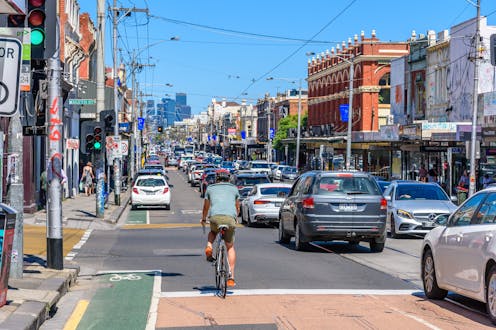
Have you ever walked or ridden a bike along a street, and thought to yourself, “Gosh, it’s noisy”, or “This feels unpleasant”? Odds are you were on a stroad.
Maybe you’ve seen someone on social media talking about a “loud, polluted, car-filled, congestion-blocked, unbearably hot, decaying concrete nightmare” of a street. Yep, that’s definitely a stroad.
The term stroad – a portmanteau of street and road – is said to have been coined over a decade ago by “recovering engineer” Charles Marohn to describe a hybrid street and road.
Stroads are trying to be both a thoroughfare for vehicles, and a place for people.
Typically they fail at both, with Marohn saying:
It is truly the worst of all possible approaches. Our neighborhoods are filled with stroads.
What’s wrong with stroads?
Stroads have an inherent conflict between their role as a movement corridor and their role as a place. While they try to be everything to everyone, they become nothing to anyone.
Focusing on movement funnels more cars and trucks into a street, making it more like a road.
This lessens the sense of place, which is the very reason people wanted to go there in the first place.
The end result is a stroad, something which is neither a good street for people nor a good road for drivers. In some cases, they can be a good road to drive on, but a particularly unpleasant street for pedestrians and cyclists to be on.
In the United States, where the term originated, the term stroad largely refers to highways with shops along the sides.
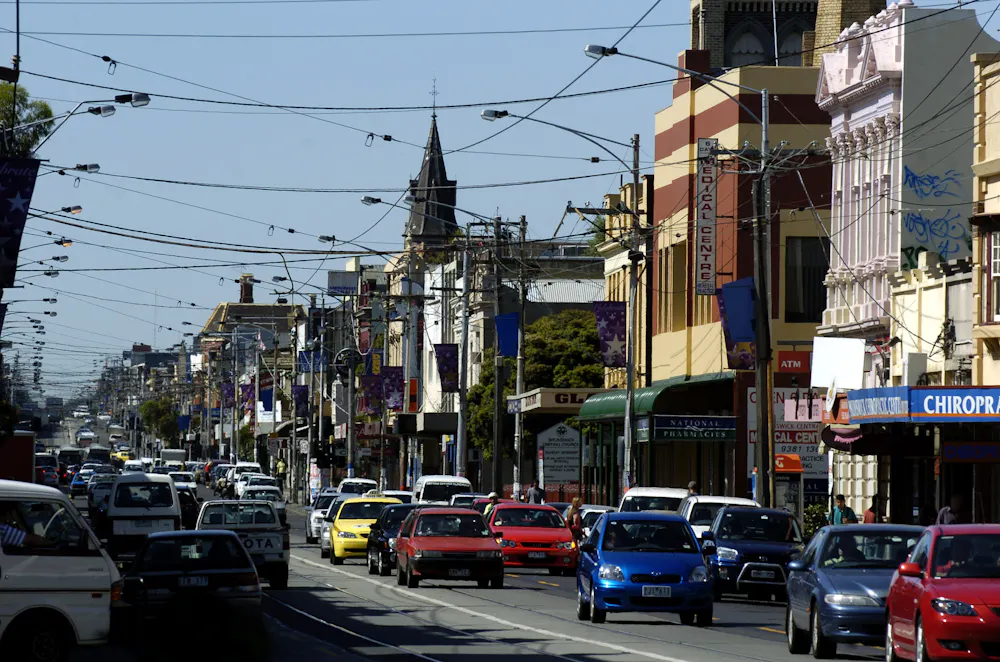
Many major roads in large Australian cites are stroads. Think of Parramatta Road or Cremorne’s Military Road in Sydney, and City Road in Melbourne. In Brisbane, consider Ann Street and Wickham Street. In Perth, think of Charles Street or Beaufort Street. Or, lastly, Sir Donald Bradman Drive or Anzac Highway in Adelaide.
We also find stroads in our many shopping strips. King Street in Sydney or Sydney Road in Melbourne spring to mind.
Again, movement of cars and trucks gets prioritised above people and sense of place. This results in a significant imbalance in space allocation between motorists and other users.
The development of stroads is a reflection on an older way of thinking, which views all streets and roads as places for cars and trucks. As one Victorian government document put it:
Traditionally, roads and streets are considered only movement corridors to get us from A to B. [But] streets not only keep people and goods moving, they’re also places for people to live, work and enjoy.
How to fix a stroad
Thinking has changed on how we should use street space. Many Australian states have begun implementing a framework called “movement and place”.
This shifts away from seeing streets as things that support movement of cars and trucks, and toward a view they move people and goods, but also have a place function.
“Movement and place” frameworks can be used to identify what a street’s role is, and where it may be lacking. However, this only diagnoses the problem, it does not solve it.
To truly solve the stroad, we need to change the priority of the street. We need to remove some space given to cars (both driving and parking), and give that space to people and place.
And yes, it can be done. There is a concept called complete streets. This re-imagines how our streets are laid out, giving more space to people and public transport. These makeovers improve overall flow of people and benefit the local economy.
Many major stroads have benefited from street makeovers. Prominent examples include:
Smaller scale, temporary initiatives, such as parklets, can help too. This is where parking spaces are converted to public space, as either parks or outside dining space. We saw pop-up parklets across Australia during COVID, to help with physical distancing. These temporary measures can be a great way to see how change could look.
Opposition to change
Such proposals often meet fierce opposition.
In 2015, then-NSW opposition leader Luke Foley called a plan to replace cars on George Street with light rail “stupid”, claiming it would worsen traffic.
In Melbourne, Robert Doyle ran for, and won, the 2008 mayoral race on a promise to reopen Swanston Street to traffic.
However, the Sydney light rail was built and Swanston Street was instead redeveloped to improve pedestrian, cycling, and tram access.
We now have two bustling civic places of which we should all be proud, both replacing unpleasant stroads which ran through the heart of each city.
While urban change can sometimes be controversial, it can help to consider the counter-factual. How would we feel if things were the other way around?
For example, if we currently had trams, widened footpaths, and bicycle lanes down Sydney’s Parramatta Road or Melbourne’s City Road, would we rip them out to build six lane stroads?
I think not.


