

Trying to stay warm in bed this winter? In pre-industrial Europe they did it with ten in the bed
- Written by The Conversation
Though the Bureau of Meteorology originally predicted temperatures would be higher than the average this winter, those living on Australia’s east coast may beg to differ.
Social media sites are increasingly attracting comments, images and videos featuring their users lamenting the frigid turn in the weather.
One notable strand of these posts typically presents a user more familiar with a northern European winter coming to terms with the fact that Australian houses and apartments aren’t insulated or heated as well as those in colder climates.
In an age before central heating, Europeans too suffered through the dilemma of how to keep warm in winter. People experienced the cold extremely differently depending on factors such as socio-economics or the region in which they lived and what materials were available there.
The greatest struggle with the cold often happened at night, and strategies for keeping warm in bed were varied and innovative.
Knowing some of the ways people in pre-industrialised Europe dealt with cold weather may provide comfort through this current bout of chilly weather – either practically, or by comparison with what often were much harsher experiences of the cold.
There were ten in the bed
One of the simplest ways to stay warm for those of relatively modest means was to huddle together.
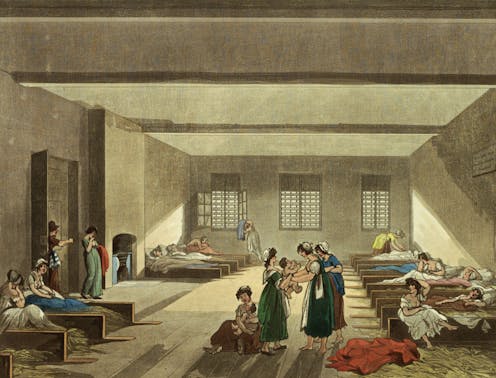
In Early Modern Europe and colonial America, the quality of bedding materials varied greatly and would likely not have been enough to keep the cold at bay in the depths of winter.
Historian Carole Shammas has revealed it was common for bedding to be made from straw, and even woollen flock was considered a luxury only available to the prosperous.
Fluffy plant downs, such as the seed heads of the thistle, cattail or bulrush were commonly used. But even such humble materials were costly.

As historian A. Roger Ekirch has shown, bedding was so expensive it might equate to up to a quarter of the value of a modest household, explaining why commodities like pillows were reserved for those with some great need, like women during childbirth. For most, some other form of bolster was used, like a log.
Recently, Holly Fletcher has outlined Early Modern attempts to regulate the bedding industry in order to secure comfort and health to a wider segment of society.
 Gerhard ter Borch, Portrait of a Family, 1656.
Hallwyl Museum/Wikimedia Commons
Gerhard ter Borch, Portrait of a Family, 1656.
Hallwyl Museum/Wikimedia Commons
Yet, the cost and general quality of bedding meant that other strategies for keeping warm persisted.
It was typical for groups of people of different genders, ages and relationship statuses to sleep in the same bed together to keep one another warm. These groups may have even included employees and employers – though sleep may also have happened in shifts, so groupings were kept appropriate according to social and cultural mores.
Bedding down
Finer quality bedding materials were available, but they came at a prohibitive financial cost and could be difficult to source.
In his diary entry of September 9 1665, the great English writer and naval official Samuel Pepys (1633–1703) wrote:
I lay the softest I ever did in my life, with a downe bed, after the Danish manner.
 Pieter Lastman, Wedding Night of Tobias and Sarah, 1611.
Museum of Fine Arts Boston/Wikimedia Commons
Pieter Lastman, Wedding Night of Tobias and Sarah, 1611.
Museum of Fine Arts Boston/Wikimedia Commons
Various downs had been used in Europe since the 7th century, and a down mattress would often be laid over one of stiffer material – like straw – to provide more support and even better insulation.
The most coveted down came from the Eider duck, of which there are various species. Eider ducks live along the northern coasts of Europe, North America and Siberia. Eiderdown is the down a female Eider duck pulls from her body to make a nest and has very high insulating properties as well as lightness, cohesion and resilience.
In places like Iceland, the production and trade of this valuable down had been controlled and protected by law since at least the 13th century, indicating its great worth to the wider Icelandic economy.
Eiderdown only became available in places like England and France in the 17th century, such was its rarity. Its impact was pronounced, and it attracted devotees. Letters relaying the latest political news were interspersed with advice on how to best sew down into a coverlet.
But not all those encountering eiderdown for the first time found it compelling or even necessary.
 The dog Gelert guards the daughter of Prince Llewellyn after saving her from the attack of a wolf. Engraving by W.H. Mote after D. Maclise.
Wellcome Collection
The dog Gelert guards the daughter of Prince Llewellyn after saving her from the attack of a wolf. Engraving by W.H. Mote after D. Maclise.
Wellcome Collection
Elizabeth Charlotte, duchesse d'Orléans (1652–1722), was the sister-in-law of king Louis XIV of France (1638–1715). Upon sleeping with eiderdown for the first time, she wrote to a relative to explain she much preferred her usual method of keeping warm in bed.
That is, as the mother of an assortment of small dogs, to whom she was devoted, she simply tucked them around herself in her bed, under her covers, and slept comfortably through the night, warmed by her furry companions.
 Vittore Carpaccio, The Dream of St Ursula, circa 1495–1500.
Wikimedia Commons
Vittore Carpaccio, The Dream of St Ursula, circa 1495–1500.
Wikimedia Commons
Whether pursuing multiple sleeping companions, sewing quilted down duvets or snuggling with willing pets, managing cold weather was a common preoccupation in Early Modern Europe, one which required careful consideration by individuals, industry and state regulators, with varying degrees of success.
At least in the 21st century, logs no longer have a place at the head of a mattress – whatever comfort that knowledge may bring.


