

The State Library of Victoria controversy shows what can happen when institutions cling to ‘neutrality’
- Written by The Conversation
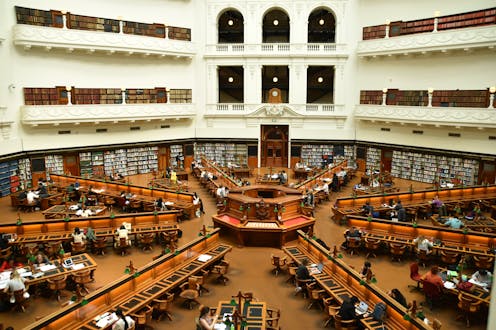
For months now, the State Library of Victoria’s official explanation for the “postponement” of its Teen Writing Bootcamp workshops has been the need to ensure safety for all involved.
The bootcamps benefit youth across the country. The State Library hires writers with diverse expertise and experiences to teach them. In March, authors Omar Sakr, Alison Evans and Jinghua Qian, all of whom have all been vocal critics of Israel’s war in Gaza, were taken aback when they were informed their workshops had been cancelled, a week before they were due to give them.
The library explained the unexpected postponement was a result of it “taking its obligations for safety of participants, presenters and facilitators very seriously” in “a time of heightened sensitivities”. It has promised the bootcamps will be rescheduled, though there is still no indication when that might be.
This week, newly-released emails reveal that “safety” may not have been the main concern for senior management and board members. Rather, the emails focused on the authors contracted to teach the bootcamp workshops and, particularly, their views and statements on Palestine.
A consistent element in library communications, including the emails shared by The Age, is insistence on the “neutrality” of the library. “We must adhere to a policy of strict neutrality,” asserted former Labor MP and then board member Maxine McKew. “The Library is apolitical,” insists official communications.
Yet the emails corroborate the version of events consistently advanced by the authors who saw their teaching contracts cancelled. Over 100 library staff argued in a letter to management that the library committed “censorship and discrimination” with its decision.
The situation has left the library’s reputation tarnished and its community relations fractured. Writers, including Michelle de Kretser and Tony Birch, are boycotting the library, citing the damage to authors’ reputations and to the trust between authors and the library. It has reportedly degraded the library’s workplace culture, with morale suffering as management tightens its grip on permitted expression, including the “pins and badges” staff are allowed to wear.
Out of step?
The controversy is surprising to many familiar with the State Library of Victoria. Previously, the library has taken an unequivocal stand in support of drag storytimes. On that issue, CEO Paul Duldig called out the “chilling effect” on democracy when events celebrating literacy are threatened by harassment and violence.
In December 2023, the library hosted former American Library Association executive director Tracie D. Hall for a major lecture on opposing censorship and defending the right to read freely.
Given this track record, the emails released this week suggest why the Teen Writing Bootcamp program’s sudden need for a “Duty of Care Review” seemed out of step.
As The Age reports, the emails do not clarify precisely when the decision to cancel the Teen Writing Bootcamps was made, or by whom. But both The Age and the Guardian have revealed the authors’ beliefs and activities were discussed with library board members, funders and donors.
The library continues to insist the bootcamps have been postponed, not cancelled, while it conducts a Duty of Care Review. Whatever the future brings, upholding authors’ rights to free expression about the war on Gaza was something the library leadership chose not to support in this instance.

The problem with neutrality
One possible explanation for the controversial decision may be beliefs around “library neutrality”. The rhetoric of neutrality can be used to avoid potential or perceived risks of events like the bootcamps, even though doing so implies certain views are too risky or dangerous for events to proceed.
Library neutrality is a concept dating back decades that still prompts deep disagreement among librarians. Proponents insist the proper role of libraries is not to “take sides” on issues. Rather, to meet their mandates, libraries must focus on providing information that meets community needs, without privileging viewpoints, including their own. As defenders of neutrality point out, this includes protecting the availability of information that is deeply unpopular or offensive.
Librarians who critique neutrality argue that when society faces polarisation, misinformation and backlash, alongside efforts to dismantle historical inequities, it becomes clear that libraries cannot be “neutral” information brokers.
Research shows librarians take care to represent perspectives fairly in their collections, programs and services, regardless of their personal views. Yet not all viewpoints are equally valid, and libraries have a responsibility not to propagate disinformation that proliferates in mainstream and social media.
Libraries are places where the realities of social and political debates come to life. As with book bans and the practice of weeding books from library shelves, librarians must make judgement calls. The stakes become heightened where there is significant public disagreement, including situations where external pressures are provided in bad faith or reflect bigoted views.
This means librarians are tasked with upholding values most people agree on in the abstract – such as freedom of information and expression – that can be challenging to apply in day-to-day decision making. It is critical for libraries to maintain the trust of their communities. But this can be a significant challenge when communities include divergent views, and when funders or donors exert pressure.
This has opened up recent discussions among librarians on post-neutrality, and questioning what “neutrality” means today. Given the challenges we face globally – from the climate emergency, to threats from disinformation and the need for sustainable development – many argue libraries must move beyond neutrality to acknowledge complex social issues and power imbalances, and help our communities navigate those issues.
The State Library of Victoria is nearly 170 years old. Leadership, staff and community members alike can take pride in its history as one of the first free public libraries in the world, built on a belief in the power of access to knowledge.
The postponement of the Teen Writing Bootcamps offers an opportunity for the library to reexamine its approach. Facing difficult issues head-on, with accountability to community, while ensuring authors – and their audiences – can engage in thoughtful and thought-provoking dialogue, is how the SLV can continue to position itself at the heart of a robust and informed society.


