News Daily

The Times

Australia

  • Written by The Conversation
Giant waves, monster winds and Earth’s strongest current: here’s why the Southern Ocean is a global engine room

The Southern Ocean is wild and dynamic. It experiences Earth’s strongest winds and largest waves. It is home to city-sized icebergs and the biggest ocean current on the globe, as well as tiny turbulent flows that fit inside a teacup.

The Southern Ocean is also crucial to Earth’s natural systems. It forms the dense water that fills the world’s deep oceans. It stores heat and carbon resulting from human-caused global warming, and controls the flux of heat to the huge ice sheet of Antarctica – the greatest threat to runaway global sea-level rise.

The scale and complexity of the Southern Ocean can be hard to comprehend. But our new paper may help. It summarises the present state of understanding of the Southern Ocean, how it is changing, and where the knowledge gaps lie.

Scientists and others regularly voyage to the Southern Ocean’s furthermost icy reaches – but more research is needed. The scientific and broader community must join together to advance Southern Ocean science and protect this vital natural asset.

research equipment on boat near Antarctica
Scientists regularly voyage to the Southern Ocean’s furthermost icy reaches – but more research is needed. Louise Biddle

Masses of ice at risk

The Antarctic Ice Sheet is the largest ice mass on Earth, equivalent to 58 metres of the global sea level.

The ice sheet flows onto the Southern Ocean surface in the form of giant ice shelves. Many of these ice shelves are being eaten away from below by a warmer ocean, or crumbling and becoming icebergs at a faster rate than before.

Beyond the ice shelves, millions of square kilometres of the Southern Ocean surface is frozen into a layer of sea ice. This acts as a giant solar reflector and shields ice shelves from powerful Southern Ocean waves.

After decades of seemingly defying warming temperatures, the Southern Ocean’s sea ice has dramatically declined in recent years. This puts ice shelves and the ice sheet under even greater stress.

penguins jump off iceberg
Most ice shelves in the Southern Ocean are losing mass. David Keyton/AP

Filling Earth’s oceans

Much of the sea ice is produced in small regions of open water, called “polynyas”, formed by strong and cold winds blowing off Antarctica. These winds cool the ocean surface below the freezing point, causing ice to form.

As the ice forms it ejects salt into the ocean surface. This extra salt, in addition to cooling effects from the atmosphere, makes the surface seawater heavier, or more “dense”.

The dense water sinks in turbulent plumes (imagine an upside-down volcano) and cascades through underwater canyons into the deep ocean, while mixing with overlying waters.

The resulting dense water mass, produced in only a few relatively small regions of Antarctica, accounts for an extraordinary 40% of the global ocean volume. It is ultimately lifted back to the ocean surface by centimetre-scale turbulent eddies – of the type you see when mixing milk into your tea.

In the deep ocean, this mixing is largely driven by ocean tides that slosh over the rough seafloor and produce internal waves.
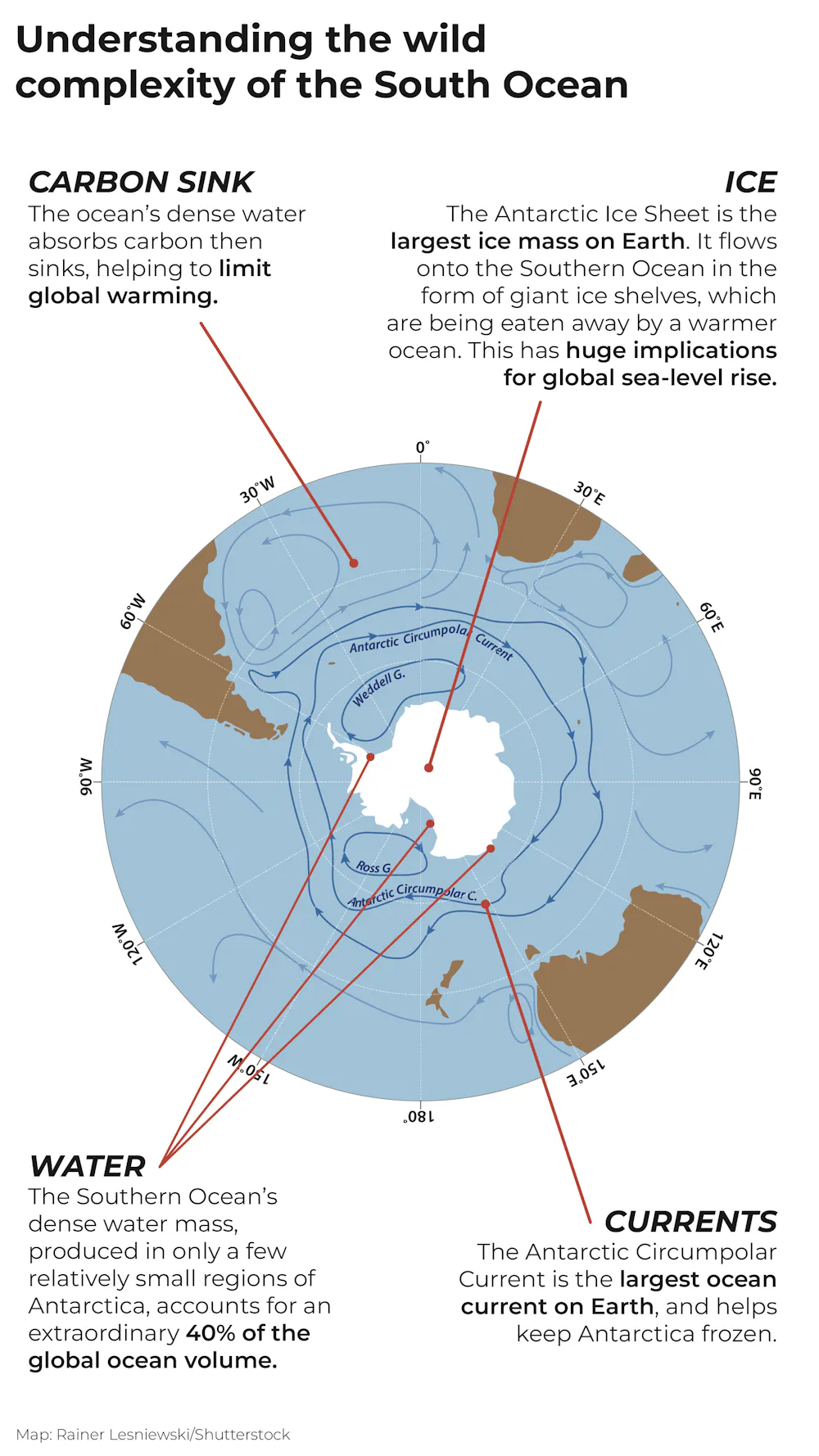
Climate system at risk It takes many hundreds of years for the ocean water to cycle from the surface Southern Ocean to the deep and back. Water returning to the surface today is like a time capsule, reflecting the cooler, pre-industrial climate when it first sank to the ocean depths. The water that sinks today has absorbed more carbon to store in the deep ocean, helping to limit global warming. However, models and observations suggest reductions in sea ice and ice shelves are weakening this crucial climate system. They are making the water warmer, less salty and more buoyant, so less prone to sinking. This means less carbon storage and a warmer atmosphere in the years ahead. An oceanographic instrument being deployed. Steve Rintoul/Australian Centre For Excellence in Antarctic Science So much we don’t know Making measurements in the Southern Ocean is immensely challenging due to its remote location and hostile conditions. This means in many cases data is sparse, and so scientists don’t know exactly how quickly changes are occurring. Our review identified several areas as a key priority for future Southern Ocean research. They include observations of ocean temperatures and melting beneath ice shelves, as well as long term measurements of dense water formation. More data is needed to monitor changes and provide early warning of significant climate events, such as ice sheet collapse. Crucially, more data is also needed to inform and assess the computer models on which government, industry and society rely to predict future climate. Unfortunately, ocean observations are expensive. For example, Australia’s premier research vessel, the RV Investigator, costs more than A$100,000 a day to run. And the new SWOT satellite – a joint project of the European Union and United States to measure the ocean surface at unprecedented resolution – cost more than US$1 billion. two women examining cylinders Scientists Sylvie King and Treden Tranchant taking samples on board the research vessel Investigator, in a bid to understand more about Southern Ocean currents. More such work is needed. Amelia Pearson/Australian Antarctic Division These costs also highlight the need for enhanced national and international collaboration. This would make the best use of available resources, and promote technological innovation to develop more cost-effective observing systems such as drones and drifting robotic instruments. The federal government’s scientific priorities and funding decisions should reflect the crucial importance of Southern Ocean science. We are currently in the UN Decade of Ocean Science, which aims to improve predictions of ocean and climate change. Improved understanding of the Southern Ocean is vital to this effort.

Read more https://theconversation.com/giant-waves-monster-winds-and-earths-strongest-current-heres-why-the-southern-ocean-is-a-global-engine-room-233669

Split Corrugated Conduit for Flexible Cable Protection

For wiring assemblies in vehicles, machinery and equipment, choosing suitable cable protection helps keep cables organised and reduces direct contact with surrounding parts. Mojak Plastics supplies plastic tubing and conduit options for different installation needs, and split corrugated conduit can... Read more

Trailers Melbourne Buyers Can Compare: When Box Trailers Make Sense

For many homeowners, businesses and tradespeople, trailers Melbourne customers use every week need to be versatile enough for changing loads. A box trailer can be particularly useful because its enclosed sides help contain cargo while providing a straightforward loading area... Read more

Bottle Label Printing That Balances Design and Readability

Product labels need to attract attention while making information easy to find and understand. On a bottle, the available space may be limited by the container’s shape, so every design decision matters. Bottle label printing should account for visual hierarchy... Read more

Office Cleaning Melbourne: Planning a Consistent Workplace Routine

Businesses looking for office cleaning Melbourne need a plan that reflects the way their workplace operates. A clean office supports day-to-day organisation, helps shared spaces remain presentable and gives employees and visitors a more orderly environment. Eco Green Cleaning Management... Read more

Pinboard Solutions for Offices, Schools and Shared Information Spaces

Why a Pinboard Remains Useful A pinboard provides a simple way to display information that needs to remain visible without being rewritten. Lawdex supplies fabric and cork options for offices, schools, staff areas and other environments. A pinboard can be used... Read more

Retractable Hose Reel: A Practical Guide To Choosing The Right Hose Storage

A retractable hose reel can make hose storage more organised, accessible and practical in workshops, commercial facilities, service areas and other working environments. Instead of leaving a hose coiled across the floor or requiring staff to manually wind it after... Read more