

Is it OK for kids to lift weights? At what age and how heavy? Here’s what parents need to know
- Written by The Conversation
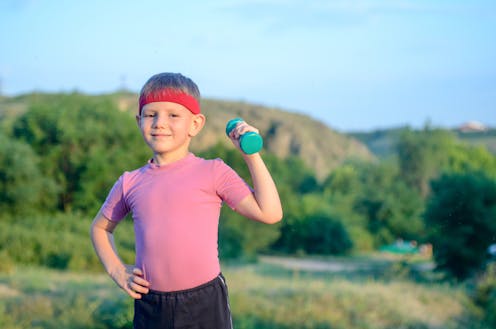
Exercise is excellent for kids.
Kids who exercise are fitter, stronger, and less likely to be overweight or obese. They have better physical and mental health, perform better in the classroom, and are more likely to exercise as an adult.
In short, the more exercise they do now, the better. But what about weight training? If you’ve ever spent much time in the comments section of social media posts featuring kids lifting weights, you’ll know debate rages about whether or not it’s safe for children.
Unfortunately, there are still many myths about weight training and kids. The research evidence suggests it’s safe, as long as a few common sense precautions are followed.
A common misconception
Lifting weights is an example of “resistance training”, which can include bodyweight exercises, weightlifting, jump training, and even sprinting.
A common misconception is that resistance training is bad for kids.
You may have heard it stunts their growth – but this rumour isn’t supported by the scientific evidence.
The concerns around stunting growth come from the potential for kids to experience what is known as a “growth plate injury.” A growth plate is a section of cartilage at the end of bone that allows the bone to grow. These plates turn into bone sometime during puberty when bone growth stops.
A growth plate injury can lead to early bone closure and a shorter limb length – or a stunting of bone growth.
These injuries can occur in kids, but they most often occur during impact related injuries, either during sport or because of a fall.
In fact, there is no evidence a supervised resistance training program stunts kids’ growth or damages growth plates.
The load placed on the body is similar for resistance training as it is for jumping and landing, something all kids do. Moreover, the risk of injury is much lower in resistance training than many other recreational and sport activities.

What are the positives of kids lifting weights?
Resistance training improves children’s physical fitness, including their strength, power, speed, agility, and endurance.
Resistance training may also be beneficial for overweight or obese kids who may be unwilling or unable to do aerobic activities such as running and swimming.
Resistance training can also benefit kids’ physical and mental health. For example, it can improve their metabolic health, help them manage weight, reduce symptoms of depression and anxiety, improve self-esteem, and help academically.
How young is too young to lift weights?
While there is no minimum age to start, participants should be able to follow directions and safety rules. Kids who are ready for sport are generally ready for some type of resistance training.
Both the World Health Organization (WHO) and the Australian government recommend kids aged five to 17 get 60 minutes of physical activity per day. They encourage kids to strengthen their muscles and bones at least three days per week.
Lots of exercises increase muscle and bone strength. These include high intensity sport, outside play like climbing, jumping, and running, and of course, resistance training.
This means kids don’t have to necessarily lift weights. If they are doing these other types of exercise, they’re fine.
However, very few kids are meeting these guidelines.
Australian data show that less than one-quarter (about 23%) of kids aged five to 14 get enough exercise.
That number shrinks to about 6% in older kids aged 15 to 17.
This suggests adding formal exercise to your kid’s routine is a good thing.
 The key is to start slowly and make it fun.
Gajus/Shutterstock
The key is to start slowly and make it fun.
Gajus/Shutterstock
How should your kids start resistance exercise?
The key is to start slowly and make it fun.
The goal is to get kids to enjoy resistance training and set them up for lifelong success.
For young kids in early primary school, the focus should be on balance, coordination, agility and endurance.
This means playing games involving running and chasing, and activities that develop muscle endurance (like climbing, carrying and pushing things).
You might also want to introduce bodyweight exercises – such as push-ups, pull-ups, and planks – to teach kids how to move their body.
As they transition into upper primary school, kids can do more targeted training. This might include more bodyweight exercises, jump training like hurdling and skipping, and even light training with weights, like squats and bicep curls.
Finally, as they move into high school, they can try more formal weight training exercises, using moderate weights. They might like to try lunges, deadlifts, presses, and rows.
As they become more confident, they can try lifting heavier weights.
 Why not lift weights with your kids?
Sorapop Udomsri/Shutterstock
Why not lift weights with your kids?
Sorapop Udomsri/Shutterstock
What do parents need to know?
Firstly, resistance training has a relatively low risk of injury when properly supervised.
Proper supervision means adults teach kids proper technique, and ensure children don’t fall into the trap of trying to impress their peers.
Secondly, start light. In beginners, lifting lighter weights for about ten or 15 repetitions (or “reps”) offers similar benefits to lifting heavier weights a few times, and is probably safer.
Lifting lighter weights but doing more reps has another benefit: it allows children to practise and improve their technique.
Lastly, don’t be afraid to get involved. Adults benefit greatly from resistance training, too.
So, why not make the most of it and join in?


